Inverse Functions
Compositions
Arithmetic Sequences
Geometric Sequences
Sequences in Context
100
If f(4) = 9, what is f -1(9)?
4
100
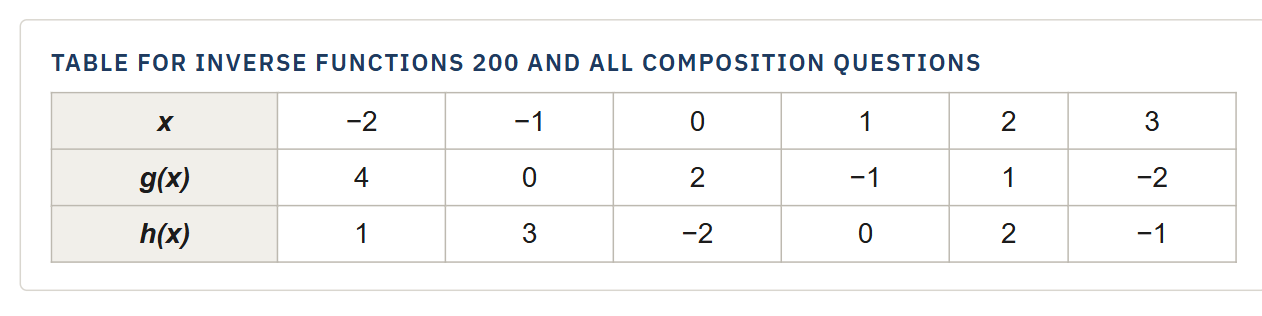 Use the table. Find g(h(1))
2
(h(1) = 0, g(0) = 2)
100
Find the common difference: 4, 11, 18, 25, …
d = 7
100
Find the common ratio: 3, 12, 48, 192, …
r = 4
100
A theater has 20 seats in the first row, and each row after that has 3 more seats than the row before it. How many seats are in row 8?
41 seats
(20 + 7·3)
200
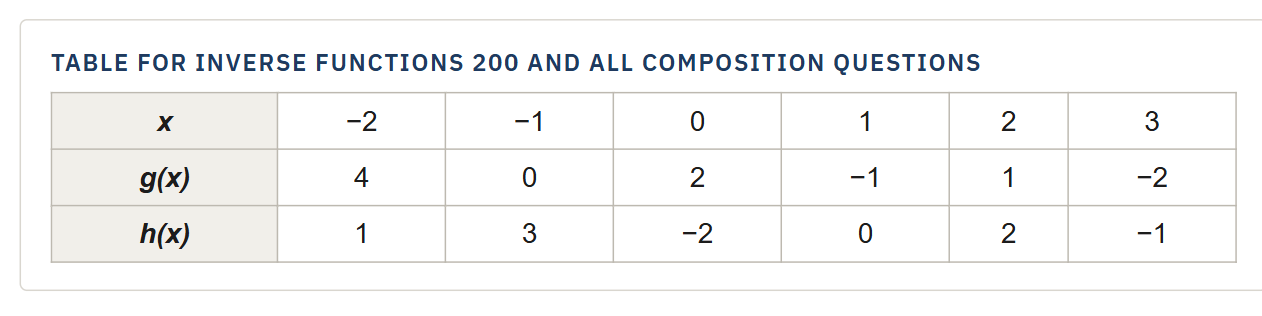 Use the table. Find h−1(3), or indicate that it is not defined.
-1
200
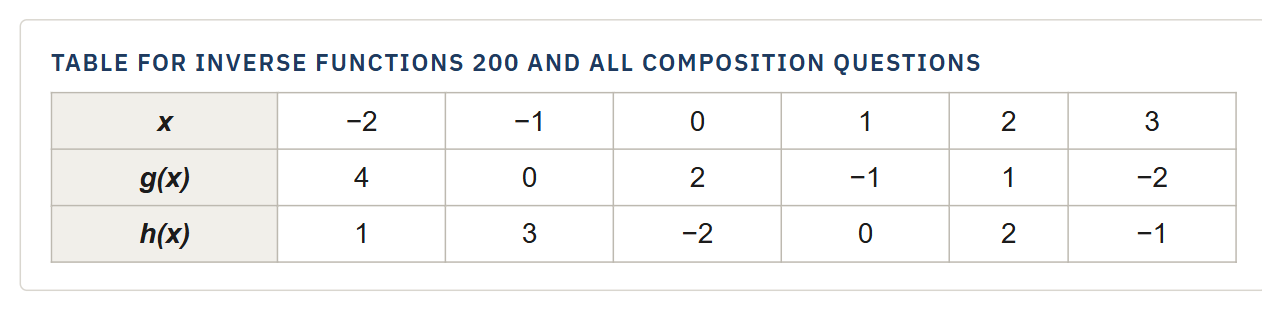 Use the table. The function p is defined by
p(x) = (h ∘ g)(x). Find p(3).
1
(g(3) = −2, h(−2) = 1)
200
An arithmetic sequence has a1 = 6 and d = 4. Find a10.
a10 = 42
200
A geometric sequence has g1 = 5 and r = 2. Find g6.
g6 = 160
200
A ball’s first bounce reaches 10 feet. Each bounce reaches 80% of the height of the bounce before it. How high is the 4th bounce?
16,200 views
(200 · 34)
300
Let f(x) = 4x − 7. Find f−1(x).
f-1(x)=(x+7)/4
300
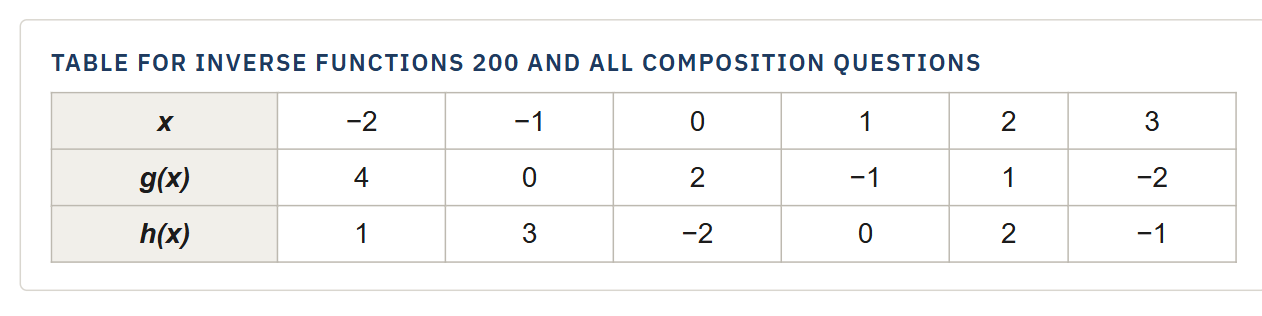 Use the table: The function q is defined by
q(x) = (g ∘ g)(x). Find q(0).
1
(g(0) = 2, g(2) = 1)
300
a2 = 5 and d = 3. Write an equation for the sequence, then find the 11th term.
an = 2 + 3(n − 1) = 3n − 1
a11 = 32
300
g1 = −3 and g6 = 96. Write an equation for the sequence, then find the 8th term.
gn = −3(−2)n−1
g8 = 384
r = −2
300
A ride shuts down, and the line of people waiting can be modeled by an arithmetic sequence. After 4 minutes there are 30 people in line, and after 10 minutes there are 72. According to the model, how many people will be in line after 16 minutes?
114 people
(d = 7 per minute)
400
find g-1(x)
g(x)=(x+3)/(x-2)
g−1(x) = (2x + 3) / (x − 1)
400
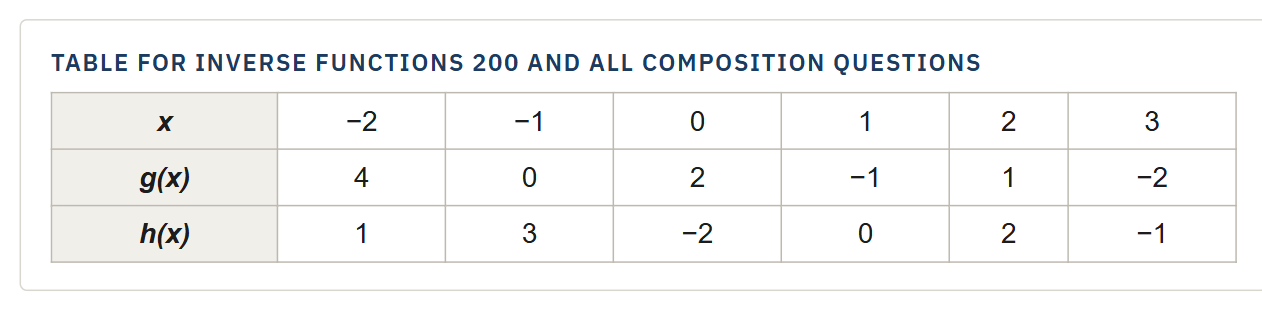 Use the table: The function r is defined by
r(x) = (h ∘ g)(x).
Find r(−2), or indicate that it is not defined.
Not defined
(g(−2) = 4; h(4) is not in the table)
400
a4 = 7 and a9 = −3. Write an equation for the sequence, then find the 11th term.
an = 13 − 2(n − 1) = 15 − 2n
a11 = −7
400
g3 = 12 and g6 = 1.5. Write an equation for the sequence, then find the 8th term.
gn = 48(0.5)n−1
g8 = 0.375
r = 0.5, g1 = 48
400
A bacteria colony is modeled by a geometric sequence, where the first day of the study is day 1. The population was 1,500 on day 2 and 12,000 on day 5. What was the population on day 7?
48,000 bacteria
(r = 2)
500
Find h−1(x).
h(x)=(3x+1)/(2x-5)
h−1(x) = (5x + 1) / (2x − 3)
500
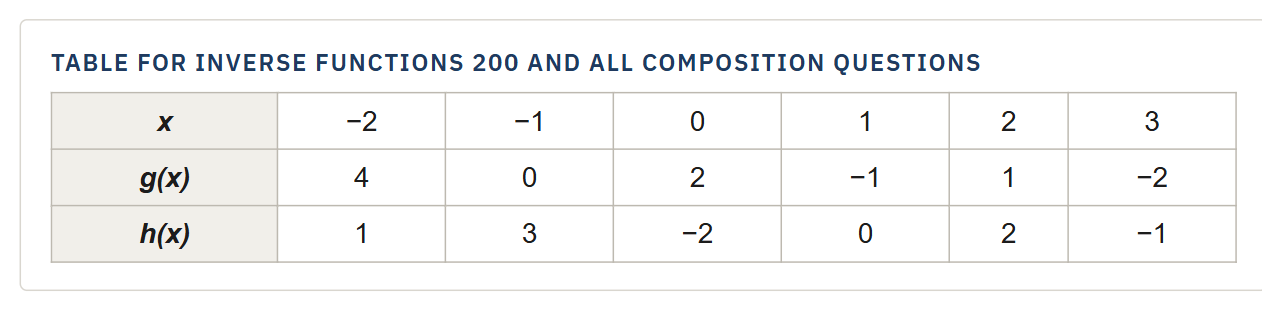 The function l is defined by
l(x) = (h−1 ∘ g)(x). Find l(1).
3
(g(1) = −1; h(3) = −1, so h−1(−1) = 3)
500
a5 = 18 and a12 = −3. Which term of the sequence is equal to −27?
the 20th term
d = −3, a1 = 30; an = 33 − 3n;
500
g2 = −6 and g5 = 162. Write an equation for the sequence, then find the 7th term.
gn = 2(−3)n−1
g7 = 1,458
500
A car’s value is modeled by a geometric sequence. In year 1 it is worth $24,000, and in year 3 it is worth $15,360. According to the model, what is the car worth in year 6?
$7,864.32
(r = 0.8)