Soil Science
Minor Crops
Nutrient Symptomology
GMOs and Genetic Engineering
Agricultural and Crop Science Equipment
100
Measured in centimoles of charge per kilogram, this soil property quantifies a soil's ability to hold onto positively charged nutrients like calcium, magnesium, and potassium.
Cation Exchange Capacity / CEC
100
Cucurbita pepo - these relatives of cucumber are one of the few crops native to the Americas (earliest evidence of cultivation from Mesoamerica, 7000-5500 BCE), and is a cultivated form of winter squash. It holds a special traditional place in our culture. The canned versions used for pies is normally from the butternut squash species C. moschata.
Pumpkins
100
This common mobile nutrient deficiency can cause poor flowering and fruiting, stunted growth and small leaves, and causes older leaves to turn reddish-purple or dark green.
Phosphorus (P)
100
This gall forming soil microbe injects plants with 3 genes: an auxin and cytokinin promoter, which together cause callus tissue formation (tumor), and an opine promoter gene, which produces its food. Scientists beginning in the 70s and 80s began to harness this mechanism to insert genes of interest randomly into crop genomes. (1st transgenic plant was tobacco in 1982).
Agrobacterium (tumefaciens)
100
Unlike spindle pickers, this non-selective harvester uses rotating brushes to strip all bolls and burs off short Texas cotton plants
Cotton strippers (Stripper picker)
200
Consisting of microscopic clay particles and humus, these ultra-small soil constituents carry high surface areas and negative charges, making them the primary site for nutrient retention.
Soil Colloids
200
Pheonix dactylifera - This fruit bearing palm tree was one of the earliest cultivated plants (~7000 BC/BCE), and on at least 7 different occasions seeds that were accidentally stored for 2000 years actually germinated. You can find them at HEB, pitted or whole, or filled with nuts and covered in chocolate. They're prominent in the first Indiana Jones movie.
Dates / Date Palm
200
Deficiency of this macronutrient caused interveinal chlorosis and necrosis on the leaf margins (edge), sometimes called "firing". In severe cases, poor osmoregulation and weak stalk strength lead to severe lodging, and this nutrient is famous for being luxury consumed.
Potassium (K)
200
This is the easier of methods to do with CRISPR, and involves a double stranded break at a targeted point on the genome which can turn off an enzyme. Useful examples are the anti-browning edits made on potatoes and apples.
Gene Silencing
200
What is this?
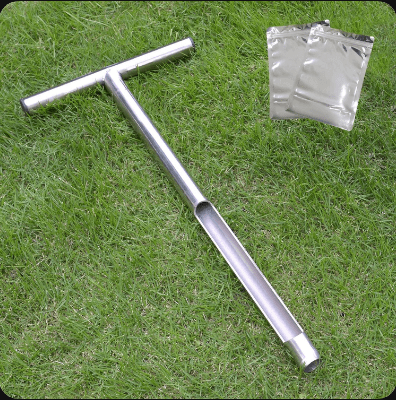
Soil Sampler Probe
300
This 2:1 expanding silicate clay mineral features a high negative charge and a massive CEC, making it popular as a lightweight, water-retaining potting soil amendment.
Vermiculite
300
Hordeum vulgare - This cool season grass and close relative of wheat is the #4 grain the the world by production, with ~70% going towards animal feed and 30% for food (like stews and bread), fermented for beer, or further distilled for whiskey. It has long awns and spikelets in a distinctive herringbone pattern. Both 2-row and 6-row varieties exist. The word barn derives from (this crop)-store
Barley
300
This deficiency causes chlorosis, but differs usually from N as it appears on younger leaves first. It sometimes appears as faint leaf striping, or as spindly/stunted plants. The symptoms are often plant specific (i.e Canola - cupped leaves, reduced flowers, whiter flowers)
Sulfur (S)
300
First approved in 1994, this genetically modified tomato became the first commercially grown GM food by inserting an antisense gene to suppress pectin degradation, delaying softening and ripening.
Flavr-Savr Tomato
300
This field-mapping technology, often mounted on combines, uses flow sensors and moisture sensors to measure and record spatial variations in crop yield as harvest occurs
Yield Monitor
400
Common in the warm, humid Southeastern US, this highly weathered soil order is characterized by an acidic argillic clay horizon and low base saturation.
Ultisol
400
Vigna unguiculata - This member of the bean family comes from Africa and is revered for its extreme drought tolerance and ability to fix nitrogen in poor soils. Black-eyed peas and purple-hulled peas are actually subspecies of this plant. The original variety is still widely grown in Africa, especially the countries Nigeria and Niger.
Cowpea
400
This def. is rare, except in acid soils. Symptoms occur in buds, unfolding leaves, fruit, and root tips. Can make plant more susceptible to pathogens/pests. It is the cause of blossom end rot on tomatoes
Calcium (Ca)
400
Who led the lab that was responsible for discovering CRISPR?, regarded as one of the most significant discoveries in the history of biology. Bonus points if you can name the year that landmark paper was released.
(Jennifer) Doudna 2012
Earned her the 2020 Nobel Prize in Chemistry
400
What is this called? And what is it used for?
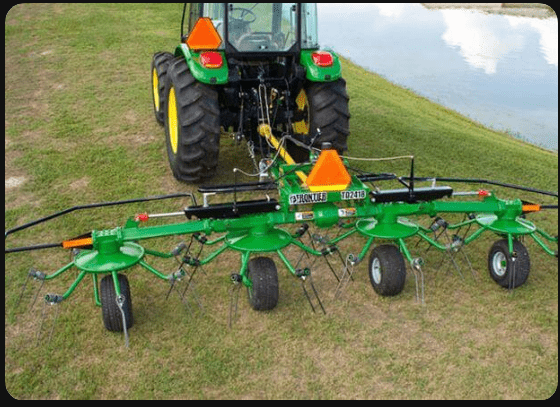
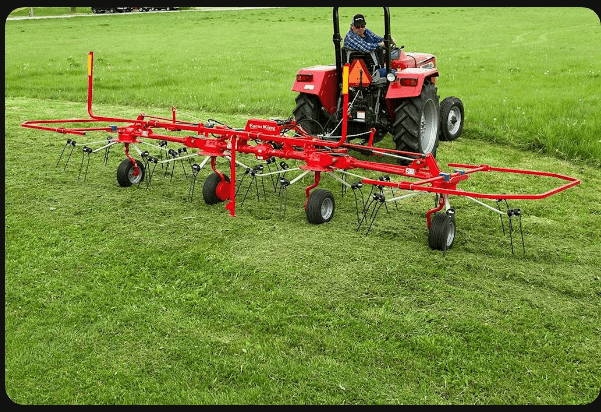
Hay Tedder, used to fluff hay for drying/curing before raking and baling.
500
This agronomic metric expresses the percentage of a soil’s total cation exchange capacity occupied by plant-essential basic cations like calcium, magnesium, and potassium.
Base Saturation (BS)
500
Manihot esculenta - This staple food crop of many tropical regions comes from the spurge family (Euphorbiaceae), and produces a large starchy tuber, which must be processed to remove the cyanide (one method by wetting, mashing, and spreading paste out for several hours). It is the #3 source of carbohydrates in tropical regions, and a staple crop for ~ 500 million people. In Taiwanese culture, later spreading to the US, they are the source of tapioca balls in Boba/Bubble Tea
Cassava (aka manihoc, yuca, etc.)
500
This micronutrient causes chlorosis on older leaves in beans. It can be caused by low pH soils.
Molybdenum (Mo)
(Legumes have a higher requirement than other plants, as it's needed for N fixation, & Mo deficiency appears as N deficiency)
500
Unlike homologous recombination, this error-prone DNA repair mechanism directly ligates double-strand breaks without using a homologous template, often introducing insertions or deletions (indels) that researchers intentionally exploit in CRISPR gene editing.
Non-homologous end joining (NHEJ)
500
This handheld device uses light transmittance at two wavelength regions, 650 nm and 940 nm, to non-destructively estimate leaf chlorophyll content, and by proxy, plant nitrogen status.
SPAD Meter (Soil-Plant Analyses Development Meter)