Pipes
Name that equation!
Potpourri
Open Channel
Runoff
100
What is the HGL? Write an equation, and explain.
How does it differ from the EGL?
HGL = hydraulic grade line
pressure head + elevation head
100
Write an equation relating energy in an open channel for channel depths across a step
E1 + z1 = E2 + z2
100
What is n? What does a higher versus lower n value represent? Give a physical example.
Manning's roughness
n varies with channel properties
higher n = more roughness - trees, etc
100
When the depth of flow is deeper than the critical depth, this is (subcritical/supercritical) flow with a (fast/slow) velocity
subcritical flow, slow velocity
100
Larger curve numbers correspond to more ________ as compared to smaller curve numbers
(a) infiltration or (b) runoff
runoff
200
On the suction side of a reservoir, total head losses are equal to 0.6 m, and NPSHR is estimated as 3.4 m. Given atmospheric pressure is equal to 101.3 kPa and vapor pressure is 2.4 kPa, at what distance below the pump intake should water be drawn?
(Note:
gamma=9790N/m^2
)
Solving for
Deltaz_(ss)
Set NPSHA = NPSHR
I get about 6.1 m
200
If you are given a value for CH, what equation should you be using, and what are you probably solving for?
CH is used in the Hazen Williams equation
Hazen Williams is typically used to estimate major head loss in pipes
200
a) Estimate f for a material with a ks of 0.01 inches and a pipe diameter of 12 inches. Assume turbulent flow.
b) In what part(s) of the Moody diagram do you need only Reynolds number to determine f?
a) f = 0.018
b) Laminar (64/Re)
200
What is the critical depth of a rectangular channel with a width of 5 ft and a Q of 23 ft3/s?
How would you solve for critical depth for a non-rectangular section? What equation would you use?
yc = 0.869 ft
Use Froude number, = 1 at critical depth
200
What are two differences between the SCS-CN Method and the Rational Method?
Many options here!
300
Water flows through a horizontal pipe with a flow rate of 2 cfs and a pipe diameter of 4 inches with f = 0.018. If the pressure at one location is 48 psi, what is the pressure 12 feet down the pipe (in psi)? Neglect minor losses.
Assume
gamma = 62.4 lb (ft)^(-3)
(1) Simplify Bernoulli
(2) Calculate frictional losses
(3) Solve for p2
I get 45.7 psi
300
What equation is used to find change in energy associated with a hydraulic jump in a rectangular channel? How would you determine the change in energy if you aren't in a rectangular channel?
(y_2 - y_1)^3/(4y_1 y_2)
300
A bridge has a design life of 50 years. It was designed to pass the 500 year flood. What is the probability that the bridge will be submerged 1+ times during its design life?
(1) Find p(0)
(2) 1 - p(0)
9.5%
300
A rectangular channel with a width of 10 m has a flow rate of 200 cms.
If the depth of flow in this channel is 1.25 m, is flow super- or sub-critical?
Will the Froude number be greater than or less than 1?
Find yc = (200^2/(10^2 * 9.81)) ^ (1/3) = 3.44
If depth is 1.25 m, this is less than yc, so flow is supercritical.
A supercritical flow has a Froude number greater than 1.
300
Will a site with a curve number of 39 generate runoff for a design storm with a depth of 2.15 inches? Why or why not?
1) Find S = (1000/CN) - 10 = 15.64 in
2) Find Ia = 3.12 inches
3) Compare Ia and P -> P < Ia, so no runoff will occur
400
Water flows with Q = 3.82 ft3/s through a 1000-ft long, 6-in diameter riveted steel pipe (ks = 0.003 ft). Determine the frictional losses using the Darcy Weisbach equation.
Assume the kinematic viscosity (𝜐) is 0.0000108 ft2/s.
(1) Estimate Re =
(Q/A)*D/nu
(I got Re = 901156)
(2) Find f using Moody Diagram (I got f is about 0.032 from ks/D = 0.006)
(3) Estimate frictional losses
hf is about 376.5 feet
400
When solving for uniform flow conditions, what equation do you use? What equation do you use for rapidly varying flow?
Uniform = Manning's Equation
Rapidly Varying Flow - Hydraulic Jump - use hydraulic jump equation
400
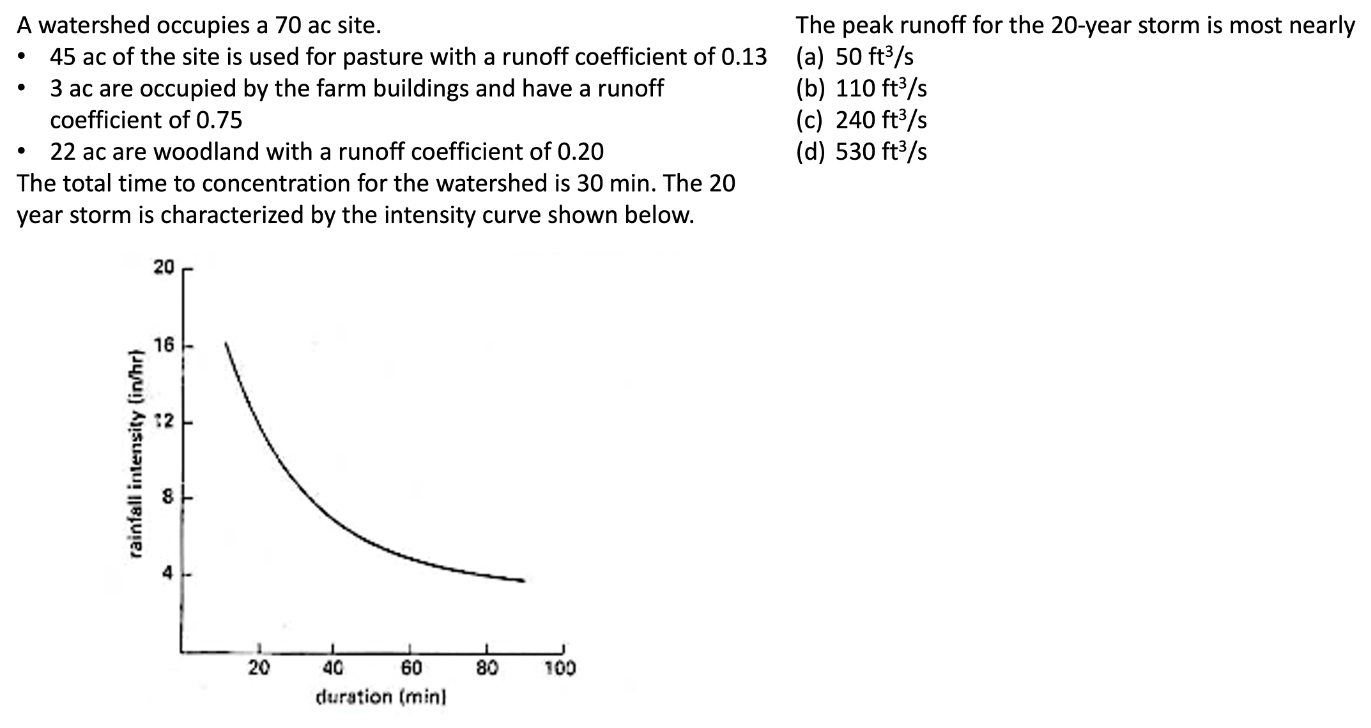
Q = 113 ft3/s or (B)
400
A rectangular irrigation channel (b = 6 ft) flows at a rate of 50 cfs. The depth in the channel is 5 ft. If a gate (height of 4.6 ft, width of 6 ft) is lowered into the channel until it is flush with the channel bottom.
a) Will the flow be choked? Why or why not?
b) How would you find the depth of flow in the river section upstream of the gate?
Find E1 = 5.043
Required E to avoid choking - water will flow at yc
yc = 1.29
Ec = 3/2 * yc = 1.935 ft
Ereq = Ec + height of gate = 1.935 + 4.6 = 6.535 ft
Since Ereq > Eavail, flow will be choked
To find upstream depth of flow, energy at the gate = 6.535 ft will be energy upstream, solve for a new y at the upstream depth
400
Which will have a longer tc: a watershed on a steep slope or shallow slope? Why?
What are units of Tc?
In what method do we use Tc?
-Slope is in the denominator
-Units of tc are minutes
-Used in the Rational Method (to calculate peak flow)
500
In the parallel pipe system shown below, write and simplify (no numbers, just variables) three equations that you would use to solve the system. Neglect minor losses.
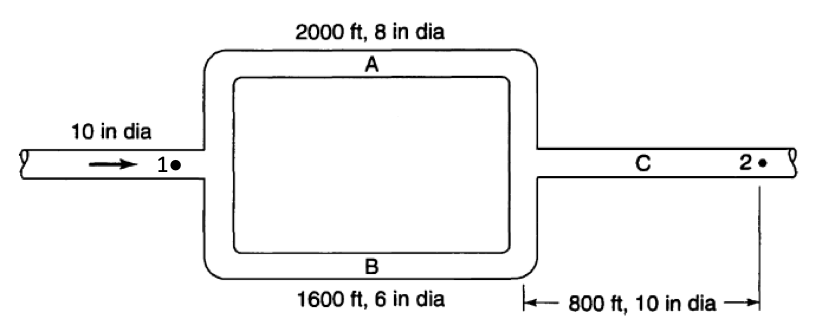
-Bernoulli
-Head loss A = head loss B
-Continuity (Q1 = Q2 = QA + QB)
500
This equation requires you to account for initial abstractions and losses. It can be used to find runoff runoff volume from a site or watershed.
SCS-CN
500
Given a unit hydrograph, spaced at 30 minute intervals:
0.4 cfs, 0.8 cfs, 3 cfs, 0.23 cfs, 0.1 cfs
Find the area of the corresponding watershed, in square miles
0.0035 mi2
500
You have two water depths and their corresponding specific energy values (y = 2 ft, SE = 4.6; y = 2.2 ft, SE = 4.74) for a rectangular channel. Sf (y = 2) = 0.0023 and Sf (y = 2.2) = 0.0043, and the channel slope is 0.01. Which section is upstream and downstream? What is the distance between the sections?
(1) Find SFbar = 0.0033
(2) (e1 - e2)/(sfbar - So) = (4.6 - 4.74)/(0.0033 - 0.01) = 20.9 ft
This is the correct order!
L = 20.9, and y = 2 ft is upstream
500
Given a design storm of 4.44 inches, what is the runoff volume according to the SCS-CN method?
You have two land uses in your watershed - one with a CN of 74 (area = 4.32 ac) and one with a CN of 52 (area = 6.44 ac).
Is there a big difference predicted between the distributed runoff and effective curve number approaches?
Q from effective CN: 1.03 in
Q from direct runoff: 1.11 in