Transformations
Dilations
Angle Relationships
Pythagorean Theorem
100
The starting figure before a transformation is called?
Pre-image
100
What is the coordinates of the origin?
(0,0)
100
Two angles that measure 90 degrees
What are complementary angles? 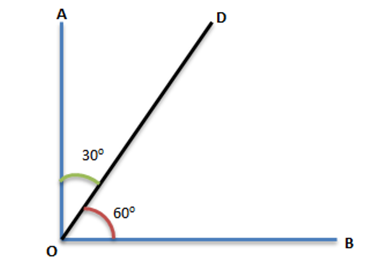
100
In terms of a, b, and c, what is the Pythagorean Theorem?
a2 + b2 = c2
200
During a translation, the pre-image is allowed to slide to a different location and its size changes during the sliding.
False
200
The ____________ of a dilation is the ratio of a length in the image to the corresponding length in the pre-image.
Scale factor.
200
Two angles that measure 180 degrees.
What are supplementary angles? 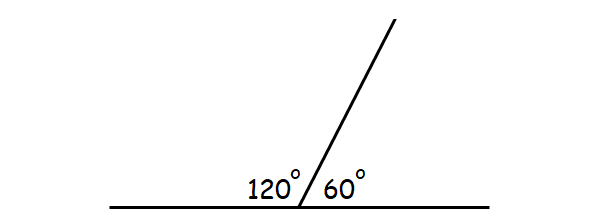
200
In terms of legs and hypotenuse, what is the Pythagorean Theorem?
leg2 + leg2 = hypotenuse2
300
When there is a reflection across the x-axis, all the x-values stay the same?
True or False?
True
300
A dilation may change the size of a figure's side lengths, but never the ________________.
Angle measures.
300
Angles that share a common vertex (corner point) and a common side, opposite each other and have the same angle measure.
Vertical angles.
300
When using the Pythagorean Theorem, which side does c always have to be?
Hypotenuse/longest side.
400
Is the rule the same for either clockwise or counterclockwise for 180 degrees?
Yes or no?
Yes
400
If the scale factor is greater than 0, but less than one, what is this called?
Reduction
400
Angles with the same measure that appear in the same place along parallel lines, seperated through a transversal.
Corresponding angles.
400
What kind of triangle must you have in order to use the Pythagorean Theorem?
Right triangle.