Quadratics
Polynomials
Synthetic Division
Graphing Polynomials
Asymptotes/Holes
100
How do we know when a parabola opens up or down?
Use: ax2+bx+c
if "a" is negative:down
if "a" is positive: up
100
What is the degree of the following function?
6x7+3x8−2x2
8
100
what is the divisor of 5x2-3x+1/x+3
-3
100
Which of the following statements are true about the polynomial function p(x)? 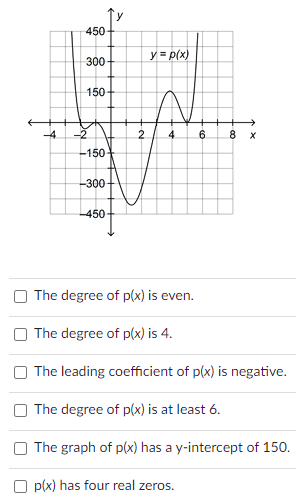
the degree is even, degree is at least 6, y-intercept of 150, & has 4 real zeros
100
how do we solve for vertical asymptotes?
set denominator=0
200
What is the vertex of f(x)=(x-2)2+1?
(2,1)
200
state the end behavior of the polynomial functions.
f(X)=−8x7+3x2+5
as x goes -00 f(x) goes to 00
as x goes to 00 f(x) goes to -00
(up towards left down towards right)
200
what remainder do we want when finding factors/zeros of a polynomial?
remainder 0
200
what are the x-intercepts of f(x)=2x2-4x-6
hint: use quadratic formula
x=-1,3
200
if the degree of the numerator is GREATER than the degree of the denominator, what does that tell us about the horizontal asymptote?
no HA
Bonus if stated: we might have a slant
300
Given f(x)=(x-2)2+1, what is the axis of symmetry?
x=2
300
If the maximum number of turns is 4, what is the smallest degree the polynomial can have?
degree 5
300
what is the remainder of x2+5x+6/x-2
is x-2 a factor?
20, x-2 is not a factor
300
if the zeros of a polynomial with degree 3 are x=-3,2,4
write in factored form
For bonus 100 points, write f(x) in standard form (expanded)
(x+3)(x-2)(x-4)
Bonus: x3-3x2-10x+24
300
identify the horizontal asymptote
f(x)=8x2+16x-24/x2-1
y=8
400
The vertex of f(x)=-x2-6x+5 is (-3,14), is this a minimum or a maximum value? How do you know?
maximum! it opens down
400
determine the zeros and state their multiplicities of the polynomial f(x)=x(x+2)(x-4)2(x+6)3
example on what to write: x=8 multiplicity 2
x=0 multiplicity 1
x=-2 multiplicity 1
x=4 multiplicity 2
x=-6 multiplicity 3
400
solve 3x3-2x2-150/x-4
if there is a remainder, write it in proper form (remainder/x-4)
3x2+10x+40+10/x-4
400
graph the function given the following:
odd, negative polynomial
increasing: (-1,1)
decreasing:(-00,-1)U(1,00)
zeros at x=-2 with odd multiplicity & x=1 with even multiplicity
relative max at (1,0) relative min at (-1,-4)
y-intercept at y=-2
we will draw together (can't input image:( )
400
find the vertical asymptote of
f(x)=x+2/x2-2x-8
x=4
500
find the vertex of f(x)=x2-4x+3. is it a maximum or minimum?
(2,-1), minimum
500
find the x-intercepts given f(x)=5x2(3x-6)(x-7)4(2x+4)
and state whether the graph will touch/bounce or cross at each point
x=0 bounce
x=2 cross
x=7 bounce
x=-2 cross
500
given f(x)=x5-1, is x-1 a factor?
how do you know? prove using synthetic division.
no! you get x4+x3+x2+x+1 and has remainder 1
500
graph the function f(x)=-(x-2)2(x-4)(x+1)
hint: determine end behavior(start up? start down? end up? end down?)/zeros(cross or touch)
bonus: what is the y-intercept? include in your graph
answers may vary (must start up and end down, must bounce at x=2, must cross at x=4 and x=-1)
y-intercept: y=16
500
state the VA, HA, and holes (if any) of
f(x)=5x+20/x2+x-12
VA: x=3
HA: y=0
Hole: x=-4