Living Things
Ecosystems
Energy
Classification
The Solar System
100
What is the basic unit of life?
Cells
100
What do we call the living parts of an ecosystem?
Biotic factors
100
What is the original source of energy for most ecosystems?
The Sun
100
What are the six kingdoms?
Archaea, Bacteria, Protists, Fungi, Plants, and Animals
100
What force keeps the planets in orbit around the Sun?
Gravity
200
What are the levels of organization of life, in order from simplest to most complex?
Cell → Tissue → Organ → Organ System → Organism
200
What are the ecological levels, in order from smallest to largest?
Organism → Population → Community → Ecosystem → Biome
200
What type of organism uses sunlight to make its own food?
Producer
200
What classification tool uses a series of paired choices (yes or no) to identify an organism?
Dichotomous key
200
What are the eight planets in order from closest to farthest from the Sun?
Mercury → Venus → Earth → Mars → Jupiter → Saturn → Uranus → Neptune
300
What is the main difference between a unicellular organism and a multicellular organism?
A unicellular organism has one cell; a multicellular organism has many specialized cells.
300
What type of relationship occurs when both organisms benefit?
Mutualism
300
In the food chain,
grass → grasshopper → frog,
what is the grasshopper?
Primary consumer
300
What are the 7 Linnaean ranks, in order from broadest to most specific?
Kingdom → Phylum → Class → Order → Family → Genus → Species
300
What are the four terrestrial planets?
Mercury, Venus, Earth, and Mars
400
What characteristic of living things describes keeping stable conditions inside the body?
Homeostasis
400
Two deer competing for the same food are demonstrating what ecological interaction?
Competition
400
What important job do decomposers such as bacteria and fungi perform?
They break down dead organisms and return nutrients to the environment.
400
What is a clade?
A group containing a common ancestor and all of its descendants.
400
What is heliocentrism?
The model in which the Sun is at the center of the solar system and the planets orbit it.
500
Give an example of two human body systems working together.
e.g., the respiratory system brings in oxygen and the circulatory system transports it to cells.
500
How is a community different from an ecosystem?
A community contains all interacting populations in an area; an ecosystem includes the community and its nonliving environment.
500
Give one way an environmental change could affect the survival of a population.
E.g. organisms may adapt, migrate, hibernate, decline in number, or become extinct.
500
According to the cladogram, which two groups share the most recent common ancestor?
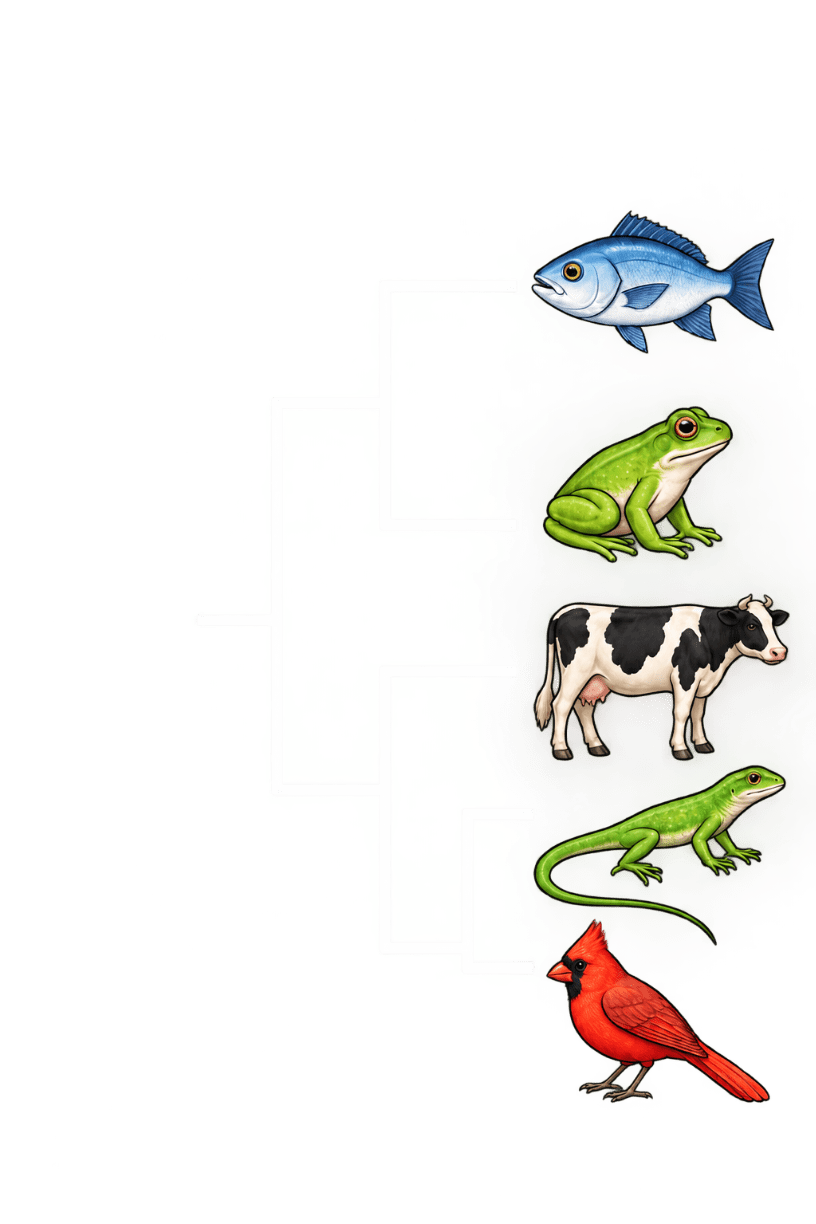
Reptiles and birds
500
Explain the difference between a meteoroid, meteor, and meteorite.
A meteoroid is a small rocky or metallic object in space; a meteor is the streak of light produced when one enters Earth’s atmosphere; a meteorite is material that reaches Earth’s surface.