EARTH’S LAYERS
PLATE TECTONICS
Density
SPACE SCIENCE
CLIMATE & EARTH CHANGES
Moon Phases
100
This is Earth’s outermost layer.
Crust
100
Plates moving apart form this boundary.
Divergent boundary
100
Formula for density.
Bonus Points: What is the unit of measure for Liquid and for Solid?
Mass ÷ Volume
Liquids → g/mL
Solids → g/cm³
100
The galaxy Earth is in.
Milky Way
100
Main cause of rising sea levels.
Melting glaciers
100
The process happens during a solar eclipse
The moon travels between the sun and the Earth, preventing the Sun's rays from reaching Earth
200
This layer is made of hot rock that flows slowly.
Mantle
200
Plates colliding form this boundary.
Convergent boundary
200
Which is denser: oceanic crust or continental crust?
Bonus Points: What will happen if Oceanic and continental crust collide?
oceanic crust
Oceanic Crust will subduct under continental crust because it is denser.
200
A huge group of stars, gas, and dust.
Galaxy
200
Long-term weather patterns.
Climate
200
An Astronaut on the Moon weighs about one-sixth of his weight on Earth. This is because?
The moon has a weaker force of gravity than the Earth.
300
This layer is liquid metal.
Outer Core
300
Plates sliding past each other.
Transform boundary
300
If mass increases but volume stays the same, density does this.
Increases
300
The force that keeps planets in orbit.
Gravity
300
Heat trapped in the atmosphere process.
Greenhouse effect
(When the heat bounces back from the Earth towards space, more and more of the heat gets trapped because there are more and more greenhouse gases. )
300
Which one rotates and revolves?
Model 1 Model 2
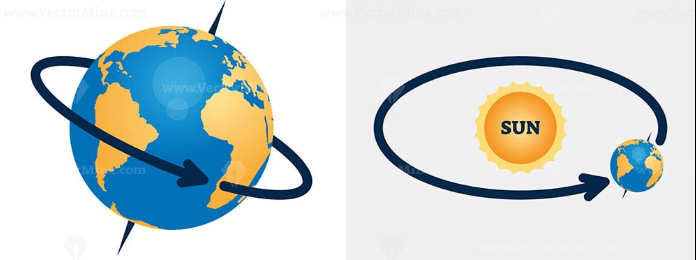
Model 1 revolution
Model 2 Rotation
400
This layer stays solid due to extreme pressure.
Inner core
400
The force that moves tectonic plates.
Convection currents in Earth’s mantle.
The hot rock in the mantle becomes less dense and rises.
As it cools, it becomes denser and sinks again.
400
Why are seasons different in the Northern and Southern Hemispheres?
Earth’s tilt / different sunlight angles
400
What is the order from biggest to smallest?
Stars, Universe, and Galaxies
Universe --> Galaxies --> Stars
400
Difference between weather and climate.
Weather = short term, climate = long term
400
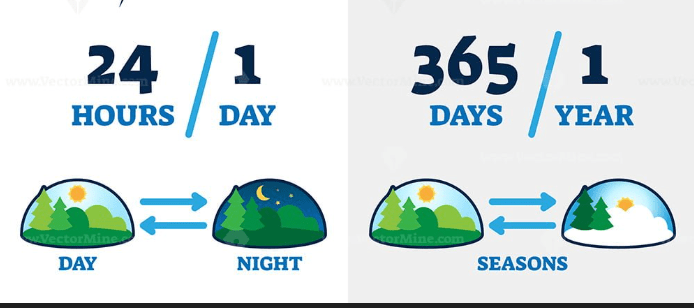
What causes day and night?
What causes seasons?
Earth is tilted on its axis cause day and night, while revolution causes seasons.
500
Correct order from surface to center.
Crust → Mantle → Outer Core → Inner Core
500
What happens when two continental plates collide?
Mountains form / neither plate sinks
500
When it is summer in the Northern Hemisphere, it is this season in the Southern Hemisphere.
Winter
500
How many objects in our solar system can be classified as a star?
1 - the sun
500
One effect of climate change (the long-term rise in the Earth’s average temperature, causing the planet to heat up,, which changes weather patterns, melts ice, and causes sea levels to rise).
Rising sea levels / warming temperatures
500
The sun and the moon appear to be nearly the same size when you see them in the sky, but this is an illusion. Why?
The Sun is larger than the Moon, but the Sun is farther away from Earth. This is why they look the same.