Energy Conservation & Transformations
Energy Conservation & Transformations 2
MIX
waves 1
waves 2
100
A television is a device that converts electrical energy into light and sound energy. What happens to the energy that enters a television but is NOT converted into light or sound?
A. It returns to the electrical source.
B. It is stored in the television.
C. It is released as heat energy.
D. It is destroyed in conversion.
C. It is released as heat energy.
100
Lena is playing with a remote-controlled car in her backyard. She knows that the car uses its wheels to move and is powered by a battery. Which of the following describes how the car uses energy to move?
A. Mechanical energy produces heat energy
B. Electrical energy produces light energy
C. Heat energy produces mechanical energy
D. Electrical energy produces mechanical energy
D. Electrical energy produces mechanical energy
100
When plants engage in photosynthesis, what type of energy are they converting to chemical energy?
A. Light energy
B. Kinetic energy
C. Potential energy
D. Thermal energy
A. Light energy
100
When energy transfers through a longitudinal wave, what happens to the particles in the medium?
A. They move up and down only.
B. They create crests and troughs.
C. They move side to side only.
D. They compress and expand.
D. They compress and expand.
100
One particularly deadly and destructive weather event is the tsunami. A giant water wave comes crashing onto shore causing destruction to trees, cars, buildings, and other inland objects. What is the best explanation of where this destructive energy comes from?
A. The energy of the tsunami wave is transferred to objects inland and along the shore.
B. The energy of the tsunami wave passes through the objects along the shore.
C. The kinetic energy of the tsunami is converted into potential energy in the objects on land.
D. The entirety of the energy of the tsunami is reflected back into the ocean.
A. The energy of the tsunami wave is transferred to objects inland and along the shore.
200
Coal power plants supply a large amount of energy to the United States. For every pound of coal burned, only about 20 percent of the energy released is transformed into electrical energy that can be used to supply energy to homes and businesses. What happens to the rest of the energy released when coal is burned?
A. It remains trapped in the coal.
B.It is reused in the power plant.
C. It escapes as heat and light.
D. It is transformed into geothermal energy.
C. It escapes as heat and light.
200
In order to power an elevator, a motor must convert electrical energy into which other type of energy?
A. Mechanical energy
B. Thermal energy
C. Nuclear energy
D. Light energy
A. Mechanical energy
200
Other than thermal energy, what type of energy is electrical energy mostly converted to in a toaster oven?
A. light
B. elastic
C. chemical
D. gravitational
A. light
200
During an earthquake, two types of seismic waves are created. Primary waves or P waves are followed by secondary or S waves which are much slower. Using the diagram below, which of the following statements correctly characterizes P and S waves?
A. S waves are longitudinal because the waves are moving parallel to the direction of the wave.
B. P waves are longitudinal compression waves moving parallel to the direction of the wave.
C. P waves are transverse because the waves are moving perpendicular to the direction of the wave.
D. S waves are transverse because the waves are creating crests and troughs.
B. P waves are longitudinal compression waves moving parallel to the direction of the wave.
200
As the frequency of a wave increases, which of the following are true? (Select 2)
A. amplitude increases
B. total energy decreases
C. the height of the wave decreases
D. volume increases
E. wavelength decreases
A. amplitude increases
E. wavelength decreases
300
A student places a battery in a flashlight and turns it on. Complete the sentence to describe the energy transformations that occur within the flashlight.
The _________energy stored in the battery is converted to ____________ energy, which is then converted to _________ energy that shines from the flashlight.
Electrical-Light-Chemical
chemical, electrical, Light
300
The pictures show a toaster, a crane, a buzzer, and a flashlight.
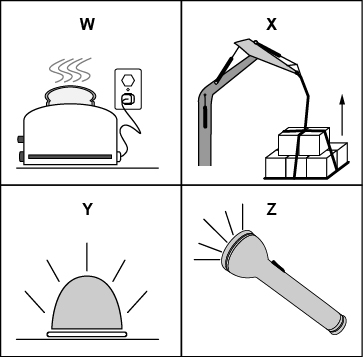
Which picture best shows electrical energy being converted into thermal energy?
Which picture best shows electrical energy being converted into thermal energy?
A. W
B. X
C. Y
D. Z
A. W
300
When an electric lamp is turned on, electrical energy is —
A. transformed.
B. destroyed.
C. created.
D. absorbed.
A. transformed.
300
In longitudinal waves, there are areas of compression and rarefaction. Click on the spot that best exemplifies rarefaction.
300
What conclusion can you make from looking at the two transverse waves below?
The ________the wave frequency, the________ the wavelength.
Shorter or higher
higher and shorter
400
What kind of energy transformation is taking place when a hair dryer is used?
A. Mechanical energy is being transformed into thermal energy.
B. Electrical energy is being transformed into thermal energy.
C. Sound energy is being transformed into electrical energy.
D. Magnetic energy is being transformed into wind energy.
B. Electrical energy is being transformed into thermal energy.
400
The pictures show four household items that transform energy.
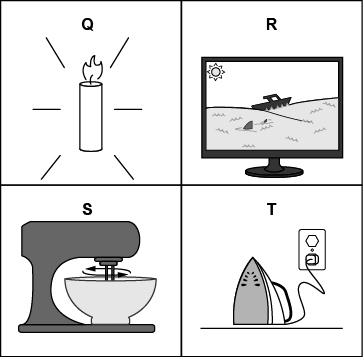
Which picture shows the transformation of electrical energy into mechanical energy?
Which picture shows the transformation of electrical energy into mechanical energy?
A. Q
B. R
C. S
D. T
C. S
400
A student observes waves moving through a stretched spring. The spring coils move back and forth in the same direction the wave is traveling.
Which explanation describes the type of wave the student observes?
A. A transverse wave because the energy dissipates through the spring motion
B. A longitudinal wave because the energy does not transfer through the spring
C. A transverse wave because the energy moves perpendicular to the particle motion
D. A longitudinal wave because the energy moves in the same direction as the particle motion
D. A longitudinal wave because the energy moves in the same direction as the particle motion
400
Within sound waves, the particles move parallel to the direction the wave is traveling. Sound waves are an example of which of the following kind of waves?
A. mechanical wave
B. longitudinal wave
C. transverse wave
D. electromagnetic wave
B. longitudinal wave
400
Using the diagram below, which of the following statements is true?
A. Both A and C are examples of longitudinal waves that have regions where particles are compressed and spread apart.
B. A is the only example of a longitudinal wave because it has a consistent amplitude.
C. A, B, and C are examples of longitudinal waves moving parallel to the direction of the wave.
D. B and C are examples of transverse waves with varying amplitude creating different sound volumes we can hear.
A. Both A and C are examples of longitudinal waves that have regions where particles are compressed and spread apart.
500
What transformation occurs when a telephone rings?
A. Electrical energy is transformed into kinetic energy.
B. Electrical energy is transformed into sound energy.
C. Potential energy is transformed into sound energy.
D. Sound energy is transformed into thermal energy.
B. Electrical energy is transformed into sound energy.
500
An oven transforms electrical energy into —
A. heat energy and light energy.
B. light energy and sound energy.
C. chemical energy and sound energy.
D. nuclear energy and mechanical energy.
A. heat energy and light energy.
500
Students are investigating wave behavior.
Select ONE correct answer in each box to complete each sentence.
Students model a wave by pushing and pulling a spring forward and backward. This produces a wave that moves through the coils. In this model, the energy travels ________________
In a second model, the students shake one end of a rope up and down and observe the wave move to the other end of the rope. In this model, the energy travels ___________________
in the same direction as the vibration
perpendicular to the vibration
in the opposite direction of the spring way
in the same direction as the vibration
perpendicular to the vibration
500
Which of our senses do we use to experience longitudinal waves?
A. sight
B. touch
C. sound
D. smell
C. sound
500
What is the best explanation of the relationship between frequency and energy in transverse waves?
A. The lower the frequency, the greater the energy it holds.
B. The longer the wavelength, the greater energy it holds.
C. The greater the number of waves per second, the greater the energy it holds.
D. The fewer the number of waves per second, the greater the energy it holds.
C. The greater the number of waves per second, the greater the energy it holds.