The Most Basic
Macro-magic
EVO-moji
Class-y
Poison Ivy I
Poison Ivy II
The World as we know it.
100
List the equation for cellular respiration. What organelle is responsible for this function?
C6H12O6 + 6 O2 -> 6CO2 + 6H2O + ATP
Mitochondria
100
Lipids are described as a diverse group of macromolecules that are grouped together because they have this in common, ___________. Name the four sub structures of lipids.
hydrophobic (fear of water)
fats, oils, phospholipids, waxes
100
What must happen for a population to evolve over time?
Organisms need to find food, avoid predation, genetic variation must be present, and reproduce
100
The Fragrant Water Lily’s scientific name is Nymphaea odorata, what other classifications would it share with the Nymphaea alba? Name all that would apply.
domain, kingdom, phylum, class, order, family, genus
100
Water loss in a leaf is prevented by the ____________.
cuticle
100
The reproductive structures of a pine tree is ______________.
cones
100
Limiting factors determine an area’s carrying capacity because
animals need resources to survive.
200
List the equation for photosynthesis. What organelle is responsible for this function?
6 CO2 + 6 H2O + light (photons) -> C6H12O6 + 6O2
Chloroplasts
200
This carbohydrate is used by plants for structure. If humans eat it, it is useful for cleaning out the digestive system due to its in ability to be digested.
cellulose (fiber)
200
A random change in DNA is called a(n) _____________________.
mutation
200
Because of their unique ability to survive extreme environments, astrobiologists are looking for these organisms on other planets. Name the domain and kingdom they would belong to...
Archaea, Archaebacteria
200
During cellular respiration, what do plants use to produce energy from glucose?
O2
200
A low-growing plant that lacks vascular tissue reproduces by _______.
spores
200
How does biodiversity typically change as a result of primary succession over time?
It gradually increases
300
The nucleolus does what?
Builds Ribosomes
300
Animal store energy as ________________. What macromolecule is this?
glycogen, carbohydrate
300
Organisms that mate, reproduce, and produce offspring are said to be ______________.
the same species
300
The scientific study of how living things are classified
taxonomy
300
After fertilization takes place in a flower, the ovule develops into a __________.
seed
300
In seedless plants, sperm can only reach the egg with the help of _______________.
water
300
Name one positive and one negative human impact on the environment.
Negative:
•Deforestation
•Pollution (air, water, soil)
•Overfishing & hunting
•Urbanization
•Agriculture & farming
•Climate change
* invasive species introduction
Positive:
•Conservation programs (protecting species & habitats)
•Sustainable farming & fishing
•Renewable energy use (solar, wind)
•Reforestation & restoration projects
•Recycling & waste reduction
400
Name three structures that only plants have that animal cells do not?
cell wall
central vacuole
chloroplasts
400
Long chains of amino acids arranged in a specific linear sequence and folded into a complex molecule _______________. Name the four types of proteins you should know.
proteins
motor/contractile, enzymes, transport, hormone
400
Birds, bees and bats are not closely related. However, they all have wings. Wings are __________________ structures and demonstrate a common ______________.
analogous structures, environment/selection pressure
400
present in recent parts of a lineage, but not in older members
derived characteristics
400
After fertilization takes place in a flower, the ovary develops into a __________.
fruit
400
an example of a vascular seedless plant
ferns
400
Name a disturbance that one result in primary succession and one that can result in secondary succession.
primary: volcanic eruption/after lava flow, glacial retreat
secondary: fire, hurricane, logging, or farming
500
The nucleus is responsible for holding the blueprint of all life. What molecule is built in the nucleus and sent tot he ribosome to allow proteins to be built in the cell?
RNA
500
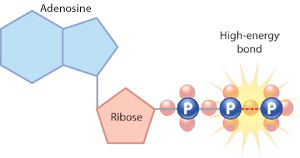
Explain why there is a high energy bond placed between the 2nd and 3rd phosphate group in this picture.
The high-energy bond between the 2nd and 3rd phosphate in ATP is like a tightly compressed spring. Because all three phosphate groups have negative charges, they hate being near each other and repel intensely. Forcing that third phosphate on creates massive tension, making that bond unstable and ready to release energy instantly when broken
500
Farmers choose cows that produce the most milk and breed only those cows so future generations produce more milk. This is an example of what?
artificial selection
500
grouping of organisms into categories based on evolutionary history/relationship
phylogeny
500
You observe a plant that has 12 petals on each of its flowers. Is it a monocot or a dicot?
This is unanswerable without further information as monocots have petals in multiples of 3 and dicots have petals in multiples of 4-5.
500
Name all parts of the male reproductive structures of a flower
stamen = anther (pollen), filament,
500
Annelids play an important role in recycling nutrients within ecosystems. Which three key nutrients does this refer to? What macromolecules are built from these nutrients in living organisms? Which essential elements are not included, and where do organisms obtain them?
These elements are essential because organisms use them to build major macromolecules:
- Carbon → backbone of carbohydrates, lipids, proteins, and nucleic acids
- Nitrogen → found in proteins (amino acids) and nucleic acids (DNA/RNA)
- Phosphorus → part of nucleic acids (DNA/RNA) and ATP (energy molecule), also phospholipids in membranes
The element(s) we’re “missing” from that list are oxygen (O) and hydrogen (H).
Organisms get those from:
- Water (H₂O) → provides both hydrogen and oxygen
- Oxygen gas (O₂) from the atmosphere (for respiration)