Fiscal sustainability
Debt Dynamics
Gross Financing Need
DDT
other
100
Solvency requires that initial debt will have to be paid off by future primary surpluses. Which of the following statements is correct?
a. Debt/GDP will keep rising if a country runs permanent primary deficits.
b. As long as the primary balance is in surplus, the debt/GDP ratio will decline.
c. Debt/GDP can decline in a country with permanent primary deficits as long as the growth rate is high enough relative to the interest rate.
d. Solvency and the “no Ponzi Game condition” are always satisfied.
c. Debt/GDP can decline in a country with permanent primary deficits as long as the growth rate is high enough relative to the interest rate.
100
The stock-flow adjustment takes into account:
a. The difference between domestic and foreign interest rates
b. Exchange rate fluctuations during the same year
c. Variable interest rates
d. Volatile growth
b. Exchange rate fluctuations during the same year
100
What does “rollover risk” refer to?
a. The risk that the average maturity of debt increases.
b. The risk of a more depreciated exchange rate.
c. The risk that maturing debt can be refinanced only at a prohibitive cost
d. The risk that the government cannot face unexpected cash obligations.
c. The risk that maturing debt can be refinanced only at a prohibitive cost
100
Which of the following statements on the DDT is correct?
a. The DDT provides a risk assessment on the sustainability of public debt.
b. The DDT projects public debt dynamics ‘below the line’ to assess financing needs.
c. The DDT projects public debt dynamics ‘above the line’ to minimize data needs.
d. The DDT does not allow to calibrate a fiscal adjustment path beyond the debt stabilizing primary balance.
c. The DDT projects public debt dynamics ‘above the line’ to minimize data needs.
100
What makes explicit contingent liabilities different from implicit contingent liabilities?
a. Whether there are explicit quasi-fiscal costs involved.
b. Whether there are financial sector, non-financial sector and public-private partnerships.
c. Whether there are on- versus off-balance sheet activities.
d. Whether liabilities are legal obligations.
d. Whether liabilities are legal obligations.
200
Which set of conditions is most unfavorable for reducing debt-to-GDP ratios?
a. Real growth is higher than real interest rates; primary surpluses are negative.
b. Real growth is lower than real interest rates; primary surpluses are negative.
c. Real growth is higher than real interest rates; primary surpluses are positive.
d. Real growth is lower than real interest rates; primary surpluses are positive
b. Real growth is lower than real interest rates; primary surpluses are negative.
200
How does a rise in inflation impact the government debt-to-GDP ratio?
a. Nominal GDP rises and the debt ratio declines.
b. The primary balance improves due to revenue windfalls, and the debt ratio declines.
c. The primary balance deteriorates due to a rise in government spending (inflation indexation or anti-inflation packages), and the debt ratio increases.
d. All the above can be true. The net effect on the debt ratio depends on the intensity of the different responses.
d. All the above can be true. The net effect on the debt ratio depends on the intensity of the different responses.
200
Which statement is correct about gross financing needs?
a. They are equal to the primary deficit plus amortization of debt.
b. They are equal to the overall deficit plus amortization of debt.
c. They are equal to the primary deficit plus interest payments.
d. They are equal to the overall deficit plus debt service.
b. They are equal to the overall deficit plus amortization of debt.
200
Which of the following statements about alternative scenarios and stress testing is NOT correct?
a. As the baseline will not be realized, even if built realistically while incorporating all available information, alternative scenarios that help assess the realism of underlying macro-fiscal assumptions and the risks surrounding it are necessary.
b. Standardized stress tests in the DDT shock one key variable at a time to help understand the sensitivity of the evolution of debt to changes in that variable.
c. Fan charts provide a probabilistic view of the uncertainty around the baseline by simultaneously shocking key variables while considering their contemporaneous correlations.
d. The constant-primary balance scenario sets the primary balance at its 10-year historical level.
d. The constant-primary balance scenario sets the primary balance at its 10-year historical level.
200
What is the main ingredient in the traditional dish “Saka-Saka,” which is very popular in Central Africa?
a. Rice
b. Cassava leaves
c. Sweet potato
d. Corn
b. Cassava leaves
300
Suppose that the initial debt-to-GDP ratio is 50%, the real interest rate is 8%, the real growth rate is 4%, and the primary balance-to-GDP ratio is 1%. What will happen to the debt-to-GDP ratio over time?
a. It will explode
b. It will remain at 50%.
c. It will decline.
d. It will increase but stabilize at a value above 50%.
a. It will explode
300
What is the gross real interest rate on public debt, 1 + r(t), if a country does not have foreign-currency denominated debt?
a. (1+i(t)_d) / (1 + inflation(t)) with i(t)_d representing the nominal effective interest rate paid on local currency debt in t.
b. A weighted average between the local and foreign currency interest rates.
c. It depends on the nominal exchange rate depreciation.
d. It is not possible to determine this with the information provided in the question.
a. (1+i(t)_d) / (1 + inflation(t)) with i(t)_d representing the nominal effective interest rate paid on local currency debt in t.
300
What information is required to make debt service projections?
a. Debt service payments on existing debt, gross financing needs and terms on new debt.
b. Debt service payments on existing debt from Bloomberg.
c. Debt service payments on new debt from country authorities.
d. Gross financing needs and terms on new debt.
d. Gross financing needs and terms on new debt.
300
Which country won the last Africa Cup of Nations?
a. Cameroun
b. République Démocratique du Congo
c. Morocco
d. Senegal
d. Go Senegal ! /Allez Senegal !
300
How does the “Baumol effect” explain rising health costs?
a. Technological improvements expand the scope of what is medically feasible as income grows.
b. As countries develop, social spending outlays increase.
c. Other sectors in the economy have high productivity growth relative to the health sector.
d. Government policies to extend health coverage increase healthcare costs.
c. Other sectors in the economy have high productivity growth relative to the health sector.
400
What (approximately) is the debt stabilizing primary balance under the following scenario: initial level of debt-to-GDP ratio = 100%; the real interest rate = 1%; the real GDP growth rate = 6.0%; the current government’s primary fiscal balance = -3%?
a. -5%
b. -3%
c. 3%
d. 5%
a. -5%
400
What is the main output of the Debt Sustainability Framework for Low-Income Countries (LIC DSF)?
a. A heatmap indicating risks associated with the level and profile of debt and financing needs.
b. The probability of default.
c. Type 1 and type 2 errors.
d. A rating of external debt distress
d. A rating of external debt distress
400
Which is the northernmost city in Africa?
a. Libreville (Gabon)
b. Yaoundé (Cameroun)
c. Brazzaville (Congo)
d. Kinshasa (RDC)
b. Yaoundé (Cameroun)
400
Which of the following statements is true about the fan chart below is correct ?
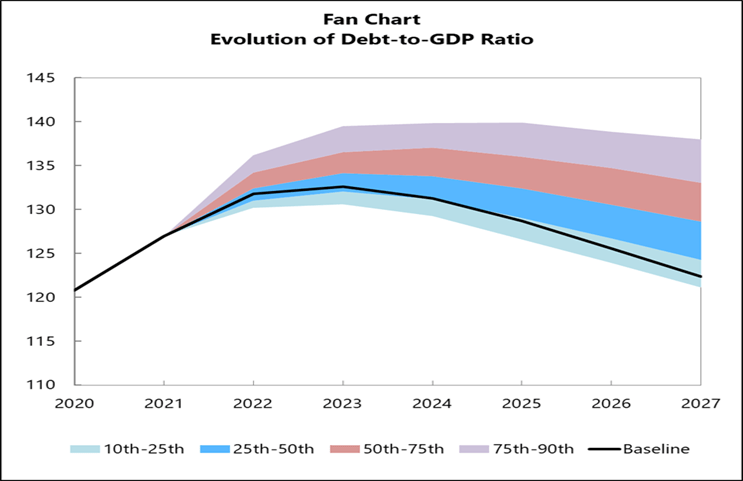
a. The chance of receiving favorable shocks relative to the baseline scenario outweigh that of unfavorable shocks.
b. The downside and upside risks around the baseline scenario are symmetric.
c. The probability that the debt-to-GDP ratio will be below 130% by 2027 is greater than 75%.
d. The probability that the debt-to-GDP ratio will remain below 128% by 2027 is approximately 50%
The probability that the debt-to-GDP ratio will remain below 128% by 2027 is approximately 50%
400
Identify the correct statement about “defined benefit” and “defined contribution” plans?
a. A defined benefit plan does define contributions whereas a defined contributions plan does not.
b. A defined benefit plan provides an annuity upon retirement, whereas a defined contribution plan provides a lump-sum.
c. A defined benefit is often “pay as you go,” whereas a defined contribution plan is “fully funded”.
d. Under a defined contribution plan, contributions and benefits are unrelated.
c. A defined benefit is often “pay as you go,” whereas a defined contribution plan is “fully funded”.
500

What is the stock-flow adjustment coefficient, mu(t), if a country does not have foreign currency denominated public debt?
a. It depends on the nominal exchange rate depreciation.
b. A weighted average between the average and end of period nominal exchange rates.
c. 1
d. It is not possible to determine this with the information provided in the question.
c. 1