Cell Theory
Eukaryotic v. Prokaryotic
Plant vs animal
Organelles
Levels of Organization
100
All living things are made up of one or more_______
Cells
100
Which of these have prokaryotic cells?
Multiple choice question.
A.snails
B.frogs
C.bacteria
D.mice
Bacteria
100
Identify two structures found in a plant cell that are not found in an animal cell.
Central Vacuole, Cell Wall, Chloroplast
100
Materials enter and leave the cell through its ___.
Cell Membrane
100
A multicellular organism is different from a unicellular organism because:
it contains many cells that perform specialized function that are complex while unicellular is made up of only one cell.
200
According to the Cell Theory, where do all cells come from?
Pre-existing Cells
200
_________________cells have genetic material that is not surrounded by a lining.
Prokaryotic
200
Which gas is a waste product of cellular respiration that animals breathe out and plants take in?
Carbon Dioxide or CO2
200
In the animal cell shown, structure D is the , which plays a role in protein production.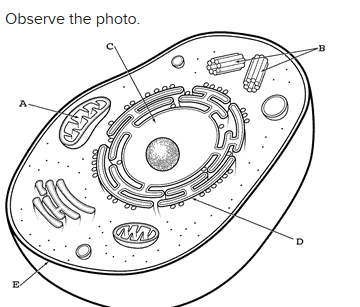
Endoplasmic Reticulum
200
In the human body, the heart is considered an organ. Which of the following is the best description of an organ?
A group of tissues working together
300
a eukaryotic cell, where is the genetic material (DNA) stored?
The nucleus
300
Besides storage, what does a vacuole provide in a plant cell?
Structure
300
describes the relationship between the nucleus and the rest of the cell
DNA within the nucleus contains instructions for all cell activities
300
A group of muscle tissues working together to pump blood through the body is an example of which level of organization?
Organ
400
T or F: The cell theory is the result of the hypothesis and observation of one person.
FLASE many scientist contributed to this discovery
400
A student identifies a cell under a microscope that contains a nucleus and several green, oval-shaped structures. What type of cell is this?
A. Prokaryotic Bacterial Cell
B. Virus
C. A eukaryotic animal cell
D.A eukaryotic plant cell
D.A eukaryotic plant cell
400
What is the primary function of the cell wall in plant cells?
To provide structural support and protection
400

In the animal cell shown, structure A is the site where what process happens?
Cellular Respiration
400
What is the primary difference between a tissue and an organ system?
an organs system is a collection of organism working together while many tissues can make up one organ and needs may organs to make a organ system
500
Which part of the cell theory explains how an injury on your skin eventually heals?
all cells come from pre-existing cells
Healing occurs because existing skin cells undergo division to create new, identical cells to replace the damaged ones.
500
Which of these is a characteristic shared by both prokaryotic and eukaryotic cells?
Cell membrane
500
What is the difference between a cell wall and a cell membrane?
The cell wall is just outside the cell membrane and is strong and rigid and only found in a plant cell
Cell membrane is flexible and lets certain material in and out
500
organelles that transport proteins in the cell.
Vesicles
500
In the levels of organization, which of the following is an example of an organ system?
A. Nervous System
B. A nerve
C. Muscle Tissue
D. The heart
A. Nervous System
600
If you observe a cell with a nucleus and a cell wall, but NO chloroplasts, what is the most likely identity of the cell?
A. Bacterium
B. A leaf cell
C. A human cheek cell
D. Funal cell ( like mushroom or yeast)
D. Fungal Cell
they are consumer and do not perform photosynthesis BUT still have a cell wall.
600
Why is the cell membrane often described as 'semi-permeable'?
It only allows certain substances to enter or leave the cell
700
In plants cells, ______________ carry out functions related to storage and support.
Central Vacuoles
700
______________ ER is important because it helps remove harmful substances from a cell.
Smooth