Solar system
Ecosystem & Water
Taxonomy
Reproduction & Traits
Body Systems
100
This list starts with Mercury and ends with Neptune, moving away from the sun.
What is the order of the planets?
100
This is the ultimate source of all energy for nearly every ecosystem on Earth.
What is the Sun?
100
The broadest taxon that is the most general
What is Domain
100
These are specific characteristics you receive from your parents, such as eye color or height.
What are inherited traits?
100
This system is responsible for transporting oxygen and nutrients through the blood to the rest of the body.
What is the circulatory system?
200
This is the specific force that governs all motion within the solar system.
What is gravity?
200
This is a diagram that shows how energy is lost as it moves up through different trophic levels.
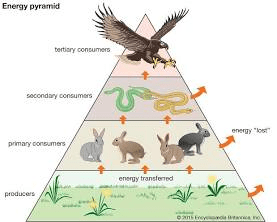
What is an energy pyramid?
200
To create a scientific name, scientists combine these two specific classification levels.
What are Genus and Species?
200
This type of reproduction requires two parents and results in offspring with high genetic diversity.
What is sexual reproduction?
200
This is the largest organ in the human body and belongs to the integumentary system.
What is the skin?
300
This region of space around a star allows for liquid water to exist on a planet's surface.
What is the habitable zone?
300
In an energy pyramid, this specific percentage of energy is actually passed on to the next level.
What is 10%?
300
This branch of science is entirely dedicated to naming, describing, and classifying organisms.
What is taxonomy?
300
This process occurs when humans purposefully breed organisms for specific desired traits.
What is selective breeding?
300
These are the two primary parts of the skeletal system used to protect the heart and lungs.
What is the ribcage?
400
While both are space rocks, one is generally much larger and orbits the sun, while the other is a streak of light caused by a rock burning up in the atmosphere.
What is the difference between an asteroid and a meteor?
400
This term describes the entire area of land where all the water under it or draining off of it goes into the same place.
What is a watershed?
400
a furry friend named Ellie
Mrs.McRoberts Dog
400
This is the primary advantage of asexual reproduction, though it results in offspring identical to the parent.
What is speed (or requiring only one parent)?
400
In the provided diagram of the alveoli, this is the specific process where CO2 leaves the blood and O2 enters.
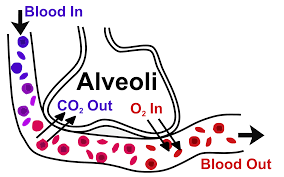
What is gas exchange?
500
According to the provided diagram, this numbered planet is the only one located squarely within the dark blue habitable zone. 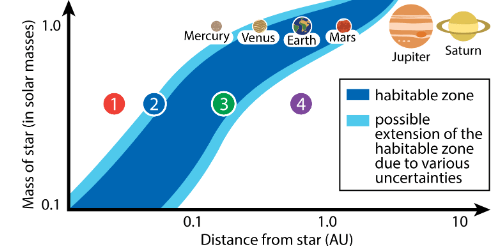
What is Planet 3?
500
In the provided watershed diagram, building a chemical factory here would be the worst choice because runoff would pollute the entire water system downstream.
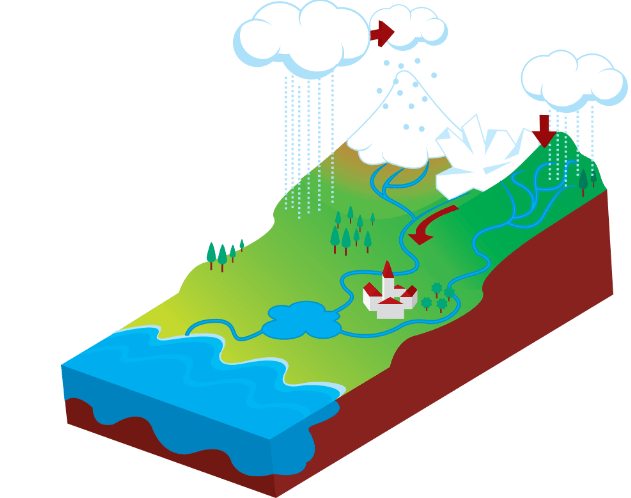
What is the top of the mountain (high elevation)?
500
Unlike eukaryotes, these types of organisms lack a nucleus and membrane-bound organelles.
What are prokaryotes?
500
This theory explains how organisms better adapted to their environment tend to survive and produce more offspring.
What is natural selection?
500
These are the levels of biological organization in order from simplest to most complex.
What are cells, tissues, organs, organ systems, and organisms?
600
Which planet's orbit would be the least affected by the sun’s gravitational pull? 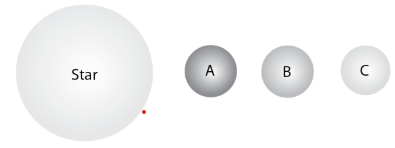
C
600
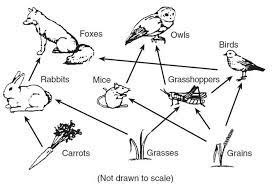
Carrots, Grasses and Grains
What are the producers in the food web?
600
Looking at the provided chart, this is the level where sea otters and wolves are no longer in the same group.
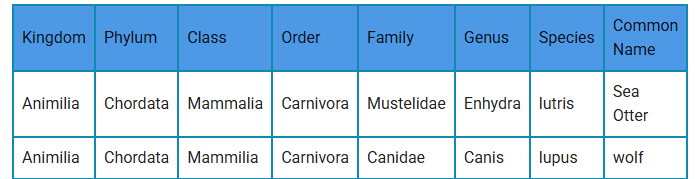
What is the Family level?
600
A major drawback of this reproductive strategy is that an entire population could be wiped out by a single disease due to a total lack of genetic diversity.
What is asexual reproduction?
600
The skin, hair, and nails collectively make up this protective body system.
What is the integumentary system?