Nature of Science
Rock Cycle
W.E.D
Earth's Spheres
Atmospheric
Layers
Layers
Earth's Layers
Weather/Climate
100
A proposed explanation made on the basis of limited evidence.
What is a hypothesis?
100
Name 3 types of rocks.
What are Igneous, Sedimentary, and Metamorphic?
100
Two types of weathering that takes place.
What is physical and chemical weathering?
100
These are the Earth's five spheres.
What is Atmosphere, Geosphere (Lithosphere), Hydrosphere, Cryosphere, and Biosphere?
100
These are the 5 layers of Earth's atmosphere.
What are Troposphere, Stratosphere, Mesophere, Thermosphere, and Exosphere
100
Name the Earth's layers.
What are the crust, mantle, outer core, inner core?
100
This is the day to day changes in temperature and atmospheric conditions in a specific place; whereas this is the long term weather conditions of an area.
What is the difference between Weather and Climate?
200
This is the process in which a scientist works to find possible answers to scientific questions or wonderings.
What is the Scientific Method?
200
This type of rock is formed when heat & pressure changes rock from 1 type to another.
What is Metamorphic rock?
200
The process in which running water, ice, or wind carries away broken bits of rock.
What is Erosion?
200
All of earth's water is contained within this sphere.
What is the Hydrosphere?
200
This is the layer of the atmosphere in which meteoroids begin to burn up (also known as the middle layer of the atmosphere).
What is the Mesosphere?
200
This is the layer in which convection currents occur.
What is the mantle?
200
The climate of an area can be different from its weather. Which of the following statements describes the climate of an area?
A.There should be heavy rains tomorrow morning.
B.The rains next week are expected to cause some flooding.
C.The average temperature from 1930-1996 was 23oC (74oF).
D.The high temperature on September 4, 2009 was 32oC (89oF).
What is C. This statement tells the average temperature of an area over a long period of time.
300
The variable that is the one changed by the scientist?
What is the independent variable?
300
Limestone is an example of this type of rock.
What is Sedimentary rock?
300
The rock shown below was weathered by winds carrying sand particles over many years. What type of weathering would this be an example of?
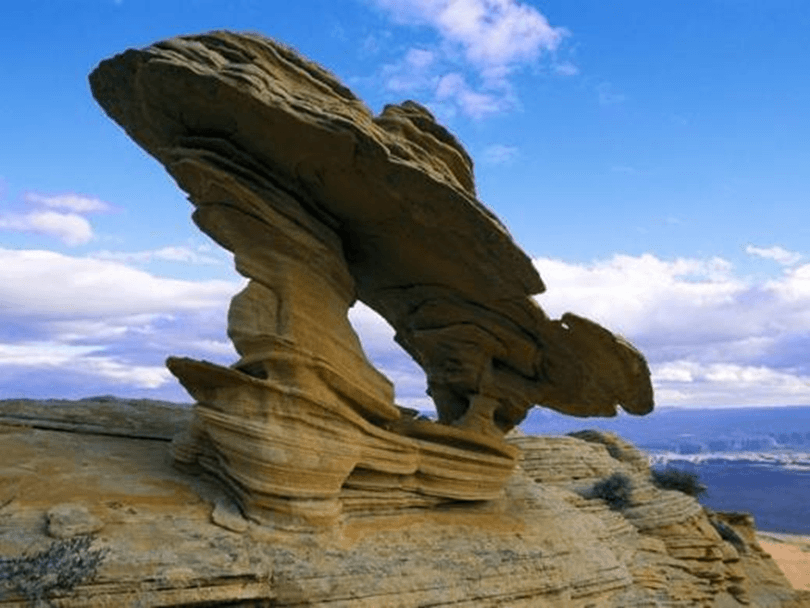
What is Physical Weathering?
300
We find all living things in this sphere.
What is the Biosphere?
300
This is the lowest layer of the atmosphere where weather takes place.
What is the Trophosphere?
300
TRUE or FALSE? - An earthquake can be predicted using a seismograph.
What is false.
300
What part of the water cycle occurs when water droplets form clouds?
Condensation
400
When graphing data from an experiment, this is the variable that is located on the x-axis.
What is the independent variable?
400
This is the state in which rocks are completely melted.
What is Magma (or lava)?
400
When sediment from rocks or land is broken down, carried away by wind or water, and deposited elsewhere.
What is Deposition?
400
When icebergs melt into the ocean, these two spheres are interacting.
What are the hydrosphere and cryosphere?
400
Contains the ozone layer which protects us from UV rays. Temperature increases and air pressure decreases as you go higher up.
What is the Stratosphere?
400
The boundary along which two plates push towards each other.
What is a convergent boundary?
400
Long-distance winds that travel for thousands of kilometers.
Moves weather patterns.
What is the Jet Stream?
500
This explains WHAT is happening in our world?
What is a Law?
500
This is the process by which metamorphic rocks are formed?
What is heat and pressure?
500
Deforestation occurs when large areas of trees are cut down. Which of the following impacts on the environment would result from deforestation?
A.increased erosion
B.colder temperatures
C.decreased carbon dioxide
D.greater oxygen production
What is A?
500
These spheres are affected when a forest fire occurs.
What are the biosphere (trees and animals), the atmosphere (gases from the fire released), geosphere (ground is scorched by fire), and (possibly) hydrosphere (if any ponds or creeks are located within the forest)?
500
Name the layers of the atmosphere in order in which an astronaut who is returning to Earth from space would enter.
What is Exosphere, Thermosphere, Mesosphere, Stratosphere, and Troposphere?
500
Plates move around the Earth due to convection currents in the mantle creating volcanoes, earthquakes, mountains, and ocean basins.
What is the Theory of Plate Tectonics?
500
These affect the weather near coastlines. One type will happen during the day; cooler air comes from the ocean while warmer air rises and leaves the land. One type happens at night; cooler air comes from the land while warmer ocean air rises and leaves the ocean.
What are land and sea breezes?