Genre and Text Structure
Fiction Annotations
Non-fiction Annotations
Exam techniques
Short Answer Responses
100
What are the steps to determine a genre?
1) Read the title - come up with a prediction
2) Look for text features
3) Read the first two paragraphs
4) Stamp the genre
100
What are the headings you use to set up a fiction annotation sheet (right side)
CSPLL
100
What is the difference between a topic and a central idea in an informational text?
A topic is the general subject, while the central idea is the author’s main point about that subject.
100
What are the 4 reasons to eliminate an answer in MCQ analysis
1. No Evidence
2. Not Evidence
3. Not Connection
4. Magic Maybe
100
What does RACECE stand for?
R: Restate the question
A: Answer the question
C: Cite evidence
E: Explain
C: Cite more evidence
E: Explain
200
A passage explains how two characters respond differently to the same conflict. Which informational text structure is being used?
Compare and contrast.
200
What is the difference between a topic and a theme in a fictional text?
Regular reading helps students develop vocabulary and writing skills.
200
An article argues that excessive screen time can negatively affect students’ sleep. What kind of evidence would best support this central idea?
Research findings, statistics, expert statements, or studies showing a connection between screen time and sleep quality.
200
Steps to our multiple choice question routine?
1) Name the skill
2) Formulate an answer
3) Find evidence
4) Eliminate
5) Choose and Circle
200
What are the two steps you need to write an explanation in RACECE?
1) Give the Context
2) Make the Connection
300
What are the 5 types of text structures?
1) Descriptive
2) Chronological
3) Compare and Contrast
4) Problem and Solution
5) Cause and Effect
300
In All American Boys, Rashad and Quinn experience the same incident from different perspectives. What literary element allows readers to understand both characters’ thoughts and experiences?
Point of view, specifically alternating first-person narration.
300
An author introduces a problem in paragraph 1, provides statistics about its effects in paragraphs 2–4, and recommends a solution in paragraph 5. What is the author’s likely purpose?
To persuade readers that the problem needs to be addressed and that a particular solution should be considered.
300
What are the 4 steps for Part-to-Whole Analysis?
WHOLE: What is the big idea/theme
PART: What happens/is explained here?
CHANGE: What does this part add, reveal, explain, or show?
CONNECT: How does that develop the big idea?
300
A student writes: “This quote shows that the character is brave because they are brave.” What is wrong with this explanation?
It repeats the claim without analyzing the evidence. A strong explanation identifies what the character does and explains why that action demonstrates bravery.
400
What text structure is most likely being used when an author includes signal words such as “as a result,” “because,” “therefore,” and “consequently”?
Cause and Effect
400
A character says, “I’m fine,” but avoids eye contact, clenches their fists, and walks away. What can a strong reader infer, and what evidence supports that inference?
The character is likely upset or hiding their feelings. Their body language contradicts their words.
400
Read: “The new recycling program is an impressive success. Within one month, the school reduced its trash by 30 percent.” What is the author’s point of view?
The author has a positive view of the recycling program and believes it is successful.
400
A question asks, “How does paragraph 6 contribute to the development of the central idea?” What two things must your answer explain?
What paragraph 6 develops or reveals, and how that information connects to the central idea of the entire text.
400
A student claims that a character values nature and cites evidence showing the character reaching through a fence to touch a tree. What explanation would successfully connect the evidence to the claim?
The character’s desire to touch the tree, despite the fence blocking them, demonstrates a strong connection to nature and a desire to experience the natural world firsthand.
500
An author describes how students are struggling with attendance, then suggests mentoring programs and family outreach as possible solutions. Identify the text structure and explain how it helps readers understand the topic.
Problem and solution. It identifies a problem and explains possible ways to address it.
500
In a story, a character witnesses an injustice but initially remains silent. Later, they decide to speak out despite the consequences. How does this change contribute to the development of a theme?
The character’s change develops the theme that standing up for what is right requires courage, even when doing so is difficult.
500
An article’s central idea is that AI friendships cannot fully replace human relationships. Paragraph 4 explains that AI can offer companionship but cannot truly experience human emotions. How does paragraph 4 contribute to the development of the central idea?
It develops the central idea by explaining a limitation of AI companionship, demonstrating why AI cannot fully replace genuine human connections.
500
A student answers, “Paragraph 7 contributes to the central idea because it explains how AI works.”
What is missing from this response, and how should the student improve it?
The student only summarizes the paragraph. They must identify the text’s overall central idea and explain how the information about AI develops, supports, or clarifies that idea.
500
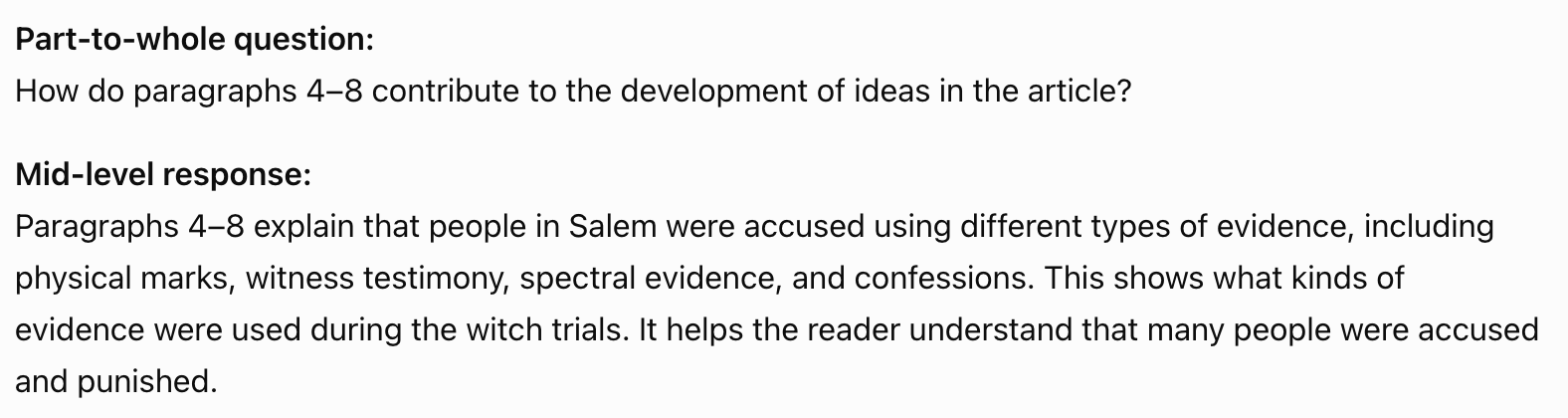
How can this explanation be improved?
It identifies accurate details and explains what happened, but it does not clearly connect the evidence to the larger central idea that the trials were unfair because the evidence was unreliable and easy to manipulate.