Systems of Equations
Quadratic Expressions
Function Concepts
Sequences
Function Transformations
Solving Quadratic Equations
200
Convert to slope-intercept form:
6x+2y=10
y=-3x+5
200
Write in expanded form.
2x(x-7)
2x^2-14x
200
Evaluate for x = 3
f(x)=x^2+5x-3
21
200
What kind of sequence is this?
105, 90, 75, 60, ...
Arithmetic
200
Describe the following transformation on the graph of f(x).
f(x)->f(x)-3
Translation 3 units down
200
Solve for x.
x^2=144
x=12 and x=-12
400
Solve.
4x+y=18
y=10
(2,10)
400
Write in expanded form.
(f-3)(2f+4)
2f^2-2f-12
400
Is this relation a function? Why or why not?
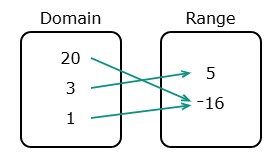
Yes, each input (domain) value only corresponds to one output (range) value
400
Identify the missing term in the sequence. Fractions must be given in simplest form.
1/6, 1/3, 1/2, ?, 5/6, 1, ...
2/3
400
Describe the following transformation on the graph of f(x).
f(x)->f(x+6)
Translation 6 units left
400
Solve for x.
x^2-5x-14=0
x=7andx=-2
600
Solve.
y=5x-4
y=3x
(2,6)
600
Write in expanded form.
(3g-9)^2
9g^2-54g+81
600
Complete the table.
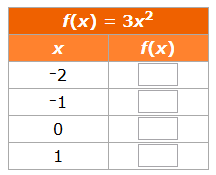
12, 3, 0, 3
600
Write a recursive formula to define this sequence.
3, 4.5, 6, 7.5, 9, ...
a_n=a_(n-1)+1.5
600
Describe the following transformation on the graph of f(x).
f(x)->-0.5f(x)
1. Reflect over x-axis
2. Vertical dilation by factor of 0.5 (shrink)
600
Solve for x.
x^2+3x=10
x=-5 and x=2
800
Solve.
-3x-5y=23
3x+6y=-21
(-11,2)
800
Write in factored form.
p^2-2p-35
(p-7)(p+5)
800
Find f(2) for this function.
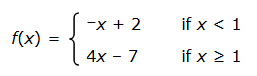
1
800
Write a recursive formula to define the sequence.
1/6,1/9,2/27,4/81,...
g_n=2/3g_(n-1)
800
Describe the following transformation on the graph of f(x).
f(x)->3f(x-4)
1. Vertical dilation by factor of 3 (stretch)
2. Translation 4 units right
800
Solve for x.
2x^2+3x-20=0
x=-4 and x=2.5
1000
Solve.
4x-6y=18
2x-6y=6
(6,1)
1000
Write in factored form.
m^2-41m+78
(m-39)(m-2)
1000
Complete the table.
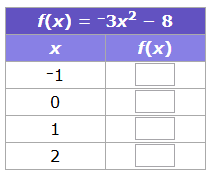
-11, -8, -11, -20
1000
Write a recursive formula to define the sequence.
1/52,1/26,1/13,2/13,...
g_n=2g_(n-1)
1000
Describe the following transformation on the graph of f(x).
f(x)->-5f(x+2)+6
1. Reflect over x-axis
2. Vertical dilation by factor of 5 (stretch)
3. Translation 2 units left
4. Translation 6 units up
1000
Solve for x.
3x^2+4x=-1
x=-1/3 and x=-1