Fossils
Relative Dating
Geologic Misc.
Geologic Time
Early Earth
100
What is a fossil?
A fossil is the evidence or remains of once living things, often preserved in rock.
100
Compare relative versus absolute age.
The relative age of a rock is its age compared to the age of other rocks. The absolute age of a rock is the number of years since the rock formed. The absolute age is more exact.
100
Explain the law of superposition
Oldest rock layers are on the bottom and youngest rock layers are on the top
100
What is the geologic time scale?
The geologic time scale is a record, in chronological order, of all the life forms and geologic events in Earth's history.
100
How old is the Earth?
Scientists hypothesize that Earth formed at the same time as the other planets and the sun, roughly 4.6 billion years ago.
200
If this happens quickly to a dead organism, the chances of it becoming a fossil increases
Burial in sediment
200
How is the relative age of a rock determined?
By comparing them to the surrounding rock layers using the Law of Superposition. Then determining if there is any crosscutting or if there are any inclusions within the rock layers.
200
What is the general rule of intrusions/extrusions (Law of Crosscutting)
Younger rock cuts across older rock or structures.
200
True or False? Explain your answer. Humans were dominant for most of geologic time.
False. If you tried to squeeze Earth's 4.6-billion year history into one year, modern humans don't even appear until the last day of the year!
200
How do scientists know the age of the Earth?
They use Relative and Absolute dating. The oldest rocks found on Earth have been radioactively dated at about 4 billion years old. However, the oldest moon rocks, also radioactively dated, are 4.6 billion years old. Scientists hypothesize that the Earth and moon are the same age, because they believe that the moon is a piece from the Earth that broke off when Earth collided with a large object just as it was forming.
300
Why is studying fossils important?
To learn about ancient life forms, climates, or changes to Earth’s surface
300
What is an index fossil, and why is it helpful in determining relative age?
An index fossil is the fossil of an organism that is widely distributed (not just found in a limited area) and lived only a short period of time. Because they live only a short period of time but are found all over the place, they are helpful in telling the relative ages of the rocks in which they occur.
300
What is the ultimate cause of earthquakes, volcanos and mountains.
Plate tectonics
300
What are the 4 Eras on the geologic time scale?
Precambrian, Paleozoic, Mesozoic, Cenozoic
300
What was early Earth like?
Early Earth had a very high temperature as a result of collisions with other things in space. Denser, solid materials formed Earth's core, but the surface was molten for a while until some it's thermal energy was transferred to space. The original atmosphere included hydrogen and helium captured from the sun as it revolved.
400
What is an index fossil?
The preserved remains of any organism that lived for a short period of time and becomes a tool to identify that geologic time period.
400
Why are fossils only found in sedimentary rock?
The heat and pressure involved in making metamorphic and igneous rocks will destroy any potential fossil material
400
What is the Law of inclusions?
Rock fragments or sediments included in a larger host rock are older than their host rock.
400
In what era did the Earth, crust, core, and oceans form?
The Precambrian Era
400

Which fossil makes a good index fossil?
The Ammonite is the only one that meets all the criteria, short lived (only in one layer) and wide spread and abundant.
500
Fossil records show that humans first appeared on Earth during this era
What is the Cenozoic era
500
Why do unconformities cause a gap in the geologic record?
An unconformity is a surface where new rock layers meet a much older rock surface. This happens rock layers shift and older layers erode away and are covered by much "newer" sediment. This potentially creates a big gap in time where some layers were lost.
500
In what era did dinosaurs first evolve and then go extinct? What caused their extinction?
The Mesozoic Era. The impact of an Asteroid is believed to have caused their extinction.
500
During what era did the climate stabilize allowing modern humans to evolve?
The Cenozoic Era.
500
Order the layers from oldest to youngest
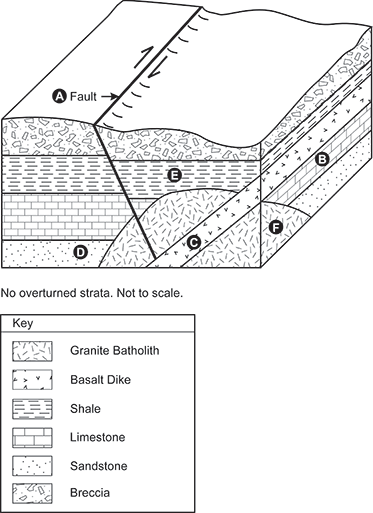
D, B, F, C, E, Breccia, A (fault)