Unit 1 Definitions
Unit 2 Definitions
Sequences of Transformations
Dilations & Similarity
Calculating Slope
100
These are the three types of rigid transformations.
What are translations, rotations, and reflections?
100
This is when a figure expands or shrinks, but maintains the same shape.
What is a dilation?
100
A transformation that maps the gray pentagon onto the purple pentagon.
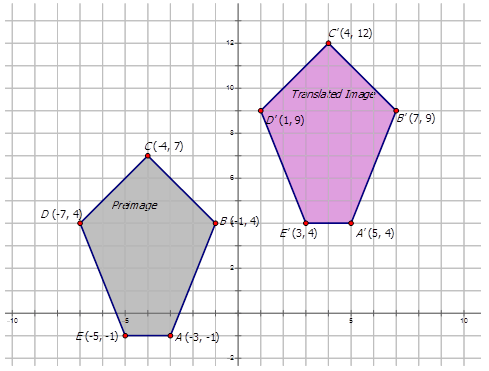
What is a translation right 5, up 2?
100
This number is the scale factor of this enlargement.
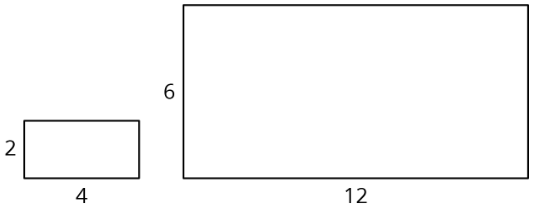
What is 3?
100
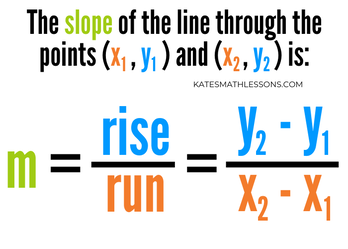
The easy-to-remember formula for calculating slope.
What is rise over run?
200
This is the word we use when two figures line up perfectly using only rigid transformations.
What is congruent?
200
In a dilation, this is the number that all original lengths are multiplied by to get the image.
What is scale factor?
200
The transformation description that maps △ABC onto △A'B'C'.
What is a reflection over the y-axis?
200
Figure B is a dilation of Figure A with a factor of 1.9. This is what we call the size change of this dilation.
What is an enlargement?
200
The slope of this line. 
What is 3/7?
300
This is what we call the resulting figure after a transformation.
What is an image?
300
On a line, this is the ratio of the vertical change to the horizontal change which represents how steep the line is.
What is slope?
300
The coordinates of the point P(4,5) after a 90° rotation counterclockwise about the origin.

What is P'(-5,4)?
300
These are the coordinates of vertex B' after a dilation of scale factor 0.5 with respect to the origin.
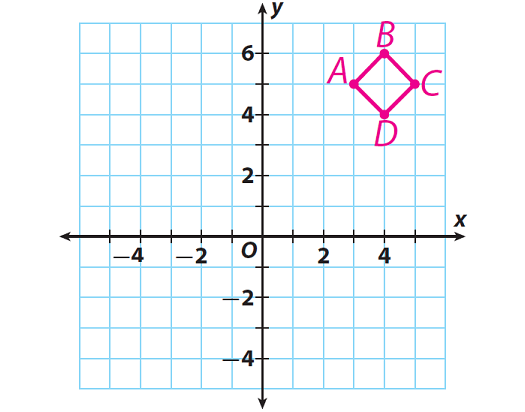
What is B'(2,3)?
300
The slope of this line in simplest form. 
What is 2/3?
400
This is a line which cuts through two parallel lines, creating pairs of congruent angles such as alternate interior angles and corresponding angles.
What is a transversal?
400
This is the word we use when two figures can line up perfectly using rigid transformations and/or uniform dilations.
What is similar?
400
The coordinates of point A' after a double reflection across the y-axis first and x-axis second.
What is (-3,-5)?
400
This is the scale factor from △PQR to △STU.

What is 3/2?
400
The slope of this line in simplest form.

What is 1/3?
500
In two figures, this is what we call the matching vertices, angles, or sides that occupy the same relative position.
What are corresponding parts?
500
In a dilation, this is the only point which does not move. The figure expands and shrinks relative to this point.
What is the center of dilation?
500
This sequence of transformations proves that polygon ABCDEF is similar to polygon STUVWX.
What is a dilation of scale factor 3 with respect to Point A, followed by a translation of 6 units right?
500
The length of side TS.

What is 12?
500
This number is the slope of the line passing through the points (1,0) and (2,2).
What is 2?