What's Trending? (+ 1 Trivia)
Give Atom Some Space
Ion Wanna Be So Far
Ion got anymore energy for this
Do you have an affinity for chem?
200
What periodic trend deals with ½ the distance between 2 atoms
Atomic Radius
200
How does atomic radius trend on the periodic table?
Increases down a group and decreases left to right across a period
200
Cations are ___ than their parent atoms?
Smaller
200
Which of the following elements has the smallest ionization energy?
A.) Nitrogen
B.) Arsenic
C.) Bismuth
C.) Bismuth
200
Why do noble gases generally have low or zero electron affinities?
They have a complete valence shell, making them stable and unreactive.
400
What periodic trend deals with the amount of energy released when an e- is added to a gas-phase atom?
Electron Affinity
400
Which of the following has the largest atomic radius?
A.) Ba
B.) Pb
C.) At
A.) Ba
400
Anions are ___ than their parent atoms.
Larger
400
What is the periodic trend for ionization energy?
Decreases down a group, increases left to right
400
Describe what electron affinity is.
The energy change when an electron is added to a (neutral) gaseous atom.
600
What periodic trend deals with the minimum energy needed to remove an e- from a gas-phase atom?
Ionization Energy
600
Which of the following atoms has the largest atomic radius?
A.) Nitrogen
B.) Antimony
C.) Phosphorus
B.) Antimony
600
Which ion has a larger ionic radius?
A.) Mg2+
B.) O2-B.) O2-
600
Which of the following has a larger ionization energy than Sr?
A.) Ca
B.) Rb
C.) Ba
A.) Ca
600
What is the periodic trend for electron affinity?
Increases across a period and decreases down a group.
800
What is the periodic trend dealing with the distance between an ion's nucleus and its outermost shell?
Ionic radius
800
Which of the following has a larger atomic radius than Ca?
A.) Al
B.) K
C.) Ga
B.) Ga
800
How does ionic radius trend on the periodic table?
Increases down a group, decreases left to right across a period
800
A snippet of the periodic table is shown. Which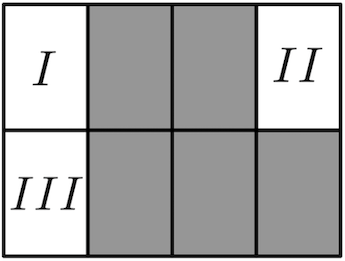 of the following orders the ionization energy of I, II, and III from smallest to largest?
A.) I < II < III
B.) II < III < I
C.) III < I < II
C.) III < I < II
800
Which element is an exception to the electron affinity trend on the periodic table?
A.) Lithium
B.) Flourine
C.) Nitrogen
D.) Neon
Nitrogen — half-filled p orbital (2p3) -> creates extra stability (symmetry)
1000
What is my favorite color?

Pink!
1000
 Match each element with the correct sphere:
A.) Al atom
B.) C atom
C.) Cs atom
A.) III
B.) II
C.) I
1000
Which of the following correctly ranks the isolelectronic species (O2-, F-, Na+, Mg2+) in order of increasing ionic radius?
A.) Mg2+ < Na+ < F- < O2-
B.) O2- < F- < Na+ < Mg2+
C.) Na+ < Mg2+ < F- < O2-
A.) Mg2+ < Na+ < F- < O2-
1000
Identify the element that possesses the following ionization energies.
I1 = 786 kJ/mol
I2 = 1577 kJ/mol
I3 = 3231 kJ/mol
I4 = 4355 kJ/mol
I5 = 16,091 kJ/mol
I6 = 19,805 kJ/mo
A.) Aluminum
B.) Silicon
C.) Phosphorus
D.) Sulfur
B.) Silicon
1000
Why is electron affinity not as straightforward as other periodic trends?
There are many exceptions due to different electron configurations and stability