Derivatives
Indefinite Integrals
Definite Integrals
Riemann Sums
2nd Fundamental Theorem of Calculus
100
What is the derivative of
ln x^2
2/x
100
Find the integral
int(x^2+pi) dx
x^3/3+pix+c
100
Evaluate
int_0^2x^3 dx
2^4/4 or 4
100
Use a right Riemann sum with 2 sub-intervals to estimate int_-1^1x^2 dx
1
100
What is F'(x) if F(x)=int_0^xg(t) dt
g(x)
200
Find f '(x) if
f(x)=(x-3)/x
3x^-2 or 3/x^2
200
What is the anti-derivative of
1/x?
lnx+c
200
Evaluate
int_-1^1e^x dx
e-e^-1
200
Use a left Riemann sum with 2 sub-intervals to estimate
int_-1^1x^3 dx
-1
200
What is F(2) if F(x)=int_0^x4t dt
8
300
What is the derivative of
y=sin x cos x
cos^2x - sin^2x
300
Find y if
y'=2x^(5/3)
y=3/4x^(8/3)+c
300
If int_-3^2f(x) dx=12 and int_-3^-1f(x) dx =-4
Then what is int_-2^2f(x) dx
16
300
Use a midpoint Riemann sum with 1 sub-interval to estimate
int_2^(3)2x dx
5/2
300
If F(x)=int_0^(4x)sqrt(t^2-1) dt
4sqrt(16x^2-1) or 4(16x^2-1)^(1/2)
400
Find y' if
y=tan^-1(2x)
2/(1+4x^2)
400
Find
int(x^4-2x)/x dx
x^4/4-2x+c
400
Evaluate
int_0^(pi/2)-sinx dx
-1
400
Use the table below and a trapezoidal sum with 3 equal intervals to estimate int_0^12f(x) dx
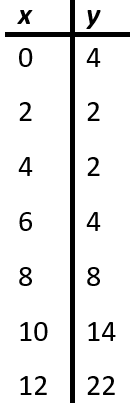
92
400
What is F'(x) if F(x)=int_x^(e^x)lnt dt
Simplify your answer.
e^x ln e^x-lnx = xe^x-lnx
500
What is the simplified derivative of
f(x)=tan x/sec x
f'(x)=(sec^2x - tan^2x)/sec x
500
Find
int(x-3e^x+x/x^(1/2))dx
x^2/2-3e^x+2x^(1/2)+c
500
If int_2^6f(x) dx=-2 and int_-1^4f(x) dx=6 and int_4^6f(x) dx=-1
Than what is int_-1^-2f(x) dx ?
7
500
Would a right Riemann sum be an over estimate or an underestimate for int_0^(pi/2)cosx dx ?
Explain.
A RRAM would be an underestimate because the graph of
cos x
is decreasing on
(0, pi/2)
and the rectangles are under the curve.
500
If f(x)=int_0^xg(t) dt and g(t)=t^2-2t
Then on what intervals is f(x) increasing.
f(x)
is increasing on
(-oo, 0) and (2, oo)
because
f'(x)>0