Phases 1
Phases 2
Phase Diagrams
Enthalpy
Specific Heat
100
The formation of frost is is an example of what phase change?
deposition
100
In an ideal gas, what happens when gas molecules collide?
They bounce right back, elastic collision occurs.
100
If a substance goes from region 1 to region 3, what phase change occured?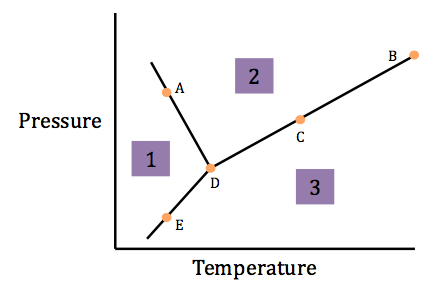
sublimation
100
Does it take more energy to evaporate a mole of water or to melt a mole of water? Why?
evaporate
100
Is condensation an endothermic or exothermic process?
exothermic
200
Water boils at 100 C. Ethanol boils at 78.5 C, in terms of intermolecular forces explain this difference.
There are hydrogen bonds within the water molecules that hold the water molecules together as a liquid. There are less intermolecular forces in ethanol.
200
What is a real gas?
What is an example of a real gas?
a gas that doesn't behave ideally
water
200
What happens at point D? What is its name?
Triple Point, solid, liquid and gas can be there at the same time.
200
Explain why ice is less dense than water
Ice molecules are in a crystal which forces them to be far apart compared to liquids where they can easily move past each other.
200
There are two metals, one with a specific heat of 0.96 j/gc and another with a specific heat of 6.00 j/gc. Which metal would be easier to heat up?
the one with lesser specific heat
300
Which of the following is not a property of solids?
For the true ones explain in terms of kinetic molecular theory why it is true.
A) definite melting point
B) high density
C) easily compressible
D) low rate of diffusion
a) definite melting point - at a certain temperature, the intermolecular forces holding the molecules together will not be able to hold it in a solid.
b) high density - molecules are held close together (except water)
c) false
d) The molecules are moving, but a lot less than liquids and gases
300
Which crystal type has the lowest melting point?
Why?
covalent molecular crystals
300
What is happening at point B?
It is the critical point, after this point it is a super critical fluid, neither a liquid or gas.
300
How much energy is needed to melt 47.0 g of water?
molar enthalpy of fusion of H2O = 6.009 kJ/mol
Molar Enthalpy of vaporization of H2O = 40.79 kJ/mol
15.5 kJ
300
How many grams of water would require 2200 J of heat to raise its temperature from 34 °C to 100°C? The specific heat of water is 4.18 J/g°C
8.0 g
400
We leave a sealed container of water on the lab bench, explain what will happen to the water level in the container over time.
The water level would decrease a little and then remain the same afterwards.
400
If we are at 0 C and 0 atm, we are a in the gas phase, if we increase the pressure what phase changes would occur? Why would this happen?

More pressure, goes from a gas to solid to liquid because liquid molecules are the closest together.
400
If I was at 150 K and normal pressure and increase my temperature, what type of phase change would occur?
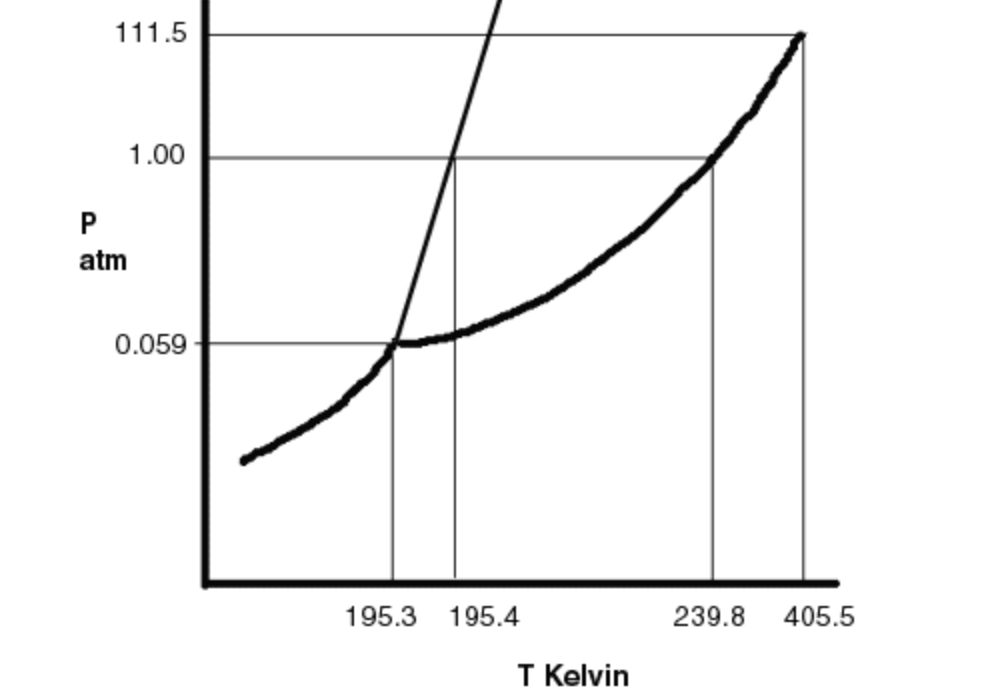
melting
400
How much energy is needed to evaporate 47.0 g of water?
molar enthalpy of fusion of H2O = 6.009 kJ/mol
Molar Enthalpy of vaporization of H2O = 40.79 kJ/mol
106 kJ
400
The specific heat of wood is 2.03 J/g°C. How much heat is needed to convert 550 g of wood at - 15°C to 10.0 °C?
27,900 J
500
Explain why the level of your drink in the straw is higher than the level of your drink.
Capillary action
500
There tends to be a lot of potholes that appear on the ground magically in the spring, water seeps into the ground and causes the destruction of the roads (and tires) in the spring, would could be the cause of this?
Water expands in the winter when it freezes, causes the break in the cement.
500
If this substance is at 300 K and at 0.05 atm and we decreased the temperature, what phase change would occur?
Deposition
500
It is found that 60.0 J of energy are required to melt 15 grams of a substance. The molar mass of the substance is 120 g/mole. Calculate the enthalpy of fusion of the substance in kilojoules per mole.
0.48 kj/ mol
500
A 55 g block of metal has an original temperature of 15.0°C and it has a specific heat of 0.45 J/g°C. If 550 J of heat were added what is the final temperature
37°C