Chapter 11
Chapter 12
Chapter 13
Chapter 14
Chapter 15
Chapter 16
100
Short-term notes payable:
A. Are negotiable.
B. Are an unconditional promise to pay.
C. Can be issued in return for money borrowed from a bank.
D. Can replace an account payable.
E. All of the choices are correct
E. All of the choices are correct
100
A partnership agreement:
A. Does not generally address the issue of the rights and duties of the partners.
B. Is binding even if it is not in writing.
C. Is the same as a limited liability partnership.
D. Is also called the articles of incorporation.
E. Is not binding unless it is in writing.
B. Is binding even if it is not in writing.
100
The costs of bringing a corporation into existence, including legal fees, promoter fees, and amounts paid to obtain a charter are called:
A. Selling expenses.
B. Prepaid fees.
C. Organization expenses.
D. Minimum legal capital.
E. Stock subscriptions.
C. Organization expenses.
100
The contract between the bond issuer and the bondholders, which identifies the rights and obligations of the parties, is called a(n):
A. Mortgage.
B. Mortgage contract.
C. Bond indenture.
D. Debenture.
E. Installment note.
C. Bond indenture.
100
Debt securities that a company intends and is able to hold until maturity are known as:
a. Trading securities. b. Available-for-sale securities. c. Held-to-maturity securities. d. Equity method investments. e. Consolidation securities.
c. Held-to-maturity securities.
100
The statement of cash flows reports:
A. Cash flows from operating activities.
B. Significant noncash financing and investing activities.
C. All of the choices are reported on a statement of cash flows.
D. Cash flows from financing activities.
E. Cash flows from investing activities.
C. All of the choices are reported on a statement of cash flows.
200
Contingent liabilities can be:
A. Probable.
B. All of the choices are correct.
C. Estimable.
D. Reasonably possible.
E. Remote.
B. All of the choices are correct.
200
In the absence of a partnership agreement, the law says that income (and loss) should be allocated based on:
A. A fractional basis.
B. Interest allowances.
C. The ratio of capital investments.
D. Equal shares.
E. Salary allowances.
D. Equal shares.
200
Stockholders' equity consists of:
A. Paid-in capital and retained earnings.
B. Retained earnings and cash.
C. Paid-in capital and par value.
D. Premiums and discounts.
E. Long-term assets.
A. Paid-in capital and retained earnings.
200
The effective interest amortization method:
A. Allocates a decreasing amount of interest over the life of a discounted bond.
B. Allocates bond interest expense over the bond's life using a changing interest rate.
C. Allocates bond interest expense over the bond's life using a constant interest rate.
D. Allocates bond interest expense using the current market rate for each interest period.
E. Is not allowed by the FASB.
C. Allocates bond interest expense over the bond's life using a constant interest rate.
200
Which of the following is an equity security?
a. U.S. Treasury bonds. b. Corporate notes. c. Corporate bonds. d. Municipal bonds. e. Company common stock.
e. Company common stock.
200
Cash flows from selling trading securities are usually reported in the statement of cash flows as part of:
A. Operating activities.
B. None of these. This is not reported in the statement of cash flows.
C. Noncash activities.
D. Financing activities.
E. Investing activities.
A. Operating activities.
300
Obligations due to be paid within one year or the company's operating cycle, whichever is longer, are:
A. Bills.
B. Current assets.
C. Current liabilities.
D. Earned revenues.
E. Operating cycle liabilities.
C. Current liabilities.
300
21. A partnership recorded the following journal entry: This entry reflects:
A. Withdrawal of a partner who pays a $10,000 bonus to each of the other partners.
B. Acceptance of a new partner who invests $70,000 and receives a $20,000 bonus.
C. Withdrawal of $10,000 each by Tanner and Jackson upon the admission of a new partner.
D. Addition of a partner who pays a bonus to each of the other partners.
E. Additional investment into the partnership by Tanner and Jackson.
B. Acceptance of a new partner who invests $70,000 and receives a $20,000 bonus.
300
A company made an error in calculating and reporting depreciation expense in 2013. The error was discovered in 2014. The item should be reported as a prior period adjustment:
A. On the 2014 income statement.
B. On the 2013 income statement.
C. On the 2013 statement of retained earnings.
D. Accounted for with a cumulative "catch-up" adjustment.
E. On the 2014 statement of retained earnings.
E. On the 2014 statement of retained earnings.
300
A bond traded at 102½ means that:
A. The market rate of interest is 2 ½% above the contract rate.
B. The bond traded at $1,025 per $1,000 bond.
C. The bonds were retired at $1,025 each.
D. The bond pays 2.5% interest.
E. The market rate of interest is 2.5%.
B. The bond traded at $1,025 per $1,000 bond.
300
Short-term investments in held-to-maturity debt securities are accounted for using the:
a. Fair value method with fair value adjustment to income. b. Fair value method with fair value adjustment to equity. c. Consolidation method. d. Cost method without amortization. e. Equity method.
d. Cost method without amortization.
300
Which of the following transactions or events should be reported as a source of cash from operating activities when using the direct method?
A. Credit sales.
B. Cash received from the sale of treasury stock.
C. Cash collections from customers.
D. Depreciation expense.
E. Cash received from the sale of a building.
C. Cash collections from customers.
400
All of the following statements regarding liabilities are true except:
A. A liability is a probable future payment of assets or services.
B. Information about liabilities is more useful when the balance sheet identifies them as either current or long term.
C. For a liability to be reported, it must be a present obligation that results from a past transaction or event, and requires a future payment of assets or services.
D. All of the responses are correct.
E. Unearned future wages to be paid to employees should be recorded as liabilities.
E. Unearned future wages to be paid to employees should be recorded as liabilities.
400
Groh and Jackson are partners. Groh's capital balance in the partnership is $64,000, and Jackson's capital balance $61,000. Groh and Jackson have agreed to share equally in income or loss. Groh and Jackson agree to accept Block with a 25% interest. Block will invest $35,000 in the partnership. The bonus that is granted to Block equals:
A. $0, because Block must actually grant a bonus to Groh and Jackson.
B. $3,333.
C. $6,667.
D. $5,000.
E. $2,500.
D. $5,000.
Total Partnership Equity = Groh's Capital + Jackson's Capital + Block's Investment
Total Partnership Equity = $64,000 + $61,000 + $35,000 = $160,000
Equity for Block = $160,000 * 0.25 (or 25%) = $40,000
Bonus to Block = Block's Capital (Equity) - Cash Investment
Bonus to Block = $40,000 - $35,000 = $5,000
400
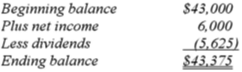
A company had a beginning balance in retained earnings of $43,000. It had net income of $6,000 and paid out cash dividends of $5,625 in the current period. The ending balance in retained earnings equals:
A. $11,625.
B. $54,625.
C. $49,000.
D. $42,625.
E. $43,375.
E. $43,375.
400
On January 1, a company issues bonds dated January 1 with a par value of $300,000. The bonds mature in 5 years. The contract rate is 9%, and interest is paid semiannually on June 30 and December 31. The market rate is 8% and the bonds are sold for $312,177. The journal entry to record the first interest payment using the effective interest method of amortization is:
A. Debit Interest Expense $12,487.08; debit Premium on Bonds Payable $1,012.92; credit Cash $13,500.00.
B. Debit Interest Expense $12,487.08; debit Discount on Bonds Payable $1,012.92; credit Cash $13,500.00.
C. Debit Interest Payable $13,500; credit Cash $13,500.00.
D. Debit Interest Expense $12,282.30; debit Premium on Bonds Payable $1,217.70; credit Cash $13,500.00.
E. Debit Interest Expense $14,717.70; credit Premium on Bonds Payable $1,217.70; credit Cash $13,500.00.
A. Debit Interest Expense $12,487.08; debit Premium on Bonds Payable $1,012.92; credit Cash $13,500.00.
Premium Amortization = $13,500 - $12,487.08 = $1,012.92
Interest Expense = $312,177 * .08 * ½ = $12,487.08
400
On February 1, Fairwing Company purchased short-term investments in available-for-sale debt securities at a cost of $40,000 cash. The journal entry on December 15 when Fairwing sells 25% of these securities ($10,000 cost) for $10,900 includes a:
a. Credit to Gain on Sale of Debt Investment for $900. b. Credit to Debt Investments—Available-for-Sale (AFS) for $10,900. c. Debit to Cash for $10,000. d. Credit to Interest Revenue for $900. e. Debit to Gain on Sale of Debt Investments for $900.
a. Credit to Gain on Sale of Debt Investment for $900.
400
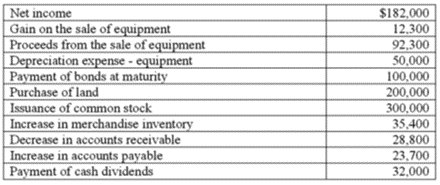
Weston is preparing the company's statement of cash flows for the fiscal year just ended. Using the following information, determine the amount of cash flows from financing activities:
A. $191,700.
B. $(168,000).
C. $(191,700).
D. $168,000.
E. $200,000.
D. $168,000.
500
On November 1, Carter Company signed a 120-day, 10% note payable, with a face value of $9,000. Carter made the appropriate year-end accrual. What is the journal entry as of March 1 to record the payment of the note assuming no reversing entry was made?
A. Debit Notes Payable $9,000; debit Interest Payable $150; credit Cash $9,150.
B. Debit Notes Payable $9,000; debit Interest Expense $300; credit Cash $9,300.
C. Debit Cash $9,300; credit Notes Payable $9,300.
D. Debit Notes Payable $9,300; credit Interest Payable $150; credit Interest Expense $150; credit Cash $9,000.
E. Debit Notes Payable $9,000; debit Interest Payable $150; debit Interest Expense $150; credit Cash $9,300.
E. Debit Notes Payable $9,000; debit Interest Payable $150; debit Interest Expense $150; credit Cash $9,300.
Interest Expense = Principal * Interest Rate * Time
Interest Expense = $9,000 * 0.10 * 60/360; Interest Expense = $150 (debit to Interest Expense)
Interest Payable = Principal * Interest Rate * Time
Interest Payable = $9,000 * 0.10 * 60/360; Interest Payable = $150 (debit to Interest Payable)
Maturity Value = Principal + Interest Expense
Maturity Value = $9,000 + $300 = $9,300 (credit to Cash)
500
Badger and Fox are forming a partnership. Badger invests a building that has a market value of $350,000; the partnership assumes responsibility for a $125,000 note secured by a mortgage on the property. Fox invests $100,000 in cash and equipment that has a market value of $75,000. For the partnership, the amounts recorded for total assets and for total capital account are:
A. Total assets $400,000; total capital $525,000.
B. Total assets $525,000; total capital $525,000.
C. Total assets $650,000; total capital $650,000.
D. Total assets $525,000; total capital $400,000.
E. Total assets $400,000; total capital $400,000.
D. Total assets $525,000; total capital $400,000.
500
Shamrock Company had net income of $30,000. The weighted-average common shares outstanding were 8,000. The company declared a $2,700 dividend on its noncumulative, nonparticipating preferred stock. There were no other stock transactions. The company's earnings per share is:
A. $2.73.
B. $2.87.
C. $3.75.
D. $3.16.
E. $3.41.
E. $3.41.
Earnings per Share = (Net Income - Preferred Dividends)/Weighted-Average Common Shares Outstanding
Earnings per Share = ($30,000 - $2,700)/8,000 = $3.41
500
A company issued 5-year, 7% bonds with a par value of $100,000. The market rate when the bonds were issued was 6.5%. The company received $101,137 cash for the bonds. Using the effective interest method, the amount of recorded interest expense for the first semiannual interest period is:
A. $3,500.00.
B. $1,750.00
C. $7,000.00
D. $6,573.90
E. $3,286.95.
E. $3,286.95.
$101,137 * 0.065 * ½ = $3,286.95
500
During the current year, Conrad Enterprises acquired long-term available-for-sale debt securities on November 1 at $103,700 cost. At its December 31 year-end, these securities had a fair value of $99,500. This is the first and only time the company purchased such securities. The journal entry to record any necessary fair value adjustment to these available-for-sale securities on December 31 is:
a. Debit Fair Value Adjustment—Available-for-Sale $4,200; credit Unrealized Gain—Equity $4,200. b. Debit Realized Loss – Income for $4,200; credit Fair Value Adjustment—Available-for-Sale $4,200. c. Debit Fair Value Adjustment—Available-for-Sale $4,200; credit Interest Revenue $4,200. d. Debit Unrealized Loss – Equity $4,200; Credit Fair Value Adjustment—Available-for-Sale $4,200. e. There is no journal entry made as there is no fair value adjustment to available-for-sale securities.
d. Debit Unrealized Loss – Equity $4,200; Credit Fair Value Adjustment—Available-for-Sale $4,200.
500
Woodlawn Company is preparing the company's statement of cash flows for the fiscal year just ended. The following information is available:
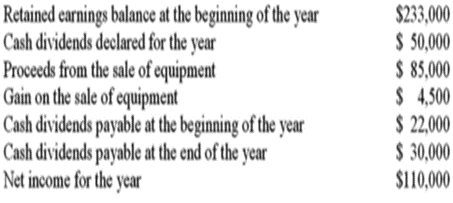
The ending balance in retained earnings is:
A. $213,000.
B. $293,000.
C. $301,000.
D. $297,500.
E. $343,000.
B. $293,000.