Acids and Bases
Nuclear
Thermodynamics
Kinetics
Solutions and Equilibrium
100
In this equation: HCO3–(aq) + H2O(l) ⇌ H2CO3(aq) + OH–(aq), what is HCO3– and what is its conjugate?
HCO3– is a base, and its conjugate acid is H2CO3
100
What is missing from the nuclear reaction shown?
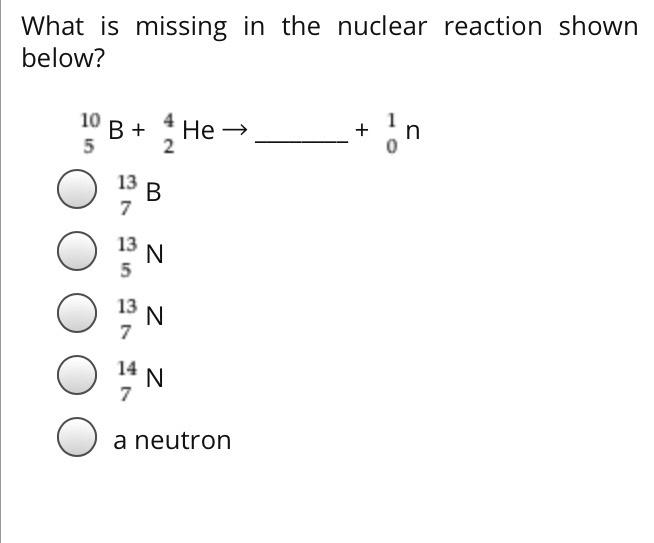
137B
100
What is the term? The enthalpy change in the formation of one mole of a compound when formed in the standard state (T=298 K, and P=1 atm) from it's elements.
Standard enthalpy of formation
100
For the reaction of N2(g) + O2(g) ⇌ 2NO(g), the equilibrium mixture is show to the right with the equilibrium constant of Kc. What is the value of Kc’ for the reaction of 2NO(g) ⇌ N2(g) + O2(g) and what does this reaction look like at equilibrium?
B
100
What is the equilibrium expression for the formation of ammonium nitrate, NH4NO3?
N2(g) + 2H2(g) + 3/2O2(g) ⇌ NH4NO3(s)
B
200
You have two acids, 1.0 M HX and 1.0 M HY, which are shown in the particulate diagrams to the right. What are the relative values of Ka and pH?
(A) Ka(HX) > Ka(HY) pH(HX) > pH(HY)
(B) Ka(HX) < Ka(HY) pH(HX) > pH(HY)
(C) Ka(HX) > Ka(HY) pH(HX) < pH(HY)
(D) Ka(HX) < Ka(HY) pH(HX) < pH(HY)
(C) Ka(HX) > Ka(HY) pH(HX) < pH(HY)
200
When radium-226 decays to form radon-222, what particle is emitted?
42α
200
What is the term? The _____ is the energy needed to raise the temperature of one gram of substance by one degree Celcius.
Specific Heat
200
Which mechanism is consistent with the energy diagram?
C
200
For the reaction of: CH4(g) + 2O2(g) ⇌ CO2(g) + 2H2O(g) ΔH < 0, which change will increase [CO2] because K increases?
Decrease T
300
What is the pH of 0.145 M CH3COOH? Ka(CH3COOH) = 1.8×10⁻⁵
2.80
300
A radioactive isotope has a half-life of 8.0 days. If you start with 120 g, how much remains after 24 days?
15 g
300
Sucrose can decompose to form carbon and water according to this equation: C12H22O11 (s)⇌12 C(s,gr)+ 11H20 (l)
ΔGx for C12H22O11=-154kJ/mol
ΔGx for H20 (l)=-237.1kJ/mol
ΔGx for C (s,gr)=0
ΔG sys=-1062
300
For a reaction, a series of experiments were carried out, and the rate of the reaction was measured over time. The generic reaction is: A⇌ products. Which statement is correct?
(A) If the plot of [A] vs. time is nonlinear, the reaction is zero order.
(B) If the plot of [A] vs. time is nonlinear, the reaction is first order.
(C) If the plot of ln[A] vs. time is linear, the reaction is zero order.
(D) If the plot of ln[A] vs. time is linear, the reaction is first order.
(D) If the plot of ln[A] vs. time is linear, the reaction is first order.
300
N2(g)+3H2(g) ⇌2NH3(g)+heat
Explain which way the reaction will shift when…
more H2 gas is added to the container
total pressure is increased by decreasing volume in the flask
temperature is decreased
argon gas is added at constant volume
catalyst is added
1. Right
2. Right
3. Right
4. No shift
5. No shift
400
What is the pH of 0.575 M ethyl amine (CH3CH2NH2)? Kb(CH3CH2NH2) = 5.6×10⁻⁴
12.254
400
Fission, fusion, or neither?
a. Two small nuclei combine to form a larger nucleus.
b. Uranium-235 splits into smaller nuclei after absorbing a neutron.
c. Hydrogen nuclei combine in stars.
d. A nucleus emits a beta particle.
a. fusion
b. fission
c. fusion
d. neither
400
Predict the ΔS for the system for each of these reactions:
A (s) ⇌ B (s)+C (s)
D (g)+E (l) ⇌F (s)+ G (g)
s⇌s+g Δsys>0
g+l⇌s+g Δs =0
400
There are two reactions with the two rate constants shown to the right. What can you conclude about these reactions?
(A) Reaction 1 is faster than reaction 2. Both reactions are first order.
(B) Reaction 1 is slower than reaction 2. Both reactions are first order.
(C) Reaction 1 is faster than reaction 2. Both reactions are second order.
(D) Reaction 1 is slower than reaction 2. Both reactions are second order.
400
Other than dispersion forces, what is the predominant intermolecular force present in a solution of methanol and carbon tetrachloride?
(A) ion-dipole forces
(B) ion-induced dipole forces
(C) dipole-dipole forces
(D) dipole-induced dipole forces
(D) dipole-induced dipole forces
500
For the titration of 1.0 M benzoic acid (C6H5COOH, Ka = 6.5×10⁻⁵) with 1.0 M NaOH, what is the pH at the equivalence point?
8.94
500
Which statement is true about beta decay?
A. The mass number decreases by 4.
B. The atomic number decreases by 1.
C. The atomic number increases by 1.
D. No particles are emitted.
C. The atomic number increases by 1
500
Find the ΔS for this reaction:
C (s,dia)+2 Br2 (g)⇌ CBr4 (g)
ΔS for C=2.4 J/mol*K
ΔS for Br2=245.5 J/mol*K
ΔS for CBr4=358.1 J/mol*K
ΔS sys= -135.3 J/mol*K
500
A series of experiments were carried out for a reaction:
2A + B⇌C
Based on the data, what is the rate law?
rate=k[A]
500
n order to determine the change in freezing point of 5.0 g of NaCl in 75 g of water, what needs to be included in the calculation?
(A) I., II., and IV.
(B) I., II., III. and IV.
(C) I., IV., and V.
(D) I., IV., V. and VI.
(D) I.,IV., V. and VI.