Oncology
Endocrine I
Endocrine II
Liver Disorders I
Liver Disorders II
100
Warning sign of cancer (1)
What is
Changes in bowel or bladder habits
A sore that does not heal
Unusual bleeding or discharge
Thickening or lump in the breast or elsewhere
Indigestion or difficulty swallowing
Obvious change in a wart or mole
Nagging cough or hoarseness
White patches inside mouth or on tongue
Unexplained fever
Unexplained tiredness / Fatigue
Weight less of 10 pounds or more
Persistent pain or discomfort
100
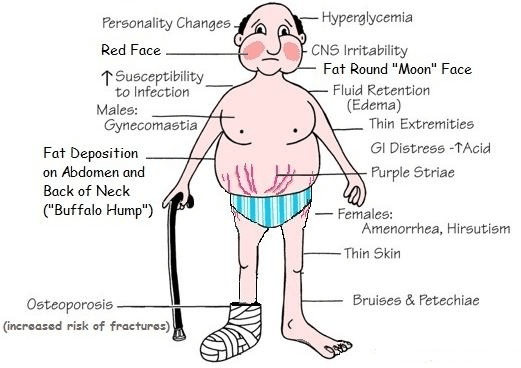
This type of “face” is seen with Cushing’s syndrome
What is a “moon face”?
First indication of Cushing syndrome may be clinical presentation
Truncal obesity (not arms/legs)
“Moon face”
Purplish/red striae of abd,
breast, or buttocks
100
The most common cause of hypoparathyroidism?
What is accidental removal of, or damage to parathyroid glands or their blood supply during neck surgery?
100
A patient with liver disease presents with ascites and esophageal varices. The nurse understands that these complications are primarily caused by:
a) Decreased production of bile
b)Increased venous pressure in the portal circulation
c) Excess glycogen storage
d) Inability of the liver to detoxify harmful substances
Rationale: b. Increased venous pressure in the portal circulation
Why - Obstructed blood flow into the liver, leading to the development of collateral channels, ascites, and esophageal varices.
- A) Decreased bile production mainly affects digestion and fat absorption, not venous pressure
- C) Excess glycogen storage affects glucose regulation, not circulation or ascites formation
- D) Inability to detoxify leads to toxin buildup but does not cause varices or ascites
100
A nurse is assessing a patient diagnosed with acute viral hepatitis. Which symptom would the nurse anticipate during the acute phase?
a) Polyuria and hypertension
b) Jaundice, dark urine, and clay-colored stools
c) Hyperactive deep tendon reflexes and hypertension
d) Increased appetite and weight gain
Rationale: b) Jaundice, dark urine, and clay-colored stools
Why dark urine? Buildup of bilirubin in the blood and excretion in the urine.
(A) Incorrect. Polyuria and hypertension are not characteristic of acute hepatitis. Instead, the patient may have nausea, anorexia, and low-grade fever.
(B) Correct. Jaundice, dark urine, and clay-colored stools are expected findings due to hyperbilirubinemia and bile flow obstruction.
© Incorrect. Hyperactive deep tendon reflexes and hypertension are not typical in acute hepatitis. The patient may have malaise, fatigue, and hepatomegaly.
(D) Incorrect. Increased appetite and weight gain are incorrect because acute hepatitis typically causes anorexia and weight loss.
200
Benign versus Malignant Tumors
What is Benign?
BENIGN TUMOR CHARACTERISTICS
Specific Morphology, Normal Chromosomes
A Smaller Nuclear-to-Cytoplasmic Ratio
Specific Differentiated Functions
Tight Adherence
Encapsulated
Slight Vascularity
No Migration/ Metastasis
Orderly, Expansive Growth
Rare Recurrence
MALIGNANT TUMOR CHARACTERISTICS
Anaplasia, Abnormal Chromosomes (Aneuploidy)
A Larger Nuclear-to-Cytoplasmic Ratio
Poorly Differentiated Functions
Loose Adherence
Rarely encapsulated
Moderate to Marked Vascularity (Angiogenesis)
Migration/ Metastasis
Contact Inhibition Does Not Occur
Heightened use of nutrients and intrinsic growth factor
Infiltrative and Expansive Growth
Pyramid effect
Doubling time
Possible Recurrence
200
Hormone that increases the calcium storage in bones
What is Calcitonin?
200
Examples of food high in Ca+ recommended for patients suffering through hypoparathyroidism
What is dark green vegs, soybeans, tofu?
200
Which of the following is not a function of the liver?
a) Storing vitamins and minerals
b) Detoxifying harmful substances
c) Producing red blood cells in an adult
d) Storing glycogen for energy use
e) Making clotting factors that stop bleeding
f) Stores energy by stockpiling glucose into glycogen
g) Makes proteins that you need to stay healthy, and grow
Rationale: C) The liver does not produce red blood cells in adults. This function primarily occurs in the bone marrow. However, in fetuses, the liver does produce red blood cells.
(A) The liver stores vitamins, minerals, and iron for future use.
(B) The liver detoxifies substances such as alcohol and medications.
(D) The liver stores excess glucose as glycogen for energy use when needed.
200
Which of the following could you attribute as an early manifestation of liver cirrhosis?
a) Mild hepatomegaly
b) Jaundice
c) Portal Hypertension
d) Peripheral edema
Rationale: a) Mild hepatomegaly
In the early stages of liver cirrhosis, mild hepatomegaly can be an early sign and is often detected during a physical examination. Fatigue and mild hepatomegaly may occur before more advanced symptoms like jaundice, portal hypertension, or peripheral edema. These later symptoms often develop as the cirrhosis becomes more severe and the liver function deteriorates.
300
Most common side effect of radiation therapy
What is bone marrow suppression?
300
This is the treatment of choice for patients suffering from Grave’s disease..
What is Radioactive iodine therapy (RAI)?
Options:
Medications
Radioactive iodine therapy (RAI) - treatment of choice
Thyroidectomy
Treatment choice based on patient age, preferences, disease severity
300
The most common feature of Cushing's syndrome?
What is weight gain?
Classic: Moon Face
Pronounced changes in body appearance
Weight gain = most common feature
Sodium / water retention
Hypertension-mineralocorticoid fluid retention
Hyperglycemia
Protein wasting (muscle weakness)
Delayed wound healing
Mood disturbances
Skin weaker, thinner
Osteoporosis—pathologic fx
Severe acne, virilization in women, feminization in men
300
Which of the following is a primary mode of transmission for Hepatitis A (HAV)
a) Blood transfusions
b) Sexual contact
c) Fecal-oral route
d) Needle sharing
Rationale: C) Fecal oral route
What are common modes of transmission for Hepatitis B and C? Blood and bodily fluids
What are examples of the fecal-oral route? Consuming food/water contaminated with feces from infected person, or consuming food prepared by someone that didn’t wash their hands.
(A) Blood transfusions are a mode of transmission for Hepatitis B and C, but not HAV.
(B) Sexual contact is a common mode of transmission for HBV and HCV but not for HAV.
© The fecal-oral route is correct because HAV spreads primarily through contaminated food or water.
(D) Needle sharing is a risk factor for HBV and HCV, but not HAV.
300
A patient presents with cirrhosis, portal hypertension and oliguria. His laboratory results show elevated BUN and Cr levels. On examination, the patient has ascites and mild peripheral edema. Which of the following interventions would you attempt first for managing his condition?
a) Initiate diuretics to reduce ascites and improve urinary output.
b) Contact the provider to suggest beginning dialysis.
c) Administer vasopressors to increase SVR and improve renal perfusion.
d) Administer fluids to restore arterial blood volume and reverse renal vasoconstriction.
Rationale: b) Contact the provider to suggest beginning dialysis
In a patient with cirrhosis and portal hypertension, the splanchnic vasodilation leads to decreased arterial blood volume, which triggers renal vasoconstriction and results in hepatorenal syndrome. The priority nursing intervention is to administer IV fluids to restore blood volume, which helps reverse renal vasoconstriction and improve renal perfusion. While diuretics or dialysis may be considered later, restoring blood volume is the first step in managing this patient’s condition.
400
Regression of cell to an immature or undifferentiated cell type. (Dysplasia, Metaplasia, Hyperplasia, Anaplasia)
What is anaplasia?
Hyperplasia: increase in the number of cells for those capable of mitotic division
Metaplasia: Reversible change in which one adult cell type is replaced by another adult cell type in response to chronic irritation and inflammation
Dysplasia: deranged cell growth of a specific tissues that results in cells that vary in size, shape, and organization (abnormal but can be reversible if irritation or inflammation removed)
Anaplasia: Regression of cell to an immature or undifferentiated cell type.
400
Most common cause for primary hyperparathyroidism.
What is benign tumor in parathyroid?
Primary
Most common cause: benign tumor in parathyroid
Age 30-70 yrs (peak 40s – 50s)
History of head / neck radiation = risk
Secondary
Compensatory response to conditions that cause hypocalcemia
Vit D deficiency, malabsorption, CKD, hyperphosphatemia
Tertiary
Hyperplasia of parathyroid = loss of negative feedback from circulating Ca
Autonomous secretion of PTH in presence of normal Ca
400
The corticosteroids decreased in secondary Addison’s disease
What is Glucocorticoid (cortisol) and androgens?
400
A nurse is reviewing a patient's liver biopsy results, which indicate fibrosis. The patient asks what this means. What is the nurse's best response?
a) "Fibrosis means your liver has developed scar tissues from long-term inflammation."
b) "Fibrosis means your liver is permanently damaged and can no longer function."
c) "Fibrosis is a normal part of the healing process and is not a concern."
d) "Fibrosis means you have end-stage liver failure and need a transplant."
Rationale : a) "Fibrosis means your liver has developed scar tissues from long term-inflammation."
Can fibrosis be reversed, and how is it treated? Fibrosis can be reversed or slowed down if treated early, particularly through antiviral therapy for viral hepatitis or lifestyle changes (ex. Cessation of alcohol use, weight management).
(A) Correct because fibrosis occurs when chronic inflammation leads to the formation of scar tissue in the liver.
(B) Incorrect because while the body attempts to heal, excessive fibrosis can lead to cirrhosis and impaired liver function.
© Incorrect because while the body attempts to heal, excessive fibrosis can lead to cirrhosis and impaired liver function.
(D) Incorrect because fibrosis is an early stage of liver damage, while cirrhosis and liver failure are more advanced stages.
400
What is the most common complaint during the chronic phase of hepatitis?
Malaise and easy fatigability
Rationale: Chronic hepatitis often causes persistent fatigue and malaise due to ongoing liver inflammation and impaired metabolism. The liver plays a role in detoxification, energy storage, and metabolism, so its dysfunction leads to feelings of exhaustion. Toxic substances (like ammonia) may accumulate in the body, contributing to muscle pain and fatigue.
Hormonal imbalances cause aches and pains!
500
BRCA 1, BRCA 2 are tumor markers for this
What is Breast/Ovarian Cancer?
AFP- Liver and Germ cell carcinomas
Beta HCG- Choriocarcinoma and Germ cell Tumors
BRCA 1, BRCA 2- Breast and Ovarian Cancer (Gene mutation)
CA-125- Ovarian Cancer
CEA- Colorectal Cancer
PSA- Prostate Cancer
500
The three primary features of addison’s disease.
What is
Progressive weakness / fatigue
Weight loss
Anorexia
Manifestations – slow onset
Progressive weakness / fatigue
Weight loss
Anorexia
Skin hyperpigmentation (sun exposed areas/joint folds) - ACTH
Hyponatremia / Salt craving
Hyperkalemia
N/V, diarrhea
Hypercalcemia
Complications
Addisonian Crisis — emergency caused by sharp drop in adrenocortical hormones
500
The medication is used to inhibit synthesis of thyroid hormones for patients with Grave's disease and in their 1st trimester of pregnancy.
What is the Propylthiouracil (PTU) ?
Meds (pts who have high likelihood of remission):
Inhibit synthesis of thyroid hormones
Methimazole (preferred – less side effects)
Slower rate of action but is more potent
Propylthiouracil (PTU) – 1st trimester of pregnancy
Iodine – Lg doses rapidly inhibit synthesis of T3 + T4
β-blockers – symptomatic relief of thyrotoxicosis
Block sympathetic stimulation:
Decrease tachycardia
Decrease nervousness / irritability
Decrease tremors
500
A nurse is caring for a patient with chronic viral hepatitis. Which finding would indicate the disease is progressing toward cirrhosis?
a) Increased albumin levels
b) Decreased liver enzyme levels
c) Persistent jaundice and ascites
d) Improvement in liver function tests
Rationale:
What are other signs? Edema, easy bruising, fatigue, itching, and mental confusion (Hepatic encephalopathy).
Why jaundice? The liver can no longer effectively process bilirubin, leading to its buildup in the blood
(A) Incorrect because albumin production decreases as liver function worsens.
(B) Incorrect because while enzymes may decrease in end-stage disease, active hepatitis or cirrhosis usually causes increased liver enzymes.
© Correct because jaundice (due to impaired bilirubin processing) and ascites (due to portal hypertension and low albumin) are signs of worsening liver disease.
(D) Incorrect because this would indicate recovery rather than progression toward cirrhosis.
500
What are possible neurological symptoms associated with liver disease due to toxin accumulation?
Answer: Confusion, nausea, loss of appetite, hepatic encephalopathy
Rationale: Toxins, particularly ammonia, accumulate in liver disease and affect brain function, leading to confusion, nausea, and appetite loss. In severe cases, this can progress to hepatic encephalopathy, causing more profound neurological impairment.