F&E/
ABG/IVs
ABG/IVs
The nurse hears the IV pump alarming & sees the following upon assessment:
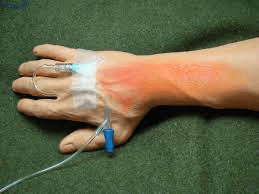
The first action the nurse should take.
What is remove the IV and start one in a new location.
An example of a Type 1 hypersensitivity reaction.
What is anaphylaxis, allergic asthma, hay fever, angioedema, and allergies to latex, bee venom, iodine, peanuts, etc?
Patient's with COPD experience this type of heart failure.
What is right-sided or cor pulmonale?
The lab to monitor therapeutic levels of warfarin.
What is INR?
The higher the number, the thinner the blood?
High cortisol levels are an indicator of this disease process.
What is Cushing's disease?
There are this number of liters in a kilogram.
What is one?
Hypoventilation leads to this ABG abnormality.
What is respiratory acidosis?
(retaining CO2)
A reason a patient may be on contact precautions and the PPE required.
What is MRSA, VRE, or Cdiff
& Gloves and Gown?
A mediastinal shift & distended neck veins indicates this type of life-threatening condition.
What is tension pneumothorax?
Identify the rhythm:
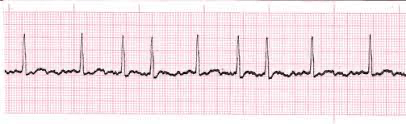
Patients who have this dysrhythmia are also at high risk of developing this.
What is Atrial Fibrillation (Afib) & blood clots?
Nutrition management for hypoglycemia.
What is the 15-15 rule?
The medical terminology used to described the production of abnormally small amounts of urine.
What is oliguria?
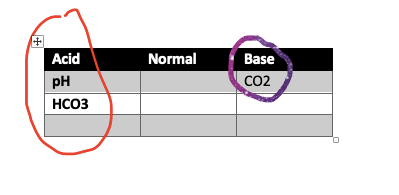
The ABG interpretation of the following values:
pH = 7.30
CO2 = 33
HCO3 = 19
What is metabolic acidosis with partial compensation?
Stridor is described as this and indicates this.
What is a high-pitched breathing sound & obstructed airway?
Immediate assistance needed.
The acronym for initial management of an MI.
What is MONA?
Morphine, Oxygen, Nitroglycerin, Aspirin
Critically high potassium levels and critically low cortisol levels occur in this disease process.
What is Addison's disease?
The nurse is caring for a client with an oral temperature of 37.8 degrees Celsius.
The nurse's most appropriate action at this time. Explain.
What is continue to monitor?
Normal range is 35.5 - 37.5 C; 95.9 - 99.5 F. Fever is considered over 38 C (100.4 F)
The nurse is caring for a patient that is over-hydrated. The expectation of the following values (low, normal, or high):
Sodium (Na); BUN/Cr; H/H
AND the order the nurse could expect.
What would be low for all 3 labs and a fluid restriction order?
Over-hydration = dilution
Informed consent is explained as this and the nurse's role for informed consent is described as this.
What is the pt understands procedure and risks & the nurse must ensure consent is obtained and signed prior to procedure?
(We do not explain the consent form. That is the surgeon's responsibility.)
4 teaching points for a patient who has a newly implanted pacemaker.
What is...
Be careful when moving the side with pacemaker
No baths/swimming
Watch for signs of infection
Batteries usually good for 10 years, check by calling to ensure battery life is good
Check pulse daily, ensure it matches set rate
ID bracelet/card
Alert security in airports that you have a pacemaker
No MRIs
No pads over pacemaker during defib/cardioversion
The type of insulin in a continuous insulin drip for diabetic ketoacidosis.
A UAP cannot perform these 3 things for patients.
What is evaluation of care, assessment, and teaching?
(Do not delegate what you cannot EAT)
4 safety measures when performing endotracheal suctioning.
What is..
catheter no more than half the diameter of the artificial airway;
performed as a sterile procedure;
suction at 80-120 mm HG, shallow suctioning;
avoid normal saline installation;
hyperoxygenate pt with 100% O2;
suction on withdrawal only;
suction no longer than 10-15 seconds;
suction only as needed.
The 6 Ps related to a cardiovascular assessment regarding circulation.
What is Paresthesia; Pallor; Pain;Polar/Poikilothermia; Pulselessness; Paralysis?
The subcutaneous injection for hypoglycemia.
What is glucagon?
5 signs & symptoms of digoxin toxicity and the antidote used.
What is Hypokalemia, bradycardia, dysrhythmias, anorexia, fatigue, muscle weakness, changes in mental status, vision changes
and digibind?