The Experiment
Chemistry
Biology
Physics
100
What is the another name for Ca(OH)2?
Limewater
100
Define the term used for a gaseous substance that harms living organisms or the environment when present in the atmosphere.
 Air pollutant
100
Identify the primary organ system affected by inhaled air pollutants.
Respiratory System
100
What physical property makes certain gases act as greenhouse gases in the atmosphere?
Ability to absorb infrared (IR) radiation
Greenhouse gases can absorb long-wave infrared radiation emitted by Earth’s surface.
Molecular vibrations that interact with IR
Their molecular bonds can vibrate or bend, allowing them to interact with infrared wavelengths.
Change in dipole moment during vibration
For a molecule to absorb IR, its vibration must change the dipole moment of the molecule.
Re-emission of infrared radiation
After absorbing energy, the molecule re-emits IR radiation in all directions, including back toward Earth.
200
What happens to the pH of the solution when CO₂ is blown into it?
pH decreases.
200
Name the atmospheric layer where most weather and air pollution processes occur.
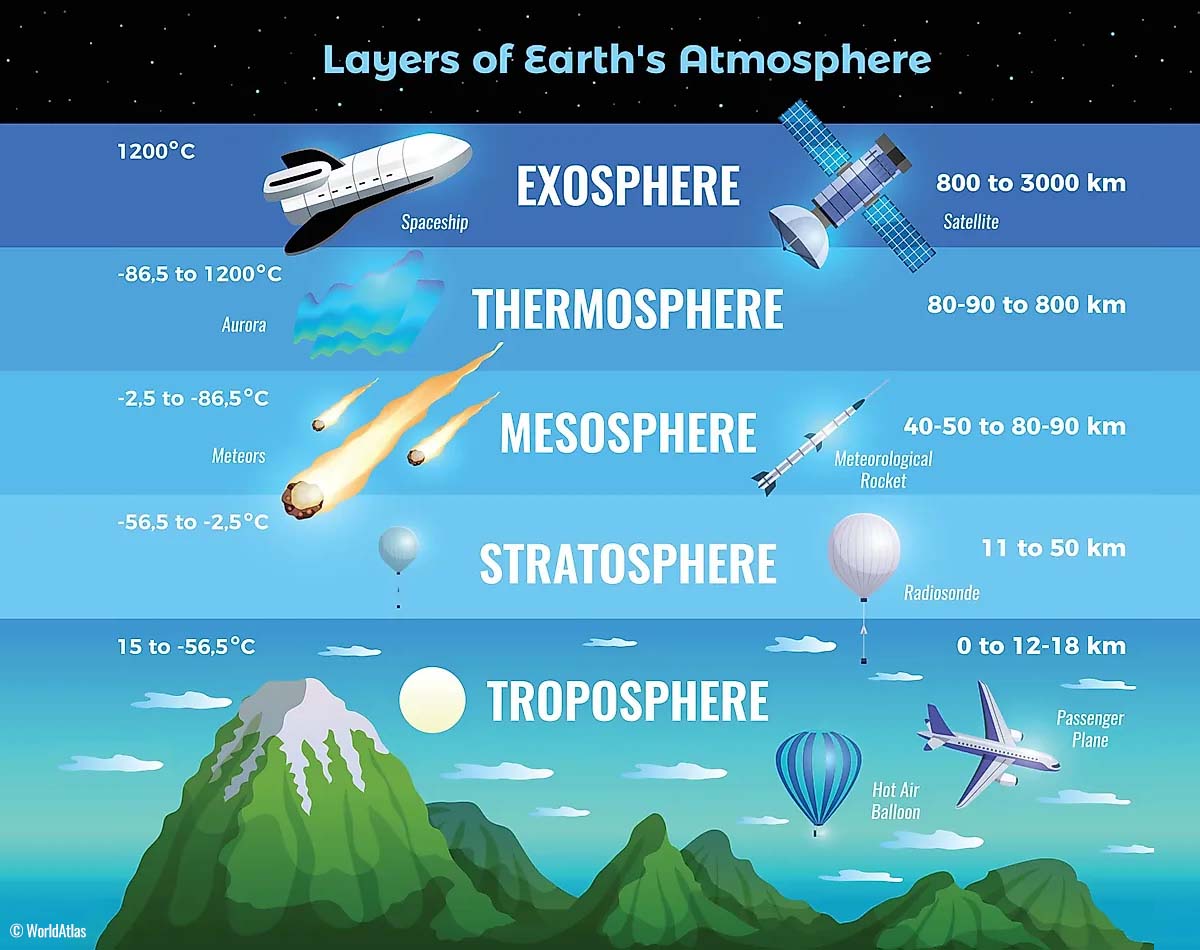 Troposphere
200
How does air pollution affect photosynthesis in plants?
Pollutants can damage leaf tissues.
Particles block sunlight reaching leaves.
Stomata may be clogged.
Photosynthesis rate decreases.
200
From a physics perspective, what would happen to Earth's temperature if there were no greenhouse gases in the atmosphere?
Without greenhouse gases, the Earth would lose heat much faster to space because infrared radiation from the surface would escape freely.
300
Write the equation for this experiment forming CaCO3 as a product.
CO2(g)+Ca(OH)2(aq)→CaCO3(s)+H2O(l)
300
What is the term for the characteristic hazy brown air pollution commonly seen over large cities in sunlight?
Photochemical smog
300
Explain how indoor air pollutants like carbon monoxide disrupt oxygen transport in the human body.
CO binds to hemoglobin with an affinity about 400 times greater than O2, forming carboxyhemoglobin. This reduces the blood's O2-carrying capacity.
300
Describe how black carbon soot deposited on snow and ice influences climate.
Black carbon lowers the albedo of snow and ice surfaces by darkening them causing more solar radiation to be absorbed rather than reflected. This leads to enhances local warming and accelerated melting.
400
When you blow more CO₂ into the limewater after the white precipitate forms, the solution becomes clear again. What soluble compound is formed?
Calcium hydrogen carbonate, Ca(HCO₃)₂
400
Identify the process in which metallic particles such as Fe undergo oxidation in the atmosphere, generating soluble ions that can further participate in redox cycle.
Corrosion
400
Define global warming potential and state what it compares
Global warming potential is a metric that compares the integrated radiative forcing of 1kg of a gas to that of 1kf of CO2 over a specified time horizon, typically 100 years..png.aspx?width=1360)
400
What physical mechanisms cause Earth’s temperature to increase due to greenhouse gases?
Solar radiation enters Earth’s atmosphere mainly as short-wave radiation (visible light).
Earth absorbs this energy at the surface (land and oceans).
The Earth re-emits energy as long-wave infrared radiation (IR).
Greenhouse gases (CO₂, CH₄, H₂O) absorb infrared radiation emitted from the surface.
These molecules re-emit the radiation in all directions.
Some of this radiation is sent back toward the surface, trapping heat.