Trig.
Inverse Trig.
Radians
Degrees
Formulas
100
Find x and H in the right triangle below.

x = 10 / tan(51°) = 8.1 (2 significant digits)
H = 10 / sin(51°) = 13 (2 significant digits)
100
sin -1 (1)
π/2 or 90º
100
360 degrees
2π radians
100
7π/6 rad
210 deg
100
sine formula
opposite over hypotenuse
200
Find the lengths of all sides of the right triangle below if its area is 400.


Area = (1/2)(2x)(x) = 400
Solve for x: x = 20 , 2x = 40
Pythagora's theorem: (2x)2 + (x)2 = H2
H = x √(5) = 20 √(5)
200
sin -1 (√3/2)
π/3 or 60º
200
180 degrees
π radians
200
5π/6 rad
150 deg
200
cosine formula
adjective over hypotenuse
300
BH is perpendicular to AC. Find x the length of BC.
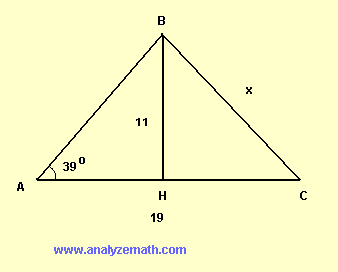
BH perpendicular to AC means that triangles ABH and HBC are right triangles. Hence
tan(39°) = 11 / AH or AH = 11 / tan(39°)
HC = 19 - AH = 19 - 11 / tan(39°)
300
π/4 or 45º
sin -1 (√2/2)
300
Degrees to radians
Multiply degrees by π/180 for radians
300
2π/3 rad
120 deg
300
tangent formula
opposite over adjacent
400
ABC is a right triangle with a right angle at A. Find x the length of DC.

Since angle A is right, both triangles ABC and ABD are right and therefore we can apply Pythagora's theorem.
142 = 102 + AD2 , 162 = 102 + AC2
Also x = AC - AD
= √( 162 - 102 ) - √( 142 - 102 ) = 2.69 (rounded to 3 significant digits)
400
sin -1 (0)
0 or 0º
400
30 deg
π/6 rad
400
π/4 rad
45 deg
400
Pythagorean formula
a^2+b^2=c^2
500
In the figure below AB and CD are perpendicular to BC and the size of angle ACB is 31°. Find the length of segment BD.

Use right triangle ABC to write: tan(31°) = 6 / BC , solve: BC = 6 / tan(31°)
Use Pythagora's theorem in the right triangle BCD to write:
92 + BC2 = BD2
Solve above for BD and substitute BC: BD = √ [ 9 + ( 6 / tan(31°) )2 ]
= 13.4 (rounded to 3 significant digits)
500
sin -1 (-1/2)
-π/6 or -30º
500
315 deg
7π/4 rad
500
π/6 rad
30 deg
500
heron's formula
area = square root of s(s-a)(s-b)(s-c), where = 1/2absinC