Simplifying Radicals
Exp. Prop. (Challenge)
Exponent Properties
Exponential Functions
Growth and Decay
100
sqrt(125)
5sqrt(5)
100
(x^4)^-3*(2x^4)
2/x^8
100
(x^2)^0
1
100
Write the exponential function represented by the graph: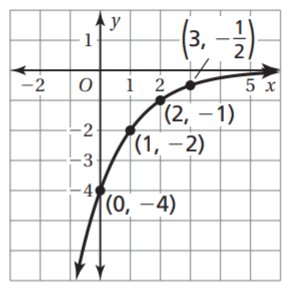
y=-4(1/2)^x
100
Does the following graph represents exponential growth or decay?
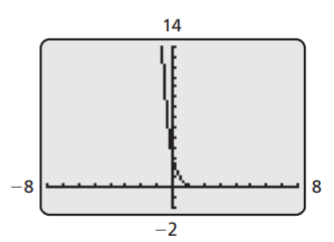
Exponential decay
200
-5sqrt(80)
-20sqrt(5)
200
(2m^-4)/(2m^-4)^3
m^8/4
200
(4v^3)(2vu^2)
8v^4u^2
200
Does the table represent a linear or exponential function?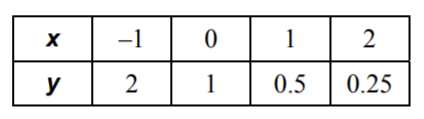
Exponential function
200
Write the rate of growth/decay rate of the following function as a percent:
y=12(0.9)^t
Decay rate: 10%
300
3sqrt(12)sqrt(6)
18sqrt(2)
300
(2x^0y^2)^-3*2yx^3
x^3/(4y^5)
300
(4a^3)^2
16a^6
300
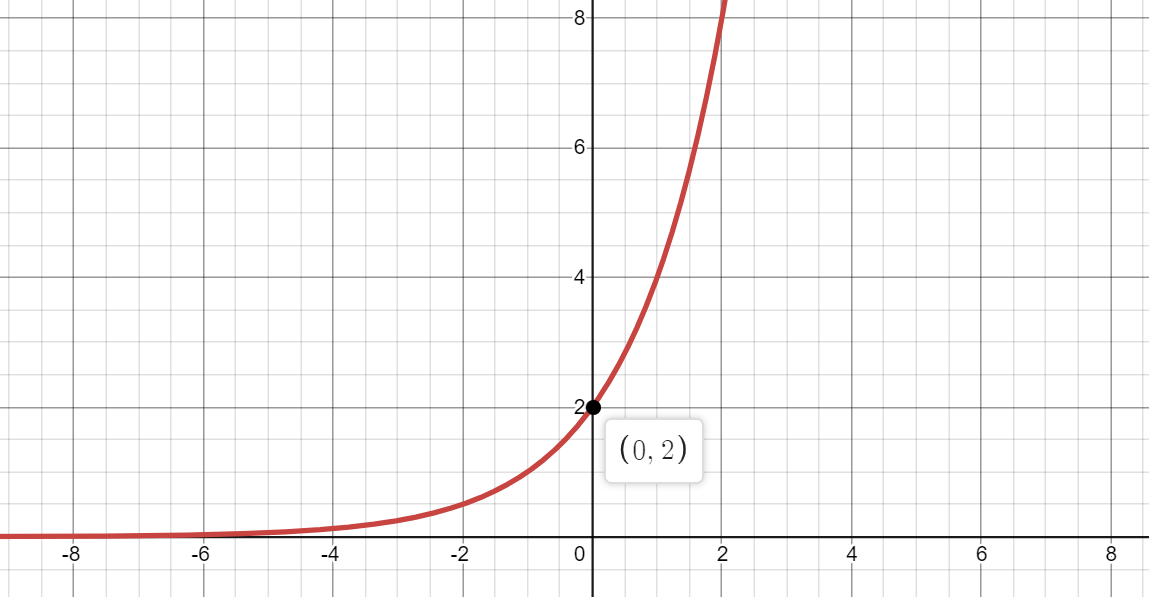
Graph the function:
y=2(2)^x
300
Determine the initial amount and the growth/decay rate (as a percent) of the following function:
g(t)=85.5(3)^t
Initial amount: 85.5
Growth rate: 200%
400
sqrt(5)/sqrt(3)
sqrt(15)/3
400
((x^-3)^4x^4)/(2x^-3)
1/(2x^5)
400
(11x^2y^-1)^2
(121x^4)/y^2
400
Evaluate the following function when
x=-2:
y=3(1/2)^x-4
y=8
400
The number of new businesses in a city has been increasing by 5% annually from 2010. In 2010, the number of new businesses was 40. Write an exponential function to model this situation.
y=40(1.05)^t
500
(3sqrt(4))/(2sqrt(20))
(3sqrt(5))/10
500
((2p m^-1q^0)^-4*2m^-1p^3)/(2pq^2)
m^3/(16p^2q^2)
500
(2h^3j^-3k^4)/(3jk^2)
(2h^3k^2)/(3j^4)
500
Determine the domain and range of the following function:
y=2(2)^x-1
Domain: All Real Numbers
Range: y>-1
500
A town has a population of 24,000. The population is expected to decrease by 2.5% annually for the next 20 years. Write a function that represents this situation.
y=24000(.975)^t