Inverse Variation
Adding/Subtracting
Multiply/Divide
Asymptotes
Simplify/Solving
100
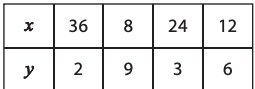 Does this table represent inverse variation? If so what is the K?
Yes, 72
100
4/(x+3) + 5/(x-3)
(9x+3)/((x+3)(x-3)
100
Multiply.
(3r^3+3r^2)/(r^2+6r+5) * (r+5)/6
(3r^2)/6
100
What are the horizontal and vertical asymptotes?
1/(x+3) +4
y=4 x=-3
100
Simplify.
((2x)/25-25/2)/4
(4x-625)/200
200
In an inverse variation, x=10 when y=3. Write an equation to represent the inverse variation.
Possible Options:
xy=30
(10)(3)=k
200
1/(n-3)+8
(8n-23)/(n-3)
200
Multiply.
2/(7k^2) * (7k^3-42k^2)/2
k-6
200
What are the horizontal and vertical asymptotes?
1/(x-5) -2
y=-2 x=5
200
Simplify.
(x^2/3 +x^2/4)/(x/12)
7x
300
y varies inversely with x. If x=6 when y=1/2, find the value of y when x=15.
y=0.2
300
(p-6)/(p-2) + 3/(2p^2)
(2p^2-12p^2+3p-6)/(2p^2(p-2))
300
Divide.
1/(r-4) divide 6/(r^2+2r-24)
(r+6)/6
300
What are the horizontal and vertical asymptotes?
(x^3+2x^2-4x+5)/(x^2+6x+8)
No horizontal asymptotes
x = -4 x = -2
300
Solve. Check for extraneous solutions.
(k+2)/(4k^2) + 1/(K^2) = 1/(2k^2)
k=-4
400
X varies inversely with y, if x =-8 when y=-1/4, what is the value for x when y=4?
x=1/2
400
3/(k-2) - 5/(2k+3)
(k-19)/((2k+3)(k-2))
400
Divide.
(k^2+8k+12)/(k^2+k-30) divide (k+2)/(2k^2)
(2k^2)/(k-5)
400
What is the domain, vertical and horizontal asymptotes, are there any holes?
(x^2-x-6)/(x^2-2x-3)
y=1
x=-1
Hole at 3
D: x cannot equal 3 and -1
400
Solve Check for extraneous solution.
1/(n-7) = 7/(n-7) - 1
n=13
500
Which equation(s) model inverse variation?
A) y =12x
B)
y=x/2
C) xy= 9
D)
y=12/x
C and D
500
(2k)/(k-6) - 6/(k-4)
(2k^2-14k+36)/((k-4)(k-6))
500
Divide.
(7x+1)/(63x^2+9x) divide (2x-6)/(9x^2+72x)
(x+8)/(2(x-3))
500
What is the domain, vertical and horizontal asymptotes, are there any holes?
(2x -1)/(x^2 -3x-10)
H.A. y=0
No Holes
V.A. x=5 x=-2
D: x cannot equal 5 and -2
500
Solve and check for extraneous solutions.
1/(b^2+8b+7) - 1/(b+7) = 1/(b+1)
b= -3.5