Trigonometric Functions
Logarithms
Rational Equations
The Unit Circle
Vocabulary
400
Find sin Θ :

Answer:
sin Θ = 4/5
Explanation:
sin= opposite/hypotenuse
Opposite of Θ is 8 and the hypotenuse is 10
So 8/10= 4/5
sin Θ = 4/5
400
Solve:
Log21 = x
Answer:
x = 0
Explanation:
Log21 = 2x = 1 and Log21 = x
Anything raised to the zero is 1
so x = 0
400
Simplify:
2x-1/x2+2 - 4x+4/x2+2
Answer:
-2x-5/x2+2
Explanation:
(2x - 1)-(4x + 4)/x2+2
= -2x-5/x2+2
400
Convert to Radians:
2 degrees
Answer:
pi/90 radians
Explanation:
(2 degrees)(pi/180) = 2pi/180 = pi/90 radians
400
The unit used for angle measurement.
What is degrees?
800
Find Cos θ :
Answer:
Tan θ = 12/13
Explanation:
Cos = adjacent/hypotenuse
We first must find the hypotenuse using pythagorean theorum.
52 + 122 = x2
25 + 144 = 169
square root of 169 = 13
Cos θ = 12/13
800
Solve:
log5x = 2
Answer:
x=25
Explanation:
52 = x
52 = 25
x=25
800
Solve the equation and find the solution(s) for:
x + 8/x = 6
Answer:
x=4 x=2
Explanation:
(x + 8/x = 6)x
x2 + 8 =6x
x2 - 6x + 8 =0
(x - 4)(x - 2) =0
x=4 x=2
Check for extraneous solutions
4 + 8/4 =6
2 + 8/2 =6
800
Convert to degrees:
pi/2 radians
Answer:
90 degrees
Explanation:
(pi/2)(180/pi) = 180/2 = 90 degrees
800
The angle formed by the line of sight and the horizontal plane for an object below the horizontal.
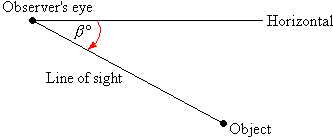
What is the angle of depression?
1200
From a point on the ground 47 feet from the foot of a tree, the angle of elevation of the top of the tree is 35º. Find the height of the tree to the nearest foot.
*calculator required*
Answer:
33 feet
Explanation:
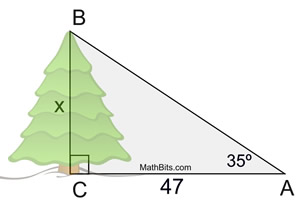
To get x, we have to do Tan 35 degrees.
Tan 35 = x/47
Tan 35 · 47 = x
x ≈ 33
1200
Solve:
log3(x - 5) = 2
Answer:
x = 14
Explanation:
32 = x - 5
9= x - 5
9 + 5 = x
x=14
1200
Solve the equation and find the solution(s):
6x/x+4 = 7x+4/x+4
Answer:
NO SOLUTIONS
Explanation:
(7x + 4)(x + 4)/x+4 = 6x(x + 4)/x+4
7x + 4 = 6x
7x -6x = -4
x= -4
Check for extraneous solutions:
6(-4)/-4+4 = 7(-4)+4/-4+4
You can't have 0 in the denominator so -4 would not work. Therefore, there is no solution.
1200
Convert to degrees:
11pi/12
Answer:
165 degrees
Explanation:
(11pi/12)(180/pi) =1980/12 = 165 degrees
1200
The exponent to which a specified base is raised to obtain a given value.
What is a logarithm?
1600
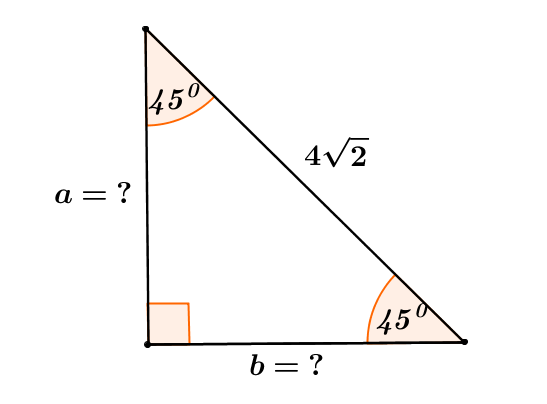
Find cosecant of 45 (the bottom one):
Answer:
√2
Explanation:
Cosecant= hypotenuse/opposite
sin 45 = a/4√2
sin 45 · 4√2 = a
a = 4
csc 45 = 4√2/4 = √2
1600
Solve:
log4x2 = 7
Answer:
x = 128
Explanation:
2 · log4x = 7
log4x = 7/2
47/2 = x
x = 128
1600
Solve the equation and find the solution(s) for:
x+2/x-3 + x/5 = 5/x-3
Answer:
x= -5
Explanation:
(x+2/x-3 + x/5 = 5/x-3) · 5(x - 3)
5(x + 2) + x(x - 3) = 25
5x + 10 + x2 - 3x = 25
x2 + 2x - 15 =0
(x + 5)(x - 3) =0
x= -5 x=3
Check for extraneous solutions
-5+2/-5-3 +-5/5 = 5/-5-3
3/8 + -1 = 5/-8
3+2/3-3 + 3/5 = 5/3-3
There can't be a 0 in the denominator so 3 is not a solution
1600
Convert to Radians:
396 degrees
Answer:
11pi/5 radians
Explanation:
(396 degrees)(pi/180) = 396pi/180 = 11pi/5 radians
1600
A line that the graph of a rational function approaches as it moves to infinity.
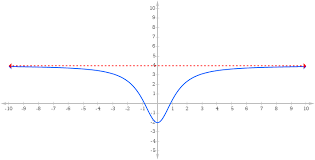
What is an asymptote?
2000
Find all 6 basic trig functions:

Answer:
sin θ = √7/4 cos θ = 3/4 tan θ = √7/3
csc θ = 4√7/7 sec θ = 4/3 cot θ = 3√7/7
Explanation:
First, we must use pythagorean theorum to find the missing side of the triangle
92 + x2 = 122
81 + x2 = 144
144 - 81 = x2
63 = x2
3√7 = x
Find all 6 basic trig functions:
Sin θ = 3√7/12 = √7/4
Cos θ = 9/12 = 3/4
Tan θ = 3√7/9 = √7/3
csc θ = 12/3√7 = (12/3√7)(√7/√7) = 12√7/3·7
=12√7/21 = 4√7/7
sec θ = 12/9 = 4/3
cot θ = 9/3√7 = (9/3√7)(√7/√7) = 9√7/ 3·7
= 9√7/21 = 3√7/7
2000
Solve:
logx + log(x + 9) = 1
Answer:
x = 1
Explanation:
Since no log is written we assume it has a common log of 10
log10x + log10(x + 9) = 1
logx(x + 9) = 1
log(x2 + 9x) = 1
101 = x2 + 9x
0= x2 + 9x - 10
0 = (x + 10)(x - 1)
x= -10 x= 1
You can't have a negative with logarithms so the only solution is x = 1
2000
Simplify:
6x/2x2+10x · 3x2-75/x2-3x-10 ÷ 3x2+12-63/x2+9x+14
Answer:
3/(x - 3)
Explanation:
Factor: 6x/2x(x + 5) · 3(x2 - 25)/(x - 5)(x + 2) · (x + 7)(x + 2)/3(x2 + 4x - 21)
= 6x/2x(x + 5) · 3(x + 5)(x + 5)/(x - 5)(x + 2) · (x + 7)(x + 2)/3(x + 7)(x - 3)
= 6x/2x(x + 5) · 3(x + 5)/(x + 2) · (x + 2)/3(x - 3)
= 3 · 3 · 1/3(x - 3)
= 3/(x-3)
2000
Convert to degrees:
23pi/4
Answer:
1035 degrees
Explanation:
(23pi/4)(180/pi) = 4140/4 = 1035 degrees
2000
A solution of an equation derived from an original equation that is not a solution of the original equation.
What is an extraneous solution?