Name Sets of R # S
PROPERTIES, REPLACEMENT & SIMPLIFY
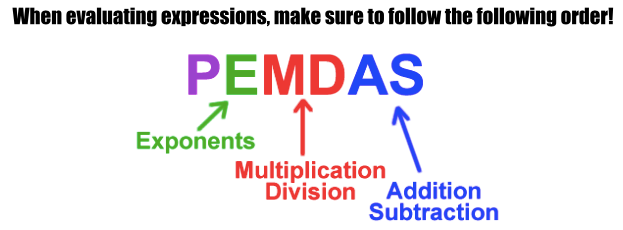
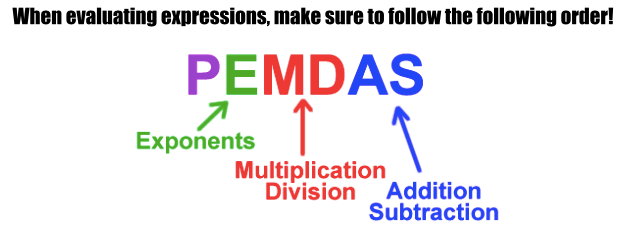
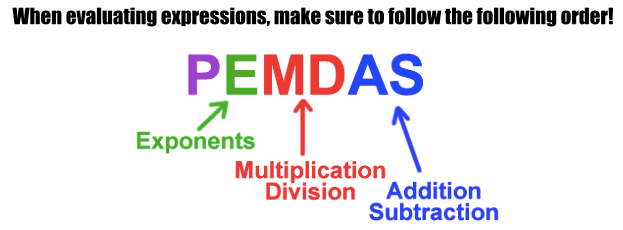
Order of Operation
Solve Equations & simplify equations
Word problems & Literal equations
100
Name ALL sets of the real number system that contain the number:
−8
Integer, Rational, Real
- −8 is a negative whole number → Integer (Z)
- −8 can be written as −8/1 → Rational (Q)
- All rational numbers are real → Real (R)
100
Name the property that justifies the situation.
-7x2+ 5 = 5 + (-7x2)
Commutative Property of Addition
The order of the numbers changes, but the sum remains the same.
100
Simplify
(9 -15)2 * (7 -22) - | -5|
Sq Rt 49 + 5
Answer:
36 * (3) - |-5|= 108/12 = 9 -5
12
= 4
100
-9 – (18v – 5) = 2(7v – 16) – 3v
-9 -18v + 5 = 14v - 32 -3v
-18v -4 = 11v -32
-29v = -28
v = 29/28
100
Solve for x
Px+Qx=R
Step 1: Factor out the x from Px +Qx
x(P+Q)=R
Step 2: x(P + Q) = R
Divide by sides by (P+Q)
x = R/P + Q
200
Name ALL sets of the real number system that contain:
0
Answer: W, Z, Q, R
0 is a whole number → W
Integers include … −2, −1, 0, 1, 2 … → Z
0 = 0/1 → Q
Plus All rational numbers are real → R (Real Numbers)
200
Name the property that justifies the situation.
5(x + 3) = 5x + 15
Distributive Property
5(x + 3)
= 5x + 5(3)
= 5x + 15
200
Simplify: 4x + 7 − 2x + 9
2x + 16
200
3(n + 11) – 5n = -2(n – 12) + 9
3n + 33 - 5n = -2n + 24 + 9
-2n + 33 = -2n + 33
All Real Numbers
200
Solve for w
2mw = k + 5nw
w = k + 5nw
2m
300
Name ALL sets of the real number system that contain:
√49
√49 = 7
Natural, Whole, Integer, Rational, Real
300
Name the Property
2x * 3 = 1
3 2x
Multiplication Inverse
300
Evaluate each expression given the variable replacements if a =3, b =-4, and c = 8
a*b2
c+ 12
3*(-4)2 /8 + 12 = 48/20 = 12/5
300
Solve the Equation
5/6w + 21 = -1/3(2w - 9)
(-1)5/6w + 21 = (-2/2)|-1/3(2w - 9)|
-5/6w - 21 =2/6(2w - 9)
-5/6w - 21 = 4/6w -18/6
-5/6w - 21 = 4/6w -3
-18 = 9/6w
-18 = 3/2w .... -36 = 3w.... w = -12
300
solve for L
A = 1 (L x h)
2
L = 2a
h
400
Determine whether the following statement is TRUE or FALSE using the closure property. If FALSE, give a counterexample.
The sum of two irrational numbers is always irrational.
Answer: FALSE
Counterexample:
√2 + (−√2) = 0
0 is rational, not irrational.
400
Name the property that justifies each equation. Be careful — there is more than one property being used.
(x + 4) + (−4) = x + [4 + (−4)]
4 + (-4) = 0
Associative Property of Addition
(x + 4) + (−4)
= x + [4 + (−4)]
Inverse Property of addition 4 + (−4) = 0
400
3(3a - 5a) - (a - 7b)
9a -15a -a + 7b = -7a + 7b
400
Solve
5x + 6 = 7
3x - 9 3
x = 27/2
400
The length of a rectangle is three centimenter less than twice the width. If the perimeter of a rectangle is 18 cm find it's demension.
Let width = x
Let length = 2x - 3
P = 2w + 2l
18 = 2x + 2(2x -3)
18 = 6x -6 Therefore x =4
500
Determine whether the statement is TRUE or FALSE. If FALSE, give a counterexample.
The product of two irrational numbers is always irrational.
FALSE
Counterexample:
√2 · √2 = 2
2 is rational.
500
Evaluate and simplify when a = −2 and b = 3.
2a² − 3(a − b) + 4b
Answer: 35
2(−2)² − 3(−2 − 3) + 4(3)
= 2(4) − 3(−5) + 12
= 8 + 15 + 12
= 35
500
Simplify by distributing and/or combining like terms
7x(5 -y) -3(9x + 2) - 4xy
500
Solve for for x
x - y = 3
2z
uesiton: Bonus Qchallenge QUESTION: Simplify completely: 2[3x − 4(2x − 5)] + 7x
x = 6z + y
challenge ANSWER: 2[3x − 8x + 20] + 7x = 2[−5x + 20] + 7x = −10x + 40 + 7x = −3x + 40.
500
The length of a rectangle is 7 inches more than its width. If the perimeter of a rectangle is 66 in find it's dimensions.
Let width = x
Let length = x + 7
P = 2x + 2(x + 7)
66 = 4x + 14
52 =4x 13 = x