Back and Forth
Choppin' Wood
Solve 'Em
Exponent Rules!
Graphically Speaking
100
Convert this logarithmic function into an exponential function:
log_2(32)=5
2^5 = 32
100
Evaluate:
log_5(125)
3
100
Solve:
log_x(64)=6
x=2
(2^6 = 64)
100
2^3xx2^2 = 2^x
x = 5
100
The graph of f(x)=4(3)^x-2 is below.
What is the y-intercept of the function, f(x)?
[Remember how we write points.]
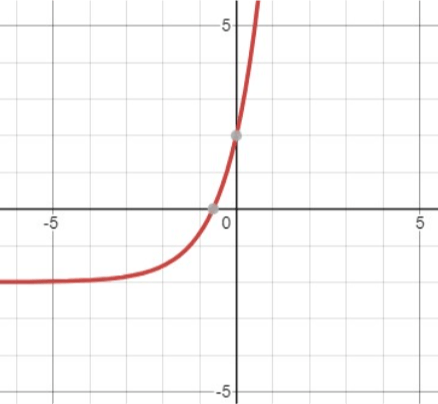
(0,2)
200
Convert this exponential function into a logarithmic function:
15^2 = 225
log_15(225)=2
200
Evaluate:
log_4(1/64)
-3
200
Solve:
log_2(x)=-3
x=1/8
200
(3^2)^3
3^6
OR
729
200
The graph of f(x)=4(3)^x-2 is below.
What is the equation for the asymptote of f(x)?
y=-2
300
Determine which student correctly completed the problem, explain the errors in the incorrect work.
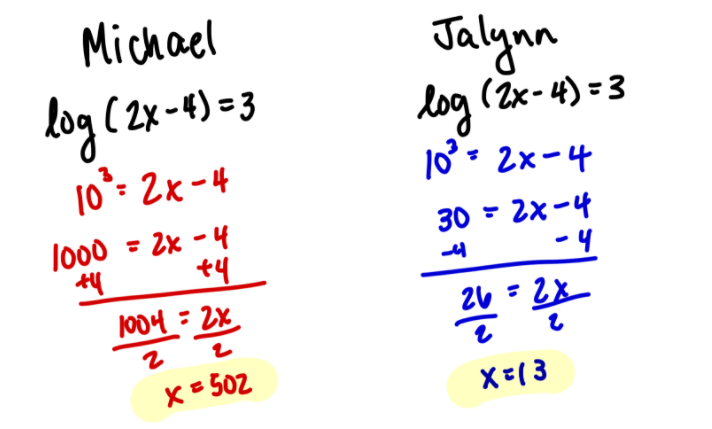
Michael is correct, Jalynn is incorrect. 10^3= 1000 not 30, she also did not use inverse operations and subtracted 4 from both sides.
300
Evaluate
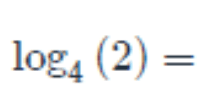
1/2
300
Solve:
log_3(4x-5)=3
x=8
300
Simplify with positive exponents:
4^3/(4^6)
4^-3
is NOT the final answer, because it doesn't have a POSITIVE exponent.
1/4^3 or 1/64
300
The graph of f(x)=3(2)^x+1 is below.
What is the domain of the function, f(x)?
[Remember how we write domain.]
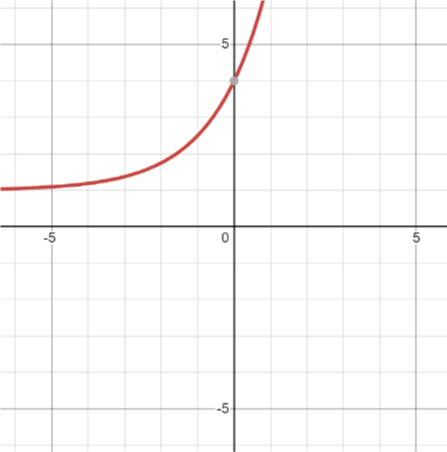
D: All real numbers or R
400
What is this function in exponential form:
log(0.0001)=-4
10^-4=0.0001
400
log(x)=0
ANYthing to the zero exponent equals... one.
1
400
Solve for the x-intercept:
f(x) = log(x+5)
x = -4 or (-4,0)
400
Solve for p.
(7^(2/3))(7^(1/3))^4 = 7^p
p = 2
400
The graph of f(x)=3(2)^x+1 is below.
What is the range of the function, f(x)?
[Remember how we write range.]
R: y>1