Polynomial and
Rational
Functions
Rational
Functions
The behavior of the graph of a polynomial function to the far left or the far right is called its ____ behavior.
And it depends upon the ____ term(s)
End, leading
Find the domain of the following rational function.
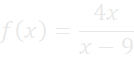
The domain of f(x) is restricted to
(-∞,9)U(9,∞)
Use the graph of the function f to solve the inequality.
(a) f(x)< 0
(b) f(x)>0
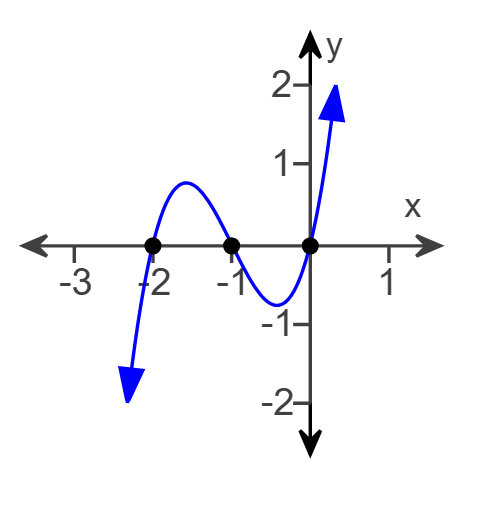
(a).
(b).
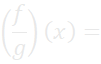
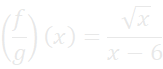
For f(x)=√x and g(x)= x- 6, find the following function.
Does the graph represent a function that has an inverse? (Use the Horizontal Line Test)
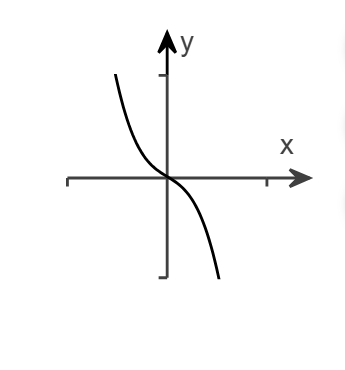
Yes. (Horizontal line hits the graph ONLY once)
Fill in the blanks so that the resulting statement is true
The graph of f(x)=x3_____ to the left and ______to the right
The graph of f(x)=x3 Falls to the left and Rises to the right
Find the vertical asymptotes, if any, of the graph of the rational function.
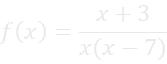
The vertical asymptotes are
x=0,x=7
Solve the polynomial inequality. Identify the Intervals and their sign. Write the solution set in interval notation.
x2-8x+16<0
Intervals = (-∞,-4) (-4,8)
Sign = +++ +++
Solution set = The solution set is EMPTY
For f(x)=2x2-9x+10 and g(x)= x-2, find the following function.
(fg)(x)=
(fg)(x)=2x3-13x2+28x-20
Find the f(g(x)) and g(f(x)) and determine if they are inverses of each other
f(x)=7x and g(x)=x/7
They are inverses of each other
(x)=x and g(x)=x
Use the Leading Coefficient Test to determine the end behavior of the graph of the given polynomial function.
f(x)=4x4+7x3-x+9
The graph of f(x) rises to the left and rises to the right
Use the graph of the rational function to complete the following statement.
As x→-1-, f(x)→___
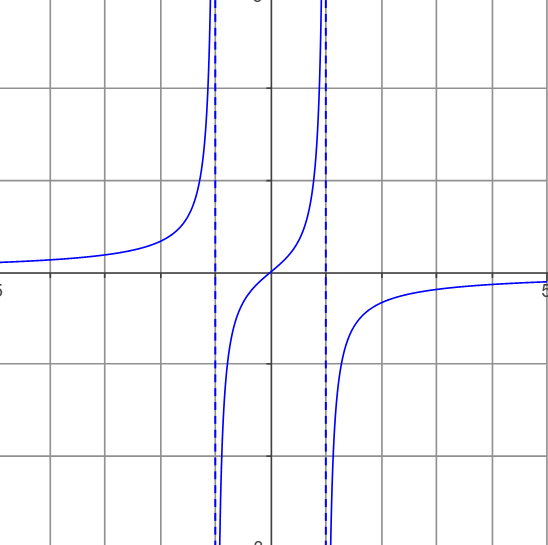
f(x)→∞
Solve the Rational Inequality, Identify the Intervals and their sign. Write the solution set in interval notation.
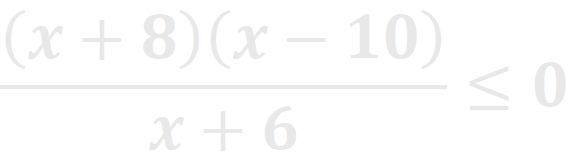
Intervals

--- +++ --- +++
Solution Set:

For f(x)=2x2-9x+10 and g(x)= x-2, find the following function.
(f/g)(x)=
(f/g)(x)= 2x-5
Find f(g(x)) and g(f(x)) and determine whether the pair of functions f and g are inverses of each other.

f(g(x)) =
g(f(x)) =
f(g(x)) =x
g(f(x)) =x
Use the leading coefficient test to determine whether y → ∞ or y → -∞ as x → -∞ for
y= -14x4-10x3
Answer: y → -∞
Find the horizontal asymptote, if any, of the graph of the rational function.
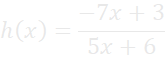
The horizontal asymptote is
y=-7/5
Solve the polynomial inequality. Identify the Intervals and their sign. Write the solution set in interval notation.
(x-3)2(x-4)(x-7)2 ≤ 0
Intervals = (-8,3) (3,4) (4,7) (7,∞)
- - - - - - +++ +++
Solution set = [4,7] U [7,∞)

Find (f ◦ g)(x)=
Write the domain in interval notation.
(f ◦ g)(x)= 10-x
The domain is (-∞,6]
The function 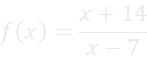 is one-to-one
Find an equation for f-1(x) the inverse function

Find the zeros for the polynomial function and give the multiplicity for each zero. State whether the graph crosses the x-axis or touches the x-axis and turns around at each zero. f(x)=2(x+7)(x+6)2
The zeros are -7,-6. There are two zeros. The multiplicity of the smallest zero is 1, the largest is 2. The graph crosses at -7 and touches and turns around at -6
Find the horizontal asymptote, if any, of the graph of the rational function.
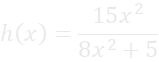
y=15/8
Solve the polynomial inequality. Identify the Intervals and their sign. Write the solution set in interval notation.
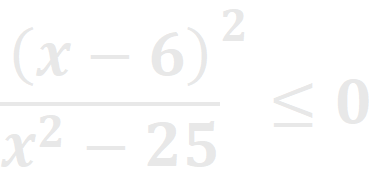
Intervals:
+++ --- +++ +++

Find (f ◦ g)(7)=
(f ◦ g)(7)=3
Given the function f(x)=x2-20, x≥0
Find an equation for f-1(x)
