Patterns
Equations
Graphs
Other
100
How can you show a pattern is quadratic from a table?
Calculate the second differences and see if they are constant.
100
Expand to standard form and simplify:
(x-4)(x+7)
x^2+3x-28
100
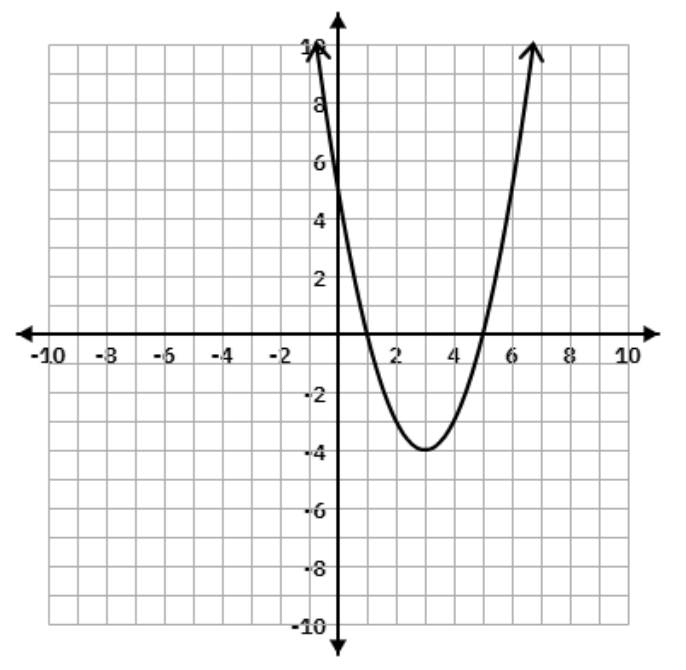
What are the x-intercepts, y-intercept and vertex of the graph above?
x-int: (1,0) and (5,0)
y-int: (0,5)
vertex: (3,-4)
100
True or False:
As x gets very large quadratic functions are always greater than exponential functions.
False.
Exponential > Quadratic
200
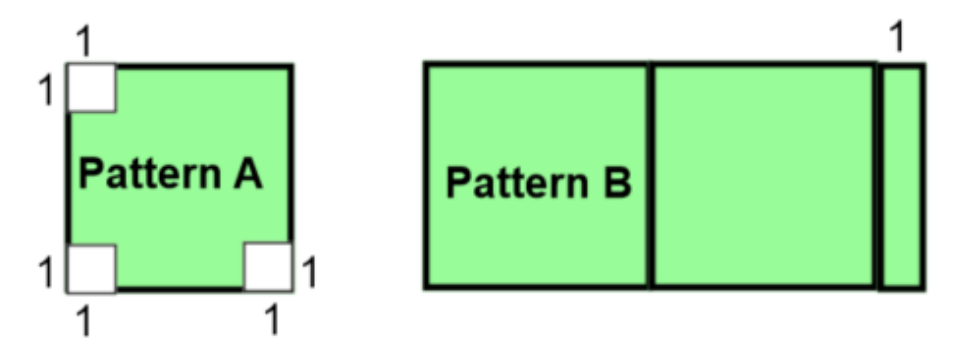
Each figure contains at least one large square. The side length of the large square is x.
Write two equations to represent both patterns' total areas.
A=x^2-3
B=2x^2+x
200
Expand to standard form and simplify:
(2x+5)^2
4x^2+20x+25
200
A quadratic function is given by the equation below. What are the x-intercepts and what is the y-intercept?
p(x) = (x + 5)(x − 1)
x-int: (-5,0) and (1,0)
y-int: (0,-5)
200
What are the x and y intercepts of the function
f(x)=(2x+4)(x-8)
x-intercepts: (-2,0) and (8,0)
y-intercept: (0,-32)
300
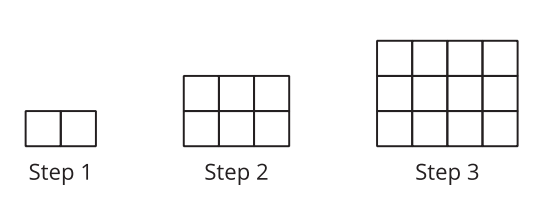
Write an equation to calculate the number of dots, d, for the nth step in the pattern, n.
d=n^2+n
300
Expand to standard form and simplify:
(3x-6)(4x-7)
12x^2-45x+42
300
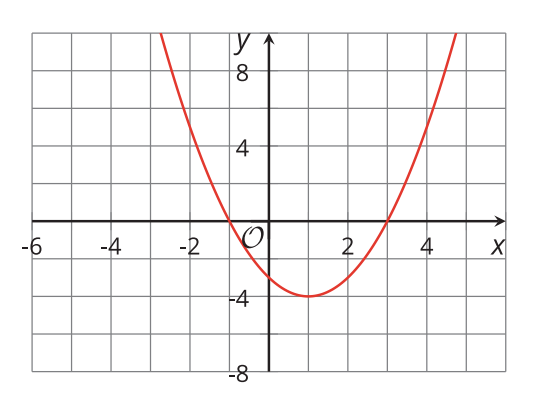
Here is a graph that represents a quadratic function.
Write the equation in factored form and standard form.
f(x)=(x+1)(x-3)
f(x)=x^2-2x-3
300
The function h defined by
h(t)=(6+4t)(4-t)
models the height, in meters, of an object t seconds after it is dropped from a helicopter.
a. Find or approximate the time when the object hits the ground. Explain or show your reasoning.
b. From what height is the object dropped? Explain or show your reasoning.
a. After 4 seconds
One x intercept is t=4, the other is t=-3/2 and negative time does not make sense in this context.
b. The y-intercept is at (0,24) so the object was dropped from a height of 24 meters.