I Can't Even Function (1)
sQuad(2)
sQuad(3)
Poly-oly(4)
Poly-Oly OH MY(5)
Get Rational (6)
Get Rational (7)
So Radical(8)
BAE (9)
100
Describe the transformations of :
-3/(x+4)-2
Flipped, stretched, left 4, down 2
100
What is the vertex of 2x^2+4x-1 ?
(-1,-3)
100
Solve the equation for x:
3x^2-1=26
x=+-3
100
Classify the polynomial:
-2x^5+3
quintic binomial
100
Factor:
27x^3-125
(3x-5)(9x^2+15x+25)
100
What is the Horizontal Asymptote of:
((x+1)(3x^2-4))/(2x^3-1)
3/2
100
Simplify
(3x^2y^4)/(2x^4y^3)/(6xy^2)/(4x^3y)
1
100
Simplify
sqrt(18x^6
3x^2sqrt2
100
log_6(1/216)
-3
200
Given the table, determine the function:
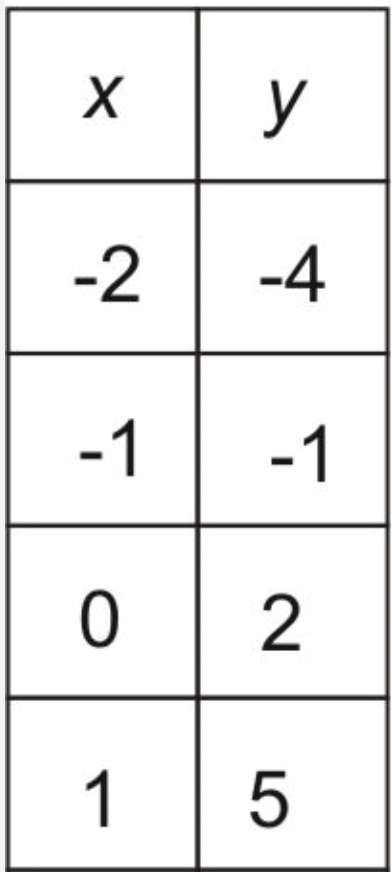
Quadratic
200
Describe the transformations of the quadratic: (x+2)^2-3
left 2, down 3
200
Solve the equation for x:
10x^2+3=11x
x=1/2,3/5
200
What is the end behavior of the function:
5-x+4x^2
LH->oo
RH->oo
200
factor:
x^3-3x^2+5x-15
(x^2+5)(x-3)
200
What is the RPOD of
f(x)=(x-4)/(x^2-16)
(4, 1/8)
200
multiply:
(x^2-4)/(x^2-1)*(x+1)/(x^2+2x)
(x-2)/(x(x-1))
200
multiply:
4sqrt(2x)*3sqrt(8x)
48x
200
625^(3/4)
125
300
Where is the graph increasing; decreasing?
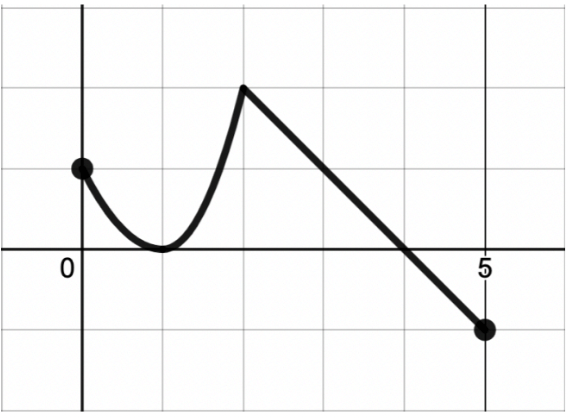
Increasing: (1,2)
Decreasing [0,1) U (2,5]
300
Given -2(x+1)^2+8 , does this graph have a maximum or minimum?
maximum
300
factor:
2x^2+5x-12
(x+4)(2x-3)
300
Solve the inequality using number line analysis:
(x-5)(2x+3)(5x-19)>0
(-3/2,2)U(5,oo)
300
Divide
4x^4-2x^2+x-3
by
(x+2)
4x^3-8x^2+14x-27+51/(x+2)
300
Find the ordered pair of the x and y intercepts of:
y=(-2x-1)/(x-2)
x=(-1/2,0)
y=(0,1/2)
300
Solve for x:
3/x+4/5=7/x
x=-2
300
3sqrt32+2sqrt50
22sqrt2
300
Solve:
-10+log_3 (x+3)=-10
x=-2
400
What are the positive and negative intervals of the graph?
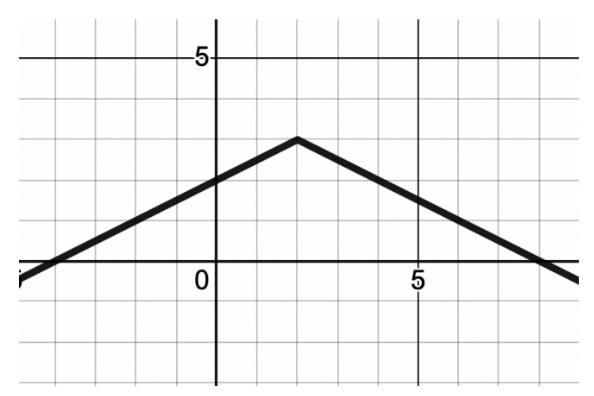
Positive: (-4,8)
Negative:
(-oo,-4) U (8,oo)
400
Describe the transformations from the blue graph to the red graph:
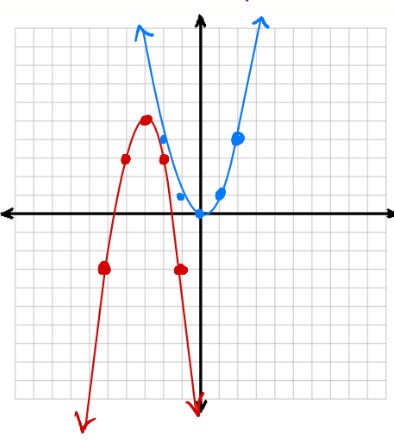
left 3, flipped, up 5, stretch (2)
400
Solve the following for x:
x^2+6x-16=0
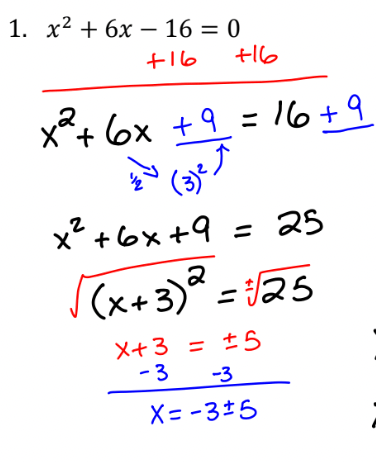
x=-3+-5
400
What is the function of the image:
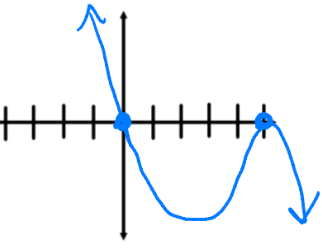
y=-x(x-5)^2
400
What is the remainder of
(2x^3+x^2-18x)/(x-1)
-15
400
What is the domain of
y=(x^2-5x-6)/(x^2-3x-4)
RR|x!=4, -1
400
subtract:
9/(4x^2-4)-5/(x-1)
20x-11
400
(1+sqrt7)(1+sqrt7)
8+2sqrt7
400
if
g(x)=5x and h(x)=x^2+3,
find
h(g(x))
25x^2+3
800
Explain which transformations are horizontal transformations and which are vertical.
vertical: (y) stretch/shrink, up/down, flip
horizontal: (x) right/left
800
Explain the difference between increasing/decreasing intervals and positive/negative intervals
increasing and decreasing pertains to when the graph is going up/down, respectively. Positive and negative intervals pertain to when the graph is above or below the x-axis, respectively.
800
Describe the discriminant of a quadratic with one solution.
the discriminant is zero
800
Explain the multiplicities in this problem and how that affects how we graph polynomials:
-2(x-4)^2(5-x)(x+2)
bounce at 4, snake at 5, cross at -2
800
Explain the Fundamental Theorem of Algebra
the highest degree of your polynomial tells you how many solutions you have
800
Explain the different "shapes" rational functions can have and why this is the case
Linear: after removing the RPOD, you are left with a function in y=mx+b form
Quadratic, after removing RPODs, you are left with a function in
y=ax^2+bx+c
Rational: after removing or not removing RPODS, you have a fraction in your equation
800
explain how to solve this problem:
(1/x+1/(2x))/((x+4)/(x-2)
find the LCD, multiply it to EVERY fraction in the problem, cross out common denominators, simplify
800
Explain when radical functions have an extraneous solution.
when you get two answers for x, but the original problem only should have one solution (given that the parent square root of x function only exists in the first quadrant)
800
Explain what can make a logarithm have extraneous solutions
a negative in the logarithm