Beautiful Blood Basics
Fighting Funky Infection Fuel
Stopping Serendipitous Seepage
Miscellaneous
100
Which protein in the blood may act as carrier proteins or antibodies?
Globulins
100
What is the most common leukocyte?
Neutrophil
100
Which coagulation pathway involves chemicals that are already found in the blood?
Intrinsic pathway
100
Which granulocytes increase in number during allergic reactions that work against basophils?
Eosinophils
200
A lack of hemoglobin and RBCs can cause what diseases?
Anemia
200
Which rare granulocytes increase in number during allergic reactions?
Basophils
200
Which blood test tests the amount of hemoglobin in the blood?
Hemoglobin blood test
200
Which test tests the percentage of RBCs in the blood?
Hematocrit blood test
300
List the three formed formed elements in blood
Erythrocytes
Thrombocytes
Leukocytes
300
What is chemotaxis?
The attraction of cells (ex. leukocytes) to chemical stimuli (like foreign invaders)
300
What is the last substance to be produced in the coagulation stage?
Fibrin
300
What are thrombocytes?
Cell fragments in the blood that help prevent blood loss
400
How would blood vessels respond to hot weather? Cold?
In hot weather, blood vessels open up so that heat can escape via the skin.
In cold weather, blood vessels constrict to bring blood closer to the deeper, warmer parts of the body.
400
What is pus?
A mixture of dead or dying white blood cells, foreign cells, and fluids
400
Label all of the parts of the coagulation factor chart.
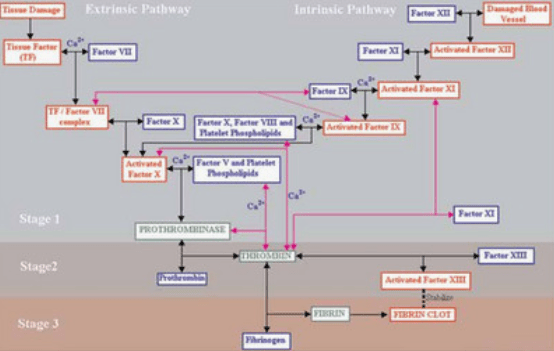
400
Most ___________ ____________ are formed in the liver.
Coagulation factors
500
Give four reasons as to why erythrocytes are the perfect shape for carrying Oxygen.
The flat shape allows for a larger surface area to hold more oxygen.
The center is very thin, which allows for CO2 and O2 to be exchanged rapidly.
The cell can twist and bend trhough tiny blood vessels easily.
Erythrocytes are anucleate, meaning they can generate enough ATP by glycolysis alone
500
What are the two substances released by basophils? What do they do?
Histamine - promotes inflammation
Heparin - prevents blood from clotting locally
500
List and explain the three steps of hemostasis.
Vasoconstriction stage - when blood vessels constrict; helps to close down the tear in the blood vessel
Platelet plug stage - damaged vessels cause the platelets to swell and get sticky to each other and the vessel wall. This happens because there is collagen in the exposed vessel wall, which the platelets are exposed to.
Coagulation stage - the blood vessel produces prothrombinase (which makes thrombin). The thrombin converts fibrinogen into fibrin. Fibrin forms long fibers thar are insoluble in water