Digging into Digestion
Moving Food
Stomach!
Mystery Box
100
Which teeth are used for tearing food?
Canines
100
What is a digestive enzyme that helps to break down starch into maltose?
Amylase
100
What is the layer of connective tissue with blood vessels and nerves in the stomach?
Submucosa
100
What is puffiness of the cheeks as a result of a viral infection of the parotid glands?
Mumps
200
What occurs when gastric juices cause damage on the esophagus?
Heartburn
200
What do the molars and premolars do?
Crush and grind food
200
What is a substance produced by the gastric pits that binds to vitamin B12 in order for it to be absorbed by the small intestines?
Intrinsic factor
200
What is the part of the stomach that joins that organ to the small intestine?
Pylorus
300
What is adventitia?
A thin layer of loose connective tissue that binds an organ to surrounding tissues or organs
300
What initiates peristaltic waves?
The presence of a bolus
300
What is gastrin?
A hormone secreted by the stomach to increase the lower esophageal sphincter tone
300
How does the serosa help the stomach?
It allows the stomach to move in the body with little friction
400
What is the difference between ingestion and digestion?
Ingestion - getting food into the body
Digestion - the breakdown of food molecules into their individual components
400
What's the difference between the parotid salivary glands and the submandibular salivary glands?
Parotid salivary glands - release saliva above the tongue
Submandibular salivary glands - release saliva underneath the tongue
400
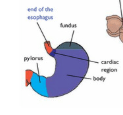
On the stomach diagram, label: cardiac region, body, fundus, pylorus
400
Why is degulutition dangerous?
The oral cavity leads to the pharynx (which leads to both the esophagus and the larynx)
500
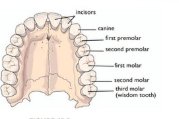
On the teeth diagram, label: incisors, canines, third molar, second molar, first premolar, and first molar
500
List and explain the three stages of deglutition.
Voluntary oral stage - the bolus is pushed toward the back of the mouth by the tongue
Pharyngeal stage - soft palate lifts and blocks the nasal cavity; vocal cords form a tight seal on the trachea
Peristalsis - the process of contraction and relaxation of smooth muscle that pushes food through the alimentary canal
500
What is significant about gastric juice? Why does it not affect the stomach tissue?
Gastric juice is highly acidic, which helps activate pepsin and kill bacteria.
It does not affect the stomach tissues because the gastric pits secrete so much mucus that gastric juice never touches stomach tissues
500
How does your body prevent food from getting into the trachea?
The soft palate rises up and closes off the nasal cavity
Larynx rises and the epiglottis drops to seal off the trachea