Molecules & Energy
Build It / Identify It
Fats & Food
Acids & Reflux
Laboratory Detectives
Bloodwork & Transport
100
A molecule with uneven charges on opposite sides is described by this term.
What is polar?
100
Starch belongs to this macromolecule group.
What are carbohydrates?
100
Of olive oil and butter, this is the saturated-fat example in the test.
What is butter?
100
A solution with a pH of 9 is classified as this.
What is a base?
100
Benedict’s solution tests for these sugar molecules in the test.
What are monosaccharides?
100
Of a metabolic panel, lipid panel, CBC, and A1C test, this is the test’s choice when a doctor is worried about diabetes.
What is an A1C test?
200
The test identifies this molecule as the chemical energy used by all cells.
What is ATP?
200
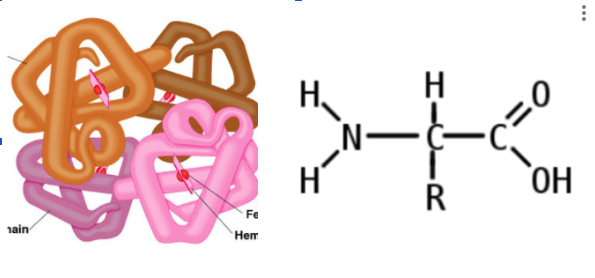 Name BOTH structures shown: the folded macromolecule on the left and the building block on the right.
What are a protein and an amino acid?
200
A fatty acid with double bonds is described by this term.
What is unsaturated?
200
The test describes the solution at pH 4 in its mixing scenario as this type of substance.
What is an acid?
200
Of french fries, a soda, a burger patty, and cheese, this is the test’s expected positive result with Benedict’s solution.
What is a soda?
200
In the test’s simplified yes-or-no question, a low A1C score leads to this expected answer about whether diabetes risk is indicated.
What is no?
300
Giving off quick energy is the function the test associates with this macromolecule group.
What are carbohydrates?
300
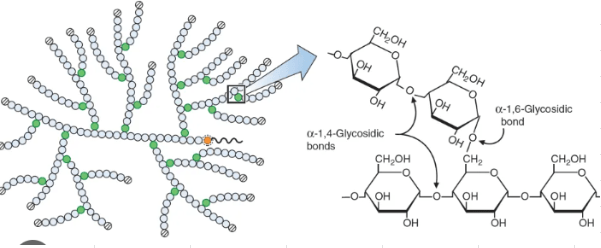 Give BOTH classifications for the branched molecule: its macromolecule group and its many-sugar-chain category.
What are a carbohydrate and a polysaccharide?
300
Choose the TWO foods the test treats as entirely lipids: potatoes, meat, oil, table sugar, salt, and bacon grease.
What are oil and bacon grease?
300
In the test, an acid at pH 4 is mixed with a base at pH 8, and the resulting pH is reported as 6. Name the reaction.
What is neutralization?
300
Name the protein-detection test listed among Benedict’s, Biuret, iodine, and paper bag tests.
What is the Biuret test?
300
In the test’s bloodwork scenario, the expected explanation for a high white blood cell count is that the body is fighting this.
What is an infection?
400
Name the type of compound category and the three elements that the test associates with complex macromolecules.
What are organic compounds, carbon, and hydrogen?
400
Name the reaction shown in the diagram. 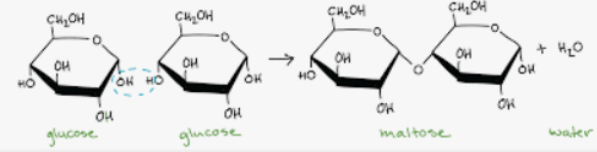
What is dehydration synthesis?
400
The test describes this process as adding hydrogens to a molecule to make it solid at room temperature.
What is hydrogenation?
400
In the test’s acid-reflux scenario, stomach acid is bubbling into this structure.
What is the esophagus?
400
This is the test’s protein-test photograph. Name the test and state whether this blue result indicates proteins are present or absent.
What are the Biuret test and proteins absent?
400
Name the cholesterol type the test calls “good,” and state where its answer choice says it carries fat.
What is HDL, carrying fat toward liver cells?
500
Select the TWO proteins: disaccharides, antibodies, triglycerides, enzymes, phospholipids, and glycogen.
What are antibodies and enzymes?
500
Read the reaction diagram. Name the sugar that appears twice on the left, the named sugar product, and the other product on the right. 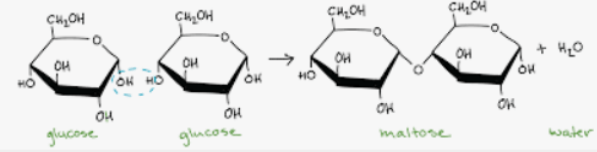
Require all three: glucose, maltose, and water (H₂O).
500
Name BOTH: the fatty-acid type described as having double bonds, and the process described as adding hydrogens to make a fat solid at room temperature.
What are an unsaturated fatty acid and hydrogenation?
500
Complete all THREE parts: classify pH 9; identify the structure receiving acid during reflux; and name the reaction between an acid and a base in the test.
What are a base, the esophagus, and neutralization?
500
Give all THREE: the sugar test used on the soda example, the molecules it tests for in this assessment, and the result of the pictured protein test.
What are Benedict’s test, monosaccharides, and proteins absent?
500
Match BOTH types: the one described as taking fat to cells and getting stuck in blood vessels, and the one described as taking fat toward liver cells.
What are LDL and HDL, respectively?