Types of Angles
Types of Lines
Angle Measures
Value of X
Parallel Lines
100
Name the obtuse angle. Name one acute angle. 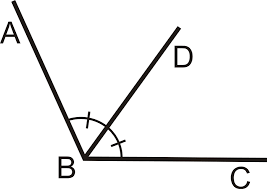
<ABC - obtuse
<ABD or <CBD - acute
100
Name all segments that are part of a line that is parallel to segment AB.

Segments DC, EF, HG
100
Find the measures of <1 and <4.

<1 = 135o
<4 = 45o
100
Find the value of x.
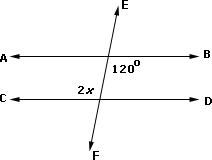
2xo = 120o
x = 60
100
Determine which lines, if any, must be parallel.
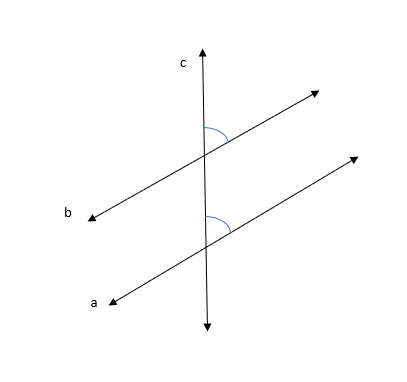
a // b
200
What type of Angles are <1 and <3? Are the congruent or supplementary?
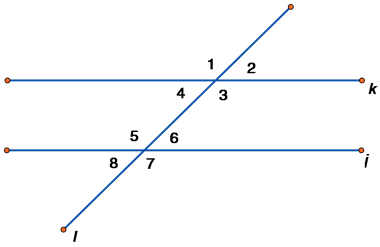
Vertical Angles
Congruent
200
List all segments that are part of a line that is perpendicular to segment AB.
Segments AE, BF
200
If the measure of <3 = 53o, what are the measures of <5 and <6?
<5 = 127o
<6 = 53o
200
Find the Value of x.

4x - 14 = 2x + 7
2x - 14 = 7
2x = 21
x = 10.5
200
Determine which lines, if any, must be parallel.
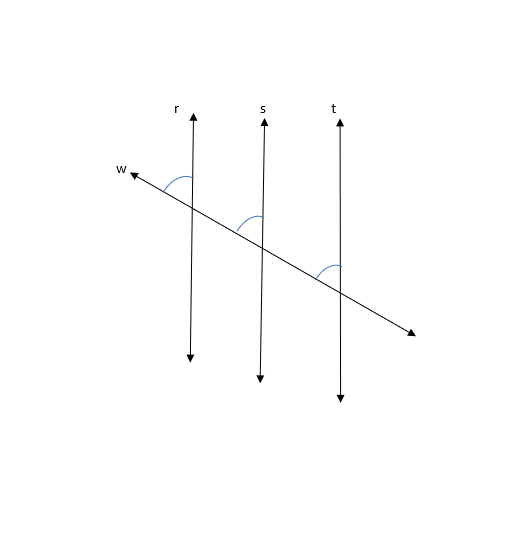
r // s // t
300
Name the four pairs of Corresponding Angles.
1 & 5, 2 & 6, 3 & 7, 4 & 8
300
List all the segments that are part of a line that is skew to segment AB.
Segments EH, FG, DH, DG
300
Find the measure of <2 and <3.
<2 = 45o
<3 = 135o
300
Find the value of x.

6x -36 = 96
6x = 132
x = 22
300
Determine which lines, if any, must be parallel.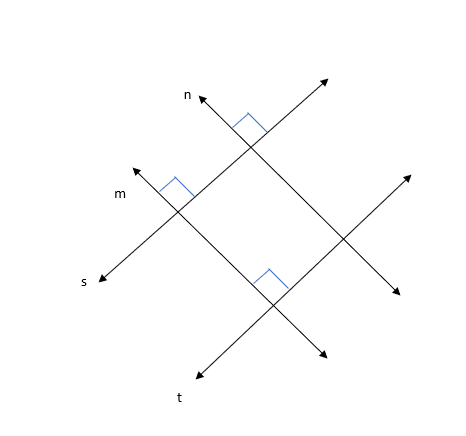
m // n
s // t
400
What is the Theorem used to describe the angle pairs 4 & 5 and 3 & 6? Are these angle pairs congruent or supplementary?
Consecutive Interior
Supplementary
400
Name a plane parallel to plane ABC.
Plane EFG.
400
If the measure of <5 = 117o, then what are the measures of <4 and <2?
<4 = 117o
<2 = 63o
400
Find the value of x.
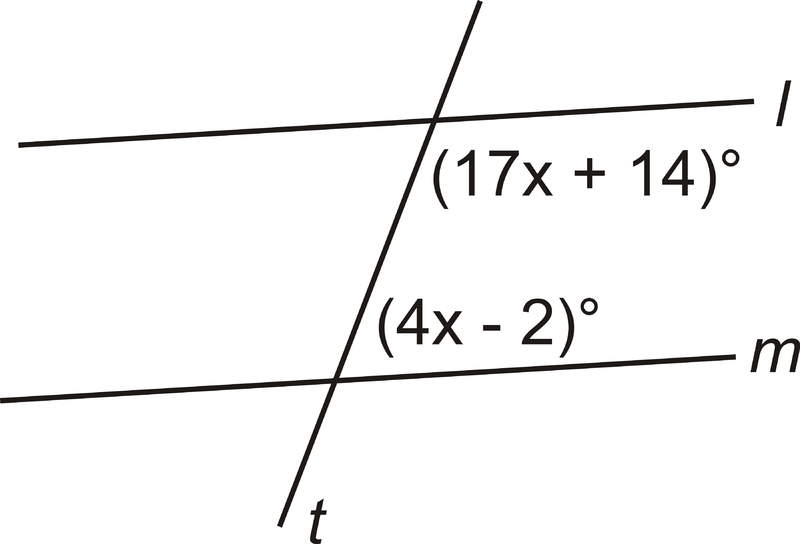
(17x + 14) + (4x - 2) = 180
21x + 12 = 180
21x = 168
x = 8
400
Determine which lines, if any, must be parallel.
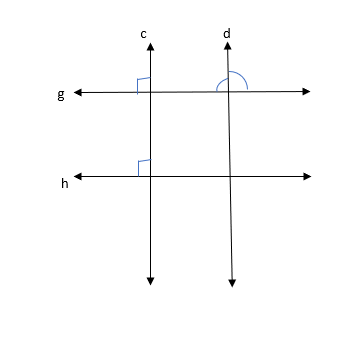
c // d
g // h