Chemical Reactions
General Chem
Polymers
Monomers
Miscellaneous
100
This type of reaction uses water to break a polymer into smaller monomer subunits.
What is hydrolysis?
100
This is another term for non-polar molecules
What is hydrophobic?
100
This is the only macromolecule that ALWAYS has phosphorus in addition to C, O, H, and N
What is Nucleic Acid
100
This is the monomer of carbohydrates
What is simple sugars
or monosaccharides ?
100
These are the five most important elements for life on earth found in the highest abundance in living organisms
What are Carbon (C), Hydrogen (H), Oxygen (O), and Nitrogen (N), and Phosphorus (P) ?
200
This type of reaction forms polymers from monomers and water is lost as bi-product
What is dehydration synthesis?
200
This is the chemical property that is a key factor in all of the emergent properties of water.
What is hydrogen bonding?
200
This polymer forms ring-like structures from C, H, and O
What is a carbohydrate?
200
These are considered the monomer of lipids
What is fatty acid?
200
If a sample of DNA had 36% Adenine, how much Cytosine would you expect to find?
14%
A = T and C=G
A+T+C+G = 100%
So, A+T = 36 + 36 = 72%
100-72 = 28%
28/2 = 14
300
What are the two types of covalent bonds and how do they form? Give an example of each.
Polar covalent and nonpolar covalent.
Polar bonds form when there is an unequal sharing of electrons generating partial charges (H2O) and nonpolar bonds form when there is an equal sharing of electrons (O2).
300
This is a chemical trait that Nitrogen, Oxygen, and Fluorine have in common - resulting in having the shared electrons more often in a covalent bond.
What is a high electronegativity?
300
This is the primary difference between a saturated and an unsaturated fat which results in one being solid and one being liquid at room temp.
A saturated fat is linear with single-bonded carbons while an unsaturated fat has a double-bonded carbon which results in a kink or bend that prevents them from packing as closely together.
300
These are the three components of a nucleotide
What are:
Phosphate group, 5-carbon sugar, nitrogenous base
300
This type of bond specifically leads to higher stability in proteins.
What are disulfide bonds? S - S
400
Name the reaction shown below AND what type of polymer is being formed
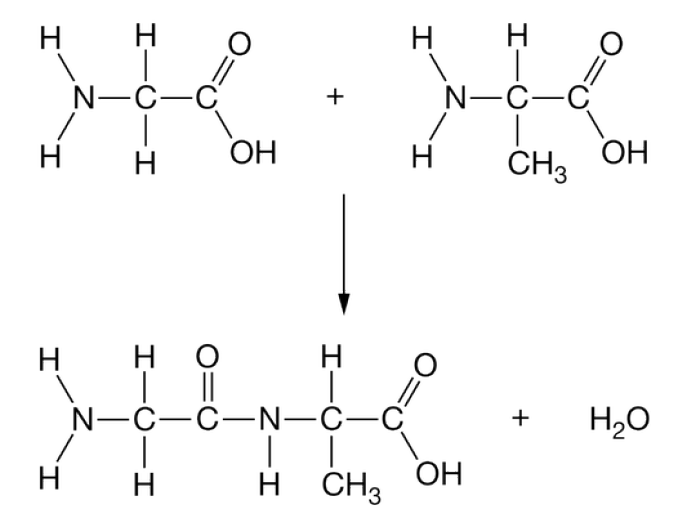
What is dehydration synthesis to form a polypeptide?
400
All Hydrophobic amino acids have an R-group that ends in these two elements.
What are Carbon and Hydrogen?
400
These are the folding patterns of protein secondary structure.
What is alpha helix and beta sheet?
400
These are the 4 components of an amino acid (connected to the alpha Carbon)
What are:
Amino group, carboxyl group, R-group, hydrogen
400
Name the bond(s) responsible for each level of protein structure.
Primary: Peptide bonds
Secondary: Hydrogen Bonds
Tertiary: Hydrogen Bonds, Disulfide Bonds, and direct hydrophilic and hydrophobic interactions of the R-groups
Quaternary: (Same as Tertiary) Hydrogen Bonds, Disulfide Bonds, and direct hydrophilic and hydrophobic interactions of the R-groups
500
This catalyst helps hydrolyze lactose into its monomer subunits
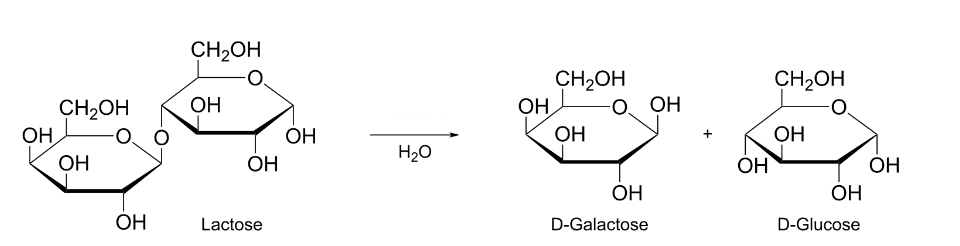
What is Lactase?
500
Explain WHY hydrogen bonds occur in water molecules.
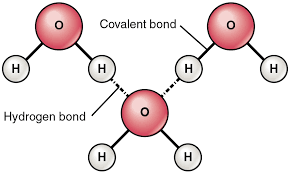
The partial - charge in the oxygen atom of one water molecule is attracted to the partial + charge of a hydrogen atom in another water molecule
500
This is what holds the 2 strands of a DNA molecule together in complementary base pairing.
What is hydrogen bonds?
500
These are the two primary difference between an RNA nucleotide and a DNA nucleotide
What is a ribose sugar instead of a deoxyribose and a Uracil base instead of a Thymine base?
500
In Sickle-cell anemia a point mutation causes a polar amino acid to be replaced with a nonpolar amino acid. Why is this specifically disruptive to the protein structure?
In the original structure, the polar amino acid would be found towards the outside of the protein because polar amino acids are hydrophilic. Swapping this amino acid for a nonpolar one means that the secondary, tertiary, and quaternary structures would be different because the hydrophobic nature of the new AA would cause it to move to the interior of the protein. This will negatively impact its function because structure determines function.