Glycolysis
Pyruvate Oxidation
Citric Acid Cycle
Oxidative Phosphorylation
Random
100
Is glycolysis aerobic or anaerobic?
Anaerobic
100
Where does pyruvate oxidation take place?
Mitochondrial Matrix
100
Where does the citric acid cycle occur in the cell?
Mitochondrial Matrix
100
Where does oxidative phosphorylation occur in the cell?
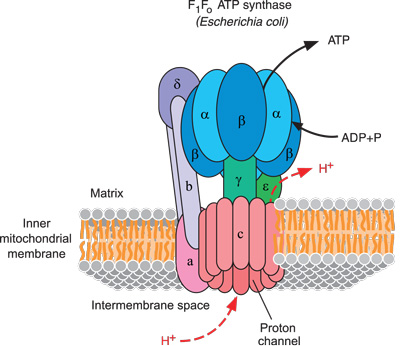
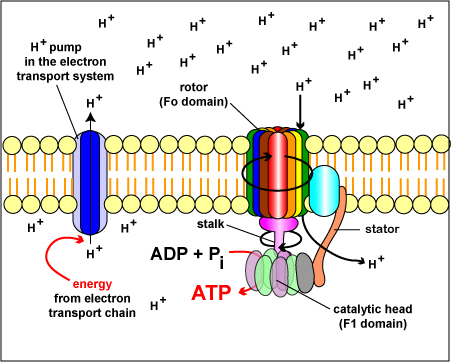
Oxidative phosphorylation occurs in the mitochondrial inner membrane/cristae.
100
What are the two types of fermentation?
Lactic Acid & Alcoholic
200
One glucose undergoes a catabolic reaction and is broken into two ________.
Pyruvate (C3H6O3)
200
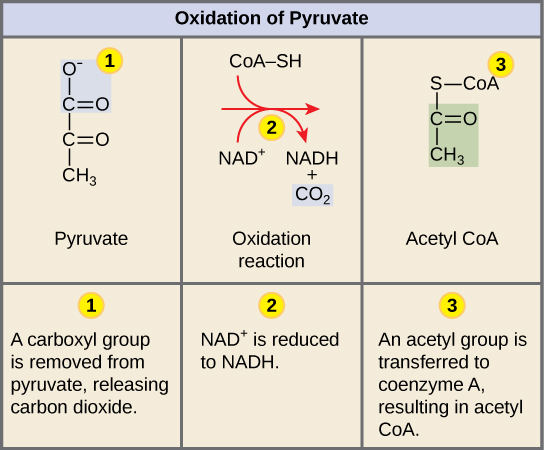
What are the inputs and outputs of pyruvate oxidation?
Inputs:
2 Pyruvate
NAD+
Outputs:
NADH
CO2
Acetyl CoA
200
Why is the citric acid cycle called a cycle?
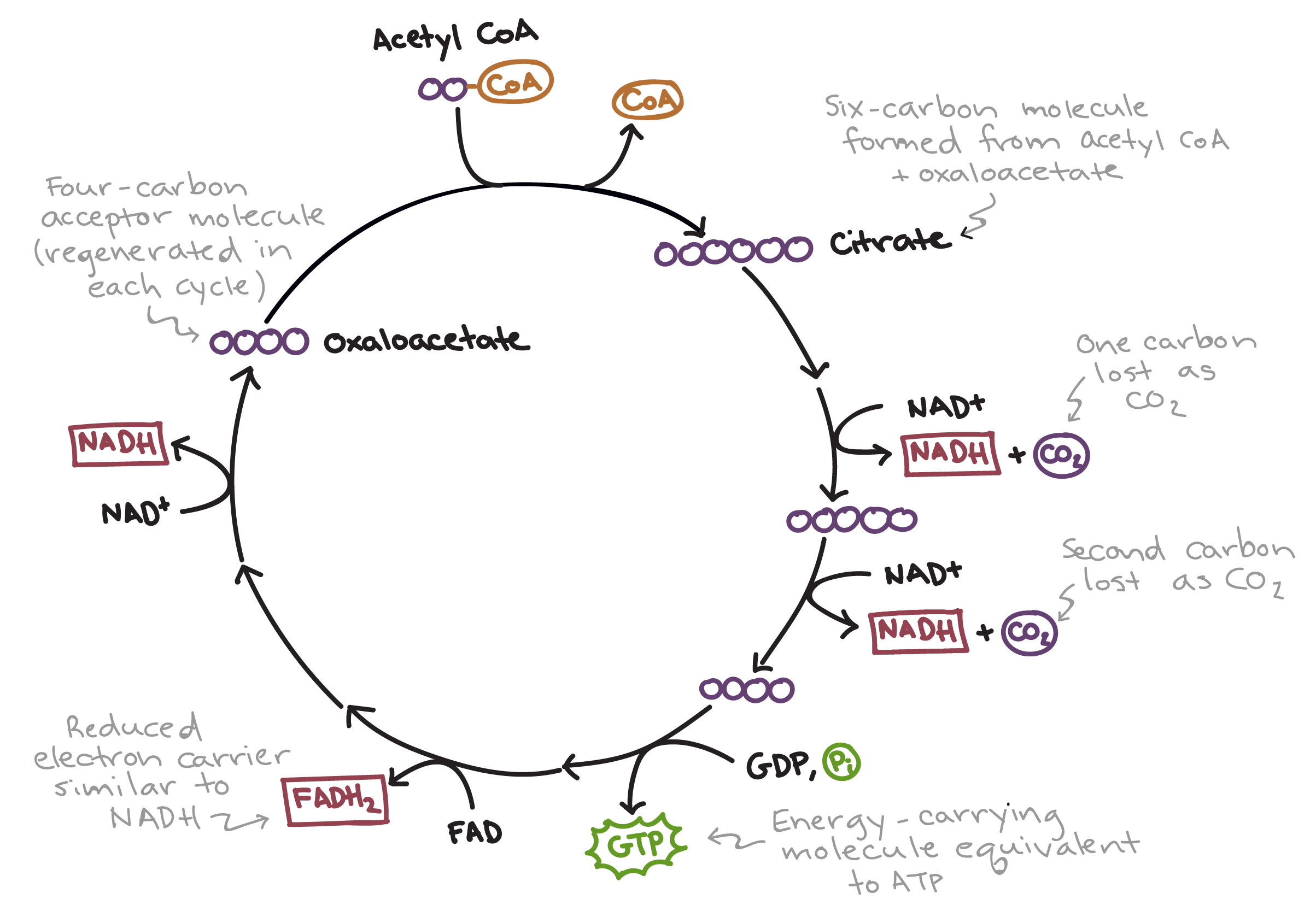
The citric acid cycle is called a cycle because the starting molecule, oxaloacetate (which has 4 carbons), is regenerated at the end of the cycle.
200
Why is oxygen needed in oxidative phosphorylation?
Without oxygen, the electrons from NADH and FADH2 cannot move through the electron transport chain and hydrogen ions cannot be pumped against their concentration gradient.
This requirement for oxygen to act as the terminal (final) electron acceptor in the electron transport chain is what makes oxidative phosphorylation aerobic.
Oxygen accepts electrons and protons, forming water.
200
How efficient is ATP? Give a percentage of how much energy is not lost as heat and entropy during cellular respiration.
40%
300
Why does glycolysis occur in the cytosol?
The enzymes required for the glycolytic pathway are only found in the cytoplasm. A transport protein is required to move glucose across membranes.
300
When humans run very fast, their muscles respire anaerobically. Instead of pyruvate oxidation, the muscles undergo fermentation and form ________. This waste product is the cause to "feeling the burn" or cramps during intense exercise.
Lactic Acid
300
Which step(s) of cellular respiration use substrate-level phosphorylation?
Glycolysis & the Citric Acid Cycle
300
Describe the role of the electron transport chain in cellular respiration.
The electron transport chain regenerates electron carriers and forms a proton gradient.
300
How many ATP molecules are made in each step of cellular respiration from one molecule of glucose?
Glycolysis: 2 ATP net produced
Citric Acid Cycle: 2 ATP produced
Oxidative Phosphorylation: 30 - 32 ATP produced
Total: 34 - 36 ATP net produced
400
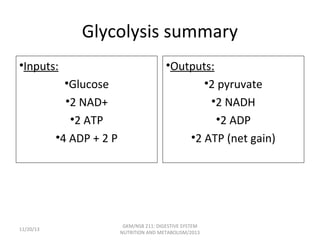
What are the inputs and outputs of glycolysis?
400
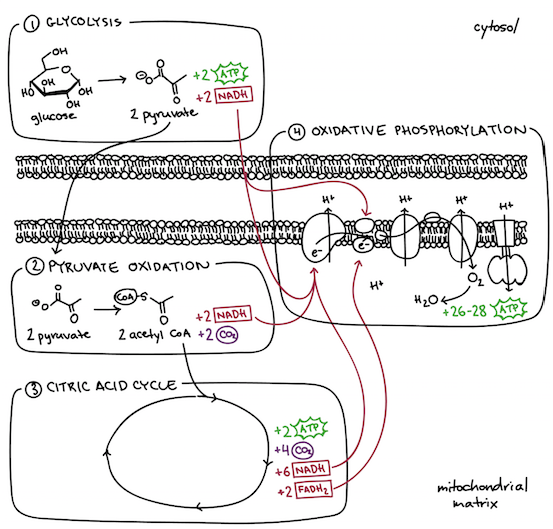
What part of the cycle does the electron carrier in pyruvate oxidation go to next?
400
What are the reactants and products of the citric acid cycle from one glucose?

400
Describe oxidative phosphorylation.
During oxidative phosphorylation, electrons derived from NADH and FADH2 combine with O2, and the energy released from these oxidation/ reduction reactions is used to drive the synthesis of ATP from ADP in chemiosmosis' ATP synthase and electrochemical gradient.
400
In cellular respiration, glucose is _______ and oxygen is reduced. This forms CO2, water, and energy.
Glucose is oxidized.
500
Why does glycolysis not produce as much ATP as oxidative phosphorylation?
ATP generation in oxidative phosphorylation is significantly greater than glycolysis alone, due to the efficiency of energy extraction in the electron transport chain.
The electron transport chain occurs because glycolysis happens in the cytosol, and NADH can't cross the inner mitochondrial membrane to deliver its electrons. Instead, it must hand its electrons off to a molecular “shuttle system” that delivers them, through a series of steps.
500
In the presence of oxygen, pyruvate is transformed into an _________ attached to a ________ molecule of a CoA.
In the presence of oxygen, pyruvate is transformed into an acetyl group attached to a carrier/transport molecule of coenzyme A. The resulting acetyl CoA most often delivers the acetyl group to the citric acid cycle for further catabolism.
500
What is the purpose of the citric acid cycle?
The function of the citric acid cycle is to harvest high-energy electrons from carbon fuels.
500
Explain the role of membrane potential in cellular respiration and what creates it.
How does membrane potential relate to ATP production?
Membrane potential is caused by a concentration gradient of molecules from a higher concentration to a lower concentration across a cell membrane.
The mitochondrial membrane potential (ΔΨm) generated by proton pumps is an essential component in the process of energy storage during oxidative phosphorylation. Together with the proton gradient (ΔpH), ΔΨm forms the transmembrane potential of hydrogen ions which is harnessed to make ATP.
More membrane potential in cell wall = more glucose = more potential energy for cellular work and cellular respiration
More membrane potential in mitochondria = more efficient ATP production = more potential energy for cellular work
500
Explain how ADP becomes converted to ATP in the ATP synthase.
ADP is converted to ATP by the enzyme ATP synthase by adding inorganic phosphate to ADP. ATP is then broken down to ADP and inorganic phosphate by the same enzyme when the body uses the energy stored in its bonds. ADP is then recycled to produce ATP again.
This process happens during chemiosmosis in oxidative phosphorylation. 90% of ATP produced in cellular respiration is made in this step.