The Big Four
Epithelium
Connecting the Body
Stay Connected
Beef
Nervous Nelly
100
This tissue type is made of cells packed tightly together with very little extracellular matrix, and lines body surfaces and cavities.
epithelial tissue
100
This flat, scale-like epithelial cell shape allows for rapid diffusion, and lines blood vessels and the air sacs of the lungs.
squamous
100
Connective tissues share these three components: cells, protein fibers, and this gel-like or fluid material.
ground substance (the matrix)
100
Made mostly of fat-storing cells with very little matrix, this loose connective tissue insulates the body and stores energy.
adipose tissue
100
This term describes the striped, banded appearance skeletal and cardiac muscle get from the regular alternation of actin and myosin.
striated
100
The two main classes of cells that make up nervous tissue are neurons and _______.
neuroglia
200
This tissue type is defined by cells dispersed within an extracellular matrix, and includes bone, blood, and cartilage.
connective tissue
200
This arrangement of epithelium, built from multiple stacked layers of cells, provides extra protection against abrasion in places like the skin.
stratified
200
This fluid connective tissue carries oxygen via erythrocytes and defends the body using leukocytes.
blood
200
The hardest connective tissue in the body, its matrix combines collagen fibers with the mineral hydroxyapatite.
bone
200
Voluntary and striated, this muscle type attaches to bone and powers deliberate movement.
skeletal muscle
200
Often called the soma, this part of the neuron holds the nucleus and most of the organelles.
cell body
300
This tissue type is excitable and contractile, allowing the body to generate a pulling force and move.
muscle tissue
300
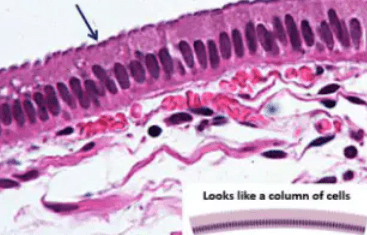
What type of epithelial cells are shown in the image?
(simple) columnar
300
Made primarily of this protein, elastic fiber snaps back to its original shape after being stretched, and is found in skin and vertebral ligaments.
elastin
300
The most common cartilage type in the body, this smooth, flexible tissue covers the ends of bones at moveable joints.
hyaline cartilage
300
Striated but involuntary, this muscle type forms the walls of the heart and contracts on its own intrinsic rhythm.
cardiac muscle
300
This insulating layer wraps around axons, speeding up the transmission of a nerve impulse.
myelin
400
This tissue type is excitable and specializes in sending and receiving electrochemical signals.
nervous tissue
400
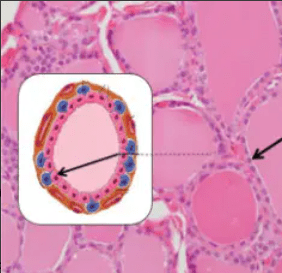 What type of epithelial cell is shown in the image?
(simple) cuboidal
400
Derived from a monocyte, this immune cell engulfs pathogens and releases cytokines to call in other immune cells.
macrophage
400
This is the most abundant cell in connective tissue proper, responsible for secreting the components of the matrix.
fibroblast
400
Found in the walls of organs like the stomach and in blood vessels, this muscle type shows no visible striations and contracts involuntarily.
smooth muscle
400
Star-shaped and found in the central nervous system, this glial cell helps form the blood-brain barrier.
astrocyte
500
Connective and muscle tissue primarily derive from which embryonic germ layer--ectoderm, mesoderm, or endoderm?
mesoderm
500
This thin sheet of extracellular material anchors epithelial tissue to the connective tissue underneath it.
basement membrane
500
This multipotent adult stem cell, scattered throughout connective tissue, can differentiate into whatever cell type is needed for repair.
mesenchymal cell
500
In this type of connective tissue, fibers run parallel to one another for maximum tensile strength in tendons.
dense regular connective tissue
500
These specialized junctions between cardiac muscle cells combine anchoring junctions with gap junctions, letting the heart beat as one coordinated unit.
intercalated discs
500
This is the name for the gap between two nerve cells, or between a nerve cell and its target, where neurotransmitters carry the signal across.
synapse