Unit One: Limits and Continuity
Unit Two: Conceptualizing the Derivative
Unit Three: Rules of Differentiation
Unit Four: Applications of the Derivative
Wild Card!!!
100
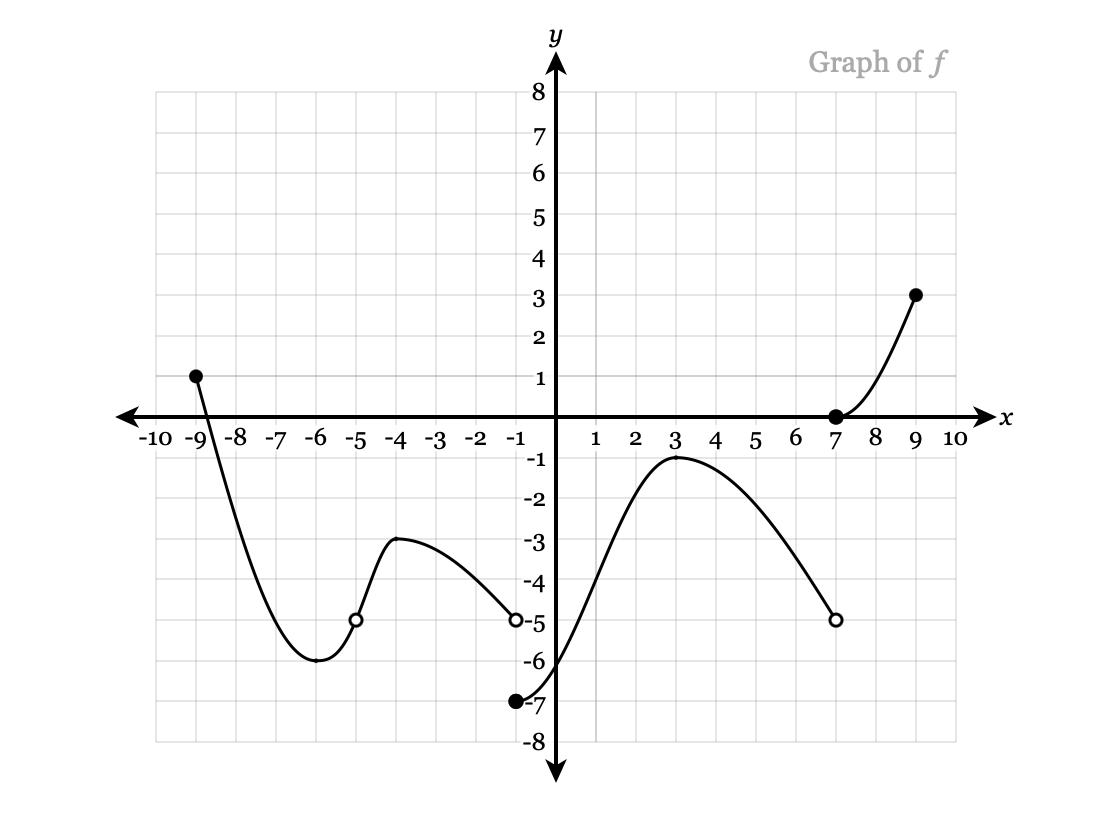
What is the lim_(x->7^-)f(x)
lim_(x->7^-)f(x)=-5
100
Find the derivative of y=3/x^7 .
y'=-21/x^8
100
Find the derivative of f(theta)=theta^2sintheta .
f'(theta)=theta^2costheta+2thetasintheta
100
f(x)=x^2+3/x^3
Find f''(x)
f''(x)=2+36/x^5
100
Find the
csc((11pi)/6)
-2
200
lim_(x->4)(sqrt(x+5)-3)/(x-4)
lim_(x->4)(sqrt(x+5)-3)/(x-4) =1/6
200
What is the slope of the normal line of the given equation when x=16?
y=sqrtx
botdy/dx|_(x=16)=-8
200
Find the derivative of
f'(x)=e^(x^2+5x+1) .
f'(x)=(2x+5)e^(x^2+5x+1)
200
f(x)=sin(x/2) on [0,4pi]
Give the intervals of f(x) where it is concave up and concave down. Justify your answer.
f(x) is concave up on
(2pi,4pi) because f''(x)>0.
f(x) is concave down on
(0,2pi) because f''(x)<0.
200
Find all x-coordinates of the relative extrema of f(x) using the Second Derivative Test. Justify your answer.
f(x)=x^3-3x^2+3
x=0 is a relative maximum of f(x) because f''(0)<0, and x=2 is a relative minimum of f(x) because f''(2)>0.
300
lim_(x->0)(sin7theta)/(12theta)
lim_(x->0)(sin7theta)/(12theta)=7/12
300
Find the equation of the tangent line of f(x)=x^2+3 at x=-1 .
y-4=-2(x+1)
300
Determine if f(x) is differentiable at x=2. Justify your answer.
f(x)={(x^2+1 if x<=2),(4x-3 if x>2):}
f(x) is differentiable at x=2 because f(x) is continuous and
lim_(x->2^-)f'(x)=lim_(x->2^+)f'(x)
300
Given the curve xe^y-10x+3y=0
Find (dy)/dx
(dy)/dx=(10-e^y)/(xe^y+3)
300
Given
x^2+y^2=9
Find (d^2y)/(dx^2)
(d^2y)/(dx^2)=(-(x^2+y^2))/(y^3)
400
f(x)=x^2+x-1
f(c)=11
Verify that the Intermediate Value Theorem is applicable on [0,5]. If the IVT applies, find the value of c guaranteed by the theorem.
The IVT is applicable on [0, 5] and the value c guaranteed on [0,5] is
c=3
.
400
Find the intervals on which f(x)=2x+1/x is increasing and decreasing. Justify your answer.
f(x) is increasing on
(-oo,-sqrt2/2)cup(sqrt2/2,oo)
because f'(x)>0 .
f(x) is decreasing on
(-sqrt2/2,0)cup(0,sqrt2/2)
because f'(x)<0 .
400
Find the derivative of
f(t)=3^(2t)/t .
f'(t)=(3^(2t)(2tln3-1))/t^2
or
f'(t)=3^(2t)((2ln3)/t-1/t^2)
400
A spherical balloon is inflated with gas at the rate 800 cubic centimeters per minute. How fast is the radius of the balloon increasing at the instant the radius is 30 centimeters?
(dr)/dt=2/(9pi) (cm)/min
400
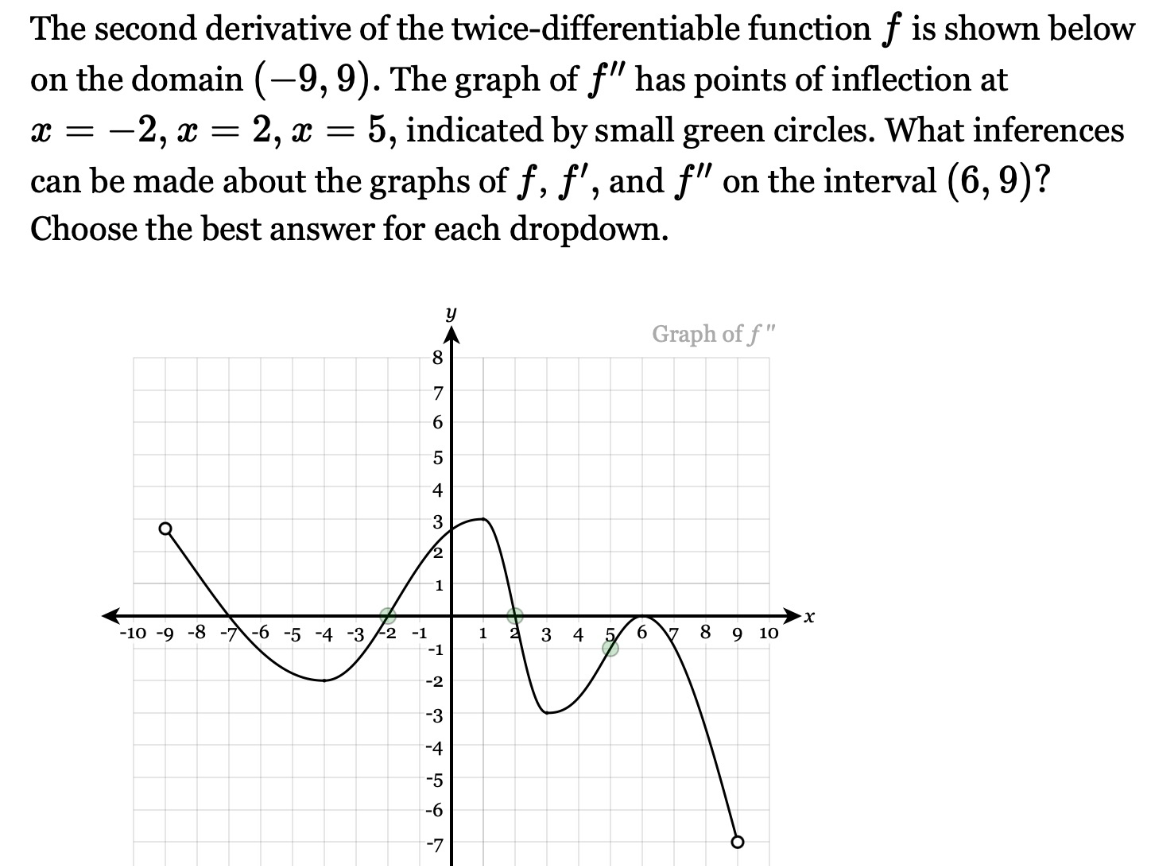
On (6,9), f is concave down because f''(x)<0 and f' is decreasing because f''(x)<0.
500
f(x)={(ax^2+x-b if x<=2),(ax+b if 2<x<5), (2ax-7 if x>=5):}
Find the values of a and b such that f is continuous on the entire real number line.
a=2
b=3
500
Find the relative extrema for
f(x)=-2x^2+4x+3
Justify your answer.
f(x) has relative extrema at x=1. x=1 is a relative maximum because f'(x) changes from f'(x)>0 to f'(x)<0 at x=1.
500
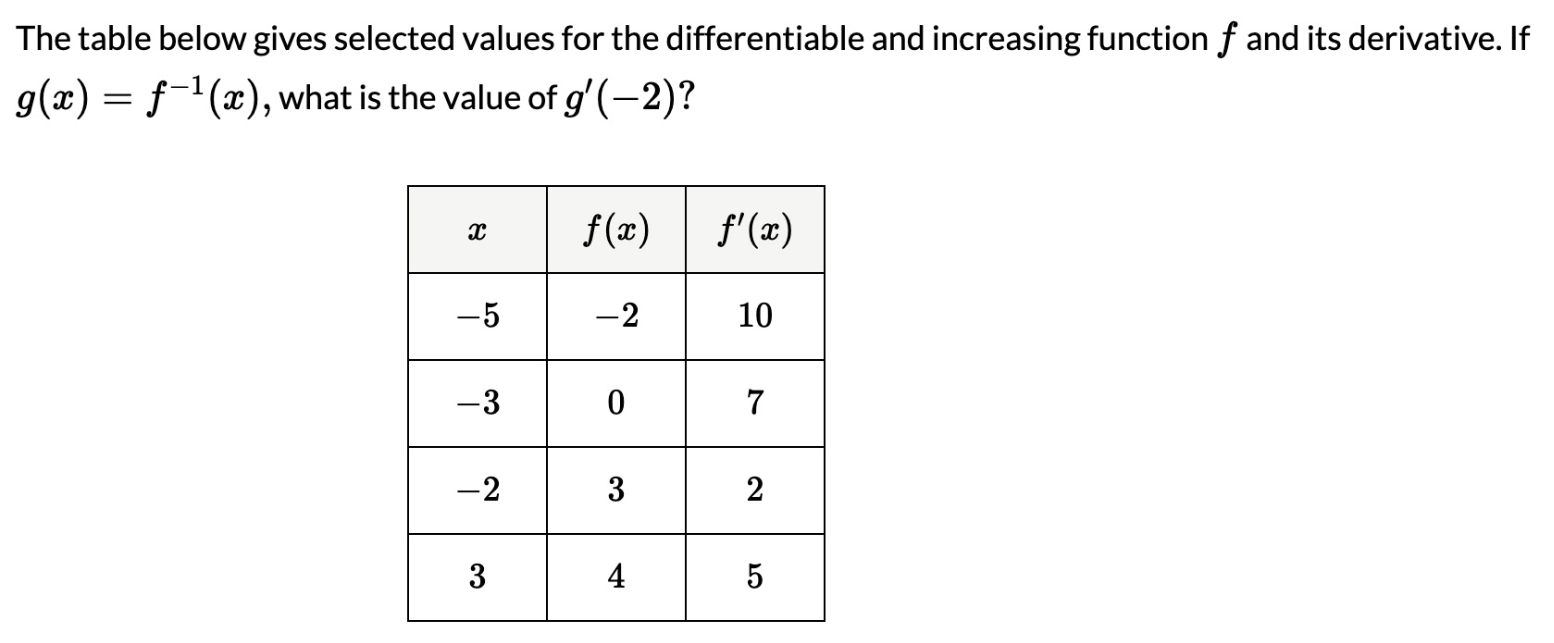
g'(-2)=1/10
500
A ladder 25 feet long is leaning against the wall of a house. The base of the ladder is pulled away from the wall at a rate of 2 feet per second. Find the rate at which the angle between the ladder and the wall of the house is changing when the base of the ladder is 7 feet away from the wall.
(d theta)/dt=1/12 (rad)/sec
500
At a sand and gravel plant, sand is falling off a conveyor belt and onto a conical pile at a rate of 10 cubic feet per minute. The diameter of the base of the cone is approximately three times the altitude. At what rate is the height of the pile changing when the pile is 15 feet high?
(dh)/dt= 8/(405pi)(ft)/min