Limits and Continuity
Derivatives
Applications of Derivatives
Definite Integrals
Application of Integrals
100
Which type of discontinuity is shown in the graph below?
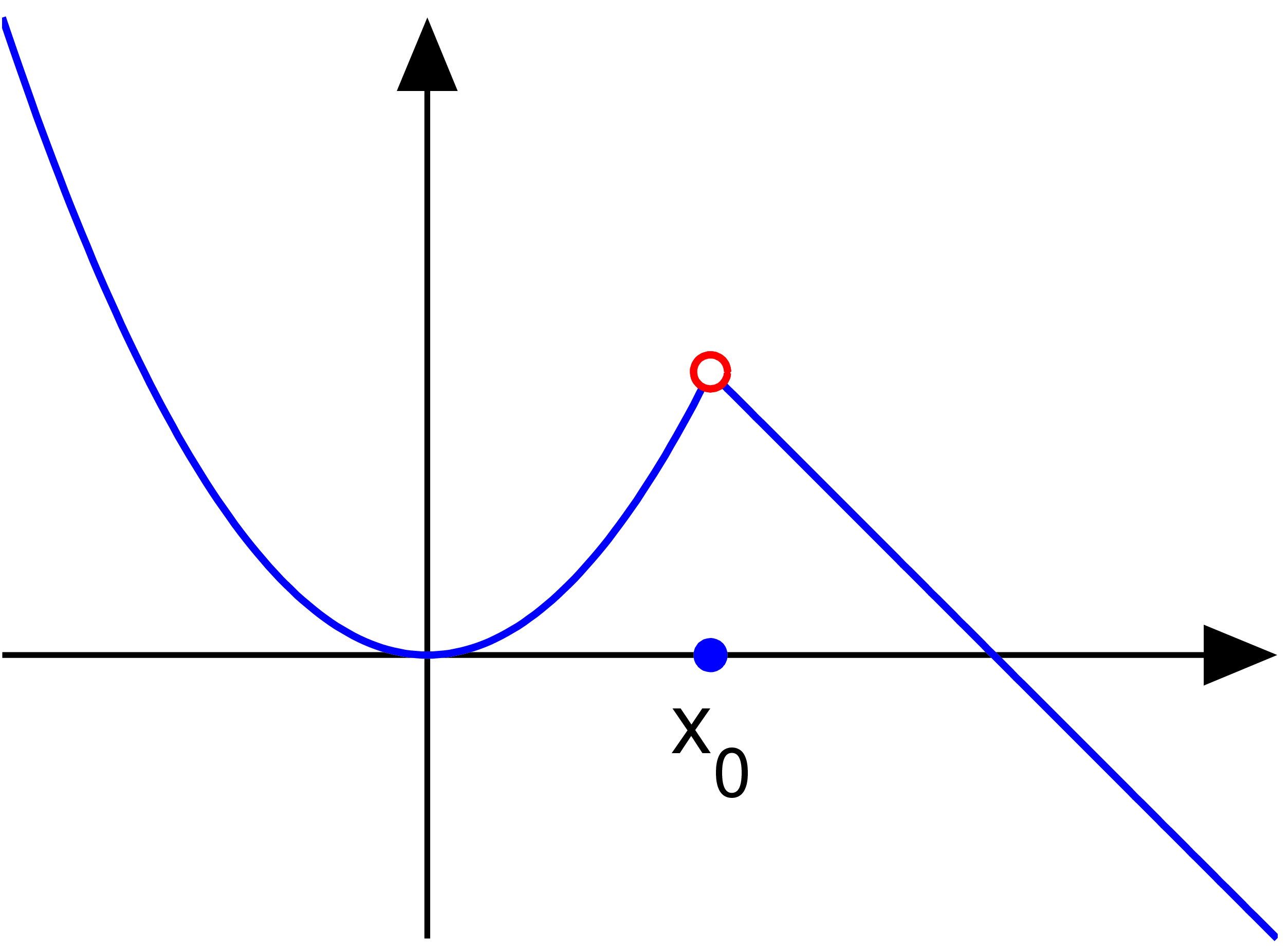
What is a removable discontinuity.
100
Determine the derivative of function f(x) at x=2
f(x)=5x^3 - 2x^2 - 5x + 8
What is 47
100
Determine the concavity of f(x) at x=3
f(x)= 2x^3 - 15x^2 + 7x + 35
What is concave up.
100
Use u substitution to solve for the integral of
xcos(5x^2)dx
What is 1/10*sin(5x^2)+c
100
Given the functions x^2ln(1+x^3) and x, determine the equation for the larger and smaller radius when the area between curves from x=0 to x=1.127 is revolved about the line y=2.
Larger radius: 2-(x^2ln(1+x^3)
Smaller radius: 2-x
200
Evaluate the limit as x approaches 3 of
(x^3 - 27) /(x-3)
What is 27
200
Use implicit differentiation to evaluate dy/dx at (3,2)
3x^3+ xy^2=6x - y
What is 79/-13.
200
Does f(x) have a local min, max, or neither at x =2
f(x)= 4/3x^3 - 1/2x^2-14x
f(x) has a local minimum at x=2.
200
Given that g(x)= the integral from 0 to x of
5x^2-8x+3. Find g'(2).
What is 7.
200
Given the function e^x, write but do not evaluate the integral expression for when the area enclosed by the x axis and y axis and the function e^x is the base of a solid with square cross sections.
What is the integral from 0 to 2 of e^2x dx.
300
How can it be determined if a function is continuous at a point?
What is when a function's left and right hand limits equal each other and are also equal to f(x) at that point.
300
Determine the derivative for the function f(x)=cos(2x^2 +5x)
What is -sin(2x^2 +5x)* (4x+5)
300
The area of a circle is increasing so that at the moment that the radius of the circle is equal to 3cm, the radius of the circle is increasing at a rate of 2cm/sec. At the instant when the radius of the circle is 3 cm, at what rate is the area of the circle increasing?
What is 12pi cm^2/sec.
300
Solve for the integral from 0 to 4 of (3x-4)^2 dx.
What is 64.
300
Given the equation y=1/2x^1/3, write but do not solve for the integral expression giving the volume of the solid created when the function is revolved about the y axis from x=0 to x=2.
What is pi* the integral from 0 to 0.63 of ((2y)^3)^2dy.
400
Does f(x) have a horizontal asymptote, and if so at what value of x?
f(x)=4x^3-2x/x^3+5
What is f(x) has a horizontal asymptote at x=4.
400
Where are derivatives undefined?
What is corners, cusps and vertical tangents.
400
Evaluate the limit as x approaches 5 of
(3x^2-12x-15)/(x-5)
What is 18.
400
Find the average value of the function f(x) on the interval [1,4], when f(x)=2x^2-3x+8
What is 14.5.
400
Given the function f(x)=lnx from x=1 to x=5, write but do not evaluate an integral expression for the volume of the solid created when the funtion is revolved around the x axis.
What is pi*the integral from 1 to 5 of (lnx)^2 dx.
500
Given the continuous function f(x), is f(x) equal to 0 at some point on the interval [0,5] according to the table below?
x: 0 1 2 3 4 5
f(x):9 5 3 -1 -6 -8
Yes, according to the IVT there must be at least one value of x on the interval 0 to 5 where f(x) is equal to zero.
500
Determine the function f'(x) given
f(x)= e^2x + sin^3 (x)
What is f'(x)= 2e^2x+3sin^2 (x)*cos(x)
500
Given that for a function, dy/dx=7 at the point (2,8), what is an approximation for the value of the function at x=2.1?
What is 8.7.
500
Approximate the integral from 0 to 4 using the values in the table below with 4 equal subintervals and a left Reimann sum approximation.
x:0 1 2 3 4
f(x):4 7 9 5 1
What is 25.
500
The velocity of a particle is given by the function
v(t)= x^3-2x^2-x
Find the total distance traveled by the particle from time t=0 to time t=3
What is 5.355.