Vocabulary
The Demographic Transition Model
Population Pyramids
More Vocab
Odds and Ends
100
The scientific study of human populations, focusing on size, structure, distribution, and changes driven by fertility, mortality, and migration. Characteristics of population, which would include things like % of men and women or % of racial/ethnic groups within a population.
Demography or Demographics
100
This model shows death rates, birth rates and RNI for a country. It has 5 stages and can help determine the development of a country.
Demographic Transition Model
100
What statistical information does a Population Pyramid show (What does each bar represent)?
Percentage of population for each age group (male and female) within a country.
100
A government policy intended to increase the birth rate of a country (example would include tax breaks for having children or parental paid leave after birth of child).
Pro-natalist
100
A type of forced migration where the migrants are fleeing a country due to war, famine, or persecution.
Refugees
200
The largest number of people that the environment of a particular area can support
Carrying Capacity
200
Stage 3 of the DTM shows a country with declining Birth Rates, declining Death Rates, as population growth begins to slow. Comparing to Wallerstein's model of economic development would this country be a core, semi-periphery, or periphery country?
Semi-periphery
200
What shape will a stage 2 population pyramid show (slowing death rates with high birth rates)?
Triangular (true pyramid)
200
These policies are examples of what?
- Expanding access to birth control and family planning
- Expanding education and economic opportunities for women
- Supporting small business loans for young women to start a business
- China's "one child" law
Anti-natalist Policies
200
Three of the top five most populated countries in the world.
India, China, United States, Indonesia, Pakistan
300
The growth rate of a population excluding immigration - calculated by subtracting the crude death rate from the crude birth rate per 1000 people.
Rate of Natural Increase (RNI)
300
Name a country that would be in Stage 5 of DTM - plateaued or declining population.
Japan, South Korea, Germany, Italy, Spain, or several east european countries (Bulgaria, Croatia, Estonia, Greece, Portugal, and Russia )
300
Seen here... is a population pyramid of Mexico, which is in this stage of the DTM? 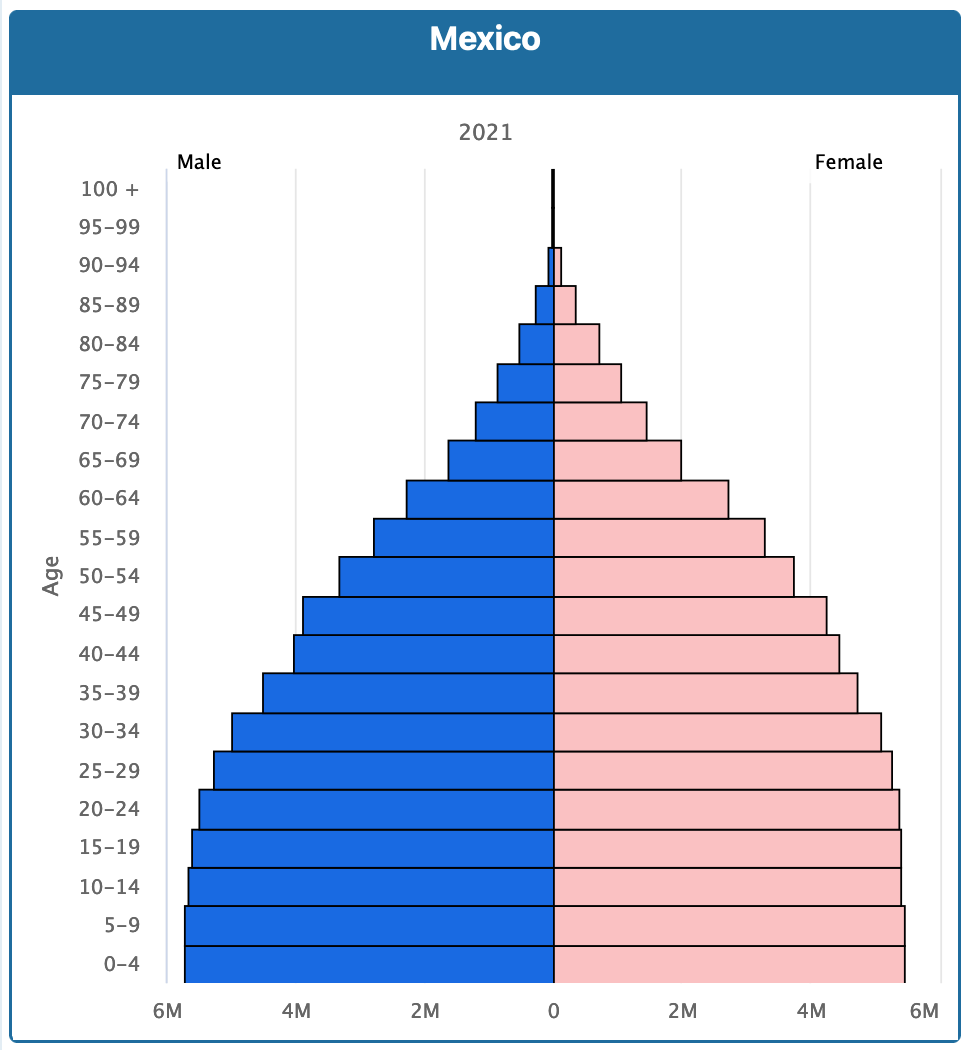
Stage 3, (Lowering birth rates, low death rates, lower natural increase)
300
A type of migration that occurs when people follow earlier migrants to join them in a new country (usually family or religious communities with some connection).
Chain Migration
300
The ratio comparing those who are too young or too old to work (therefore needing economic support) compared to the economically active who can care for themselves.
dependency ratio
400
This English economist that argued that population will grow to a point of overwhelming the carry capacity of the planet. Later debunked by the 2nd Agricultural and Industrial Revolution.
Thomas Malthus or Malthusian Theory
400
Due to widespread medical advances over the past 75 years, this stage of the DTM no longer has any countries representing it.
Stage 1
400
What stage is this pyramid?
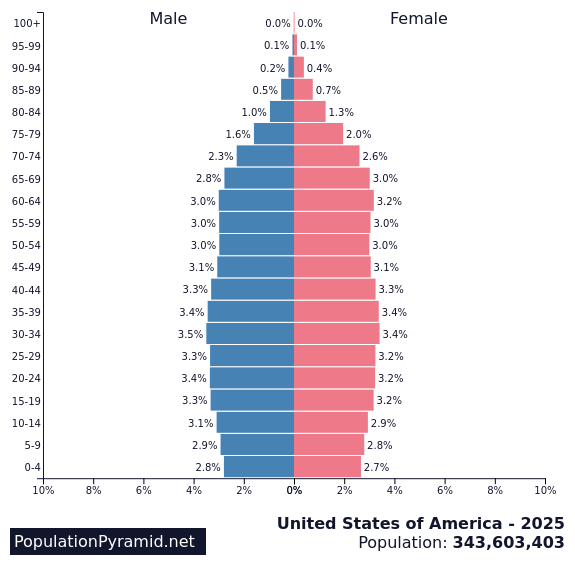
Stage 4 (fast slowing RNI but still positive growth)
400
Having a high rate of this means there is a large portion of children younger than 1 dying due to illness, disease or hunger.
Infant mortality
400
In the Epidemiological Transition, this is the "stage of pestilence and famine" - death rates are as high as birth rates.
Stage 1
500
Factors that either cause people to be attracted to migrate to a country/place or migrate away from a country/place.
Push and Pull Factors
500
The two approaches to reducing birth rates in countries that will lead to stage 3 DTM conditions..
Education (especially for women) and Contraception (family planning)
500
This pyramid of the United Arab Emirates shows an anomaly in the male population caused by what (related to rapid development)?
Guest worker program for construction
500
The most common type of internal migration over the past 100 years.
Rural to Urban Migration
500
In countries suffering from persistent political instability, persistent economic troubles, and/or persistent violence, many educated elites become emigrants to other countries. This compounds issues of economic and political stability for the country. This phenomena is known as ....
Brain Drain