Joint Mechanics
Bones & Landmarks
Hip & Thigh Muscles
Lower Leg & Foot
Ligaments & Injuries
Skull Anatomy
Image Identification
100
Which joint allows movement of the scapula relative to the thoracic wall but is not considered a true synovial joint?
Scapulothoracic articulation
100
Which large opening in the hip bone allows passage of nerves and blood vessels and is mostly covered by a membrane?
Obturator foramen
100
What is the primary action of the iliopsoas?
Hip flexion
100
Which large superficial calf muscle crosses both the knee and ankle?
Gastrocnemius
100
Which ligament connects the coracoid process to the acromion, forming an arch over the humeral head?
Coracoacromial ligament.
100
Which bone forms the upper jaw?
Maxilla
100
What structure is highlighted?
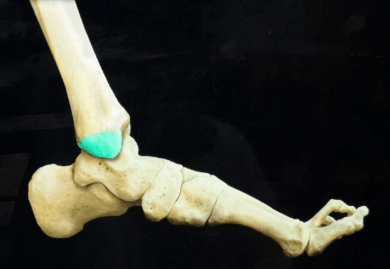
Medial malleolus
200
Which movements occur primarily at the subtalar joint?
Inversion and eversion
200
What bony prominence forms the lateral side of the ankle?
Lateral malleolus (fibula)
200
Which muscle begins at the ASIS and crosses both the hip and knee?
Sartorius
200
What are the primary and secondary actions of fibularis longus and fibularis brevis at the ankle?
Primary: Eversion
Secondary: Plantarflexion
200
Which ligament helps stabilize the medial side of the elbow against valgus stress, particularly during throwing?
Ulnar collateral ligament (UCL)
200
What suture separates the frontal bone from the parietal bones?
Coronal suture
200
What bone is highlighted in the image?
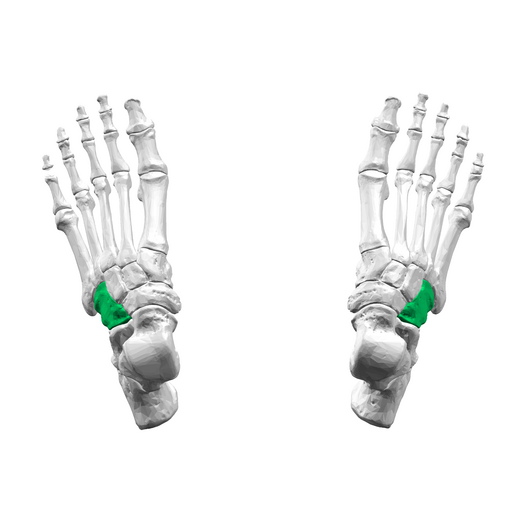
Cuboid
300
During forearm pronation, which bone rotates around the other?
Radius rotates around the ulna
300
Which femoral landmark serves as the insertion site for gluteus medius and minimus?
Greater trochanter
300
Which deep gluteal muscle passes through the greater sciatic foramen and is commonly used as an anatomical landmark for the sciatic nerve?
Piriformis
300
Which muscle is the primary dorsiflexor of the ankle?
Tibialis anterior
300
Which ligament on the medial side of the knee resists valgus stress?
Medial collateral ligament (MCL)
300
Which skull bone houses the external acoustic meatus?
Temporal bone
300
Which muscle is highlighted in the image?

Soleus
400
Why does the glenohumeral joint allow greater mobility than the humeroulnar joint? Relate your answer to their structural classifications.
Glenohumeral is a multiaxial ball-and-socket joint; humeroulnar is primarily a uniaxial hinge joint
400
Which bone of the foot articulates directly with the tibia to form the ankle joint?
Talus
400
Which muscle in the medial thigh has both an adductor portion and a hamstring portion, and how do their primary actions differ?
Adductor magnus.
The adductor portion primarily adducts the hip, while the hamstring portion primarily extends the hip.
400
Which intrinsic foot muscle flexes the great toe at the metatarsophalangeal (MTP) joint and has two heads with sesamoid bones embedded in its tendons?
Flexor hallucis brevis
400
A patient sustains an ankle injury involving excessive eversion. Which ligament complex on the medial side of the ankle is most likely stressed or injured?
Deltoid ligament complex
400
Which bone forms much of the posterior roof of the nasal cavity and contains the sella turcica?
Sphenoid bone
400
What muscle is highlighted in the image?

Abductor hallucis
500
Why is the knee more vulnerable to rotational stresses when flexed than when fully extended?
Flexion permits greater tibiofemoral rotation, while full extension places the joint in a more stable, locked position
500
Which bony projection of the pelvis bears much of your weight when sitting?
Ischial tuberosity
500
During the lowering phase of a squat, which major muscle group eccentrically controls knee flexion?
Quadriceps femoris
500
The lumbricals of the foot produce an unusual combination of movements at the toes. What are these two movements, and at which joints do they occur?
Flexion at the MTP joints and extension at the interphalangeal (IP) joints of toes 2–5
500
A football player sustains a turf toe injury when their foot is planted and the great toe is forcibly bent upward. What movement causes this injury, and which joint is primarily affected?
Hyperextension of the first metatarsophalangeal (MTP) joint, which can injure the plantar capsuloligamentous structures.
500
Which two cranial bones form the majority of the cranial vault's roof and lateral walls, and which suture separates them from the occipital bone?
Parietal bones; lambdoid suture.
500
Which muscles is highlighted in the image?

Adductor brevis
1000
A patient has difficulty extending the hip and flexing the knee following an injury to the posterior thigh. However, they can still flex the knee to some extent.
Identify two muscles that could be affected, explain why both movements are impaired, and name one muscle outside the hamstring group that could help preserve knee flexion.
Semitendinosus and semimembranosus (or biceps femoris long head) contribute to hip extension and knee flexion because they cross both joints.
Sartorius or gracilis can assist with knee flexion.