Unit 1
Unit 2
Unit 3
Calculator Questions
FRQ Questions
100
The table is best modeled by a quadratic function because successive 2nd differences of output values over equal-length input values are constant. Find the value of n.
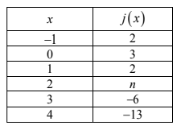
n = -1
100
The value of a new truck is modeled by the function D. The value of the truck is expected to decrease by 16% each year. At time t = 0 years, the value of the truck was $46,800. Write an expression that gives the value of the truck after m months.
46800(0.84)^(m/12)
100
Two full periods of the periodic function h are shown. What is the function doing on the interval x=30 to x=32?
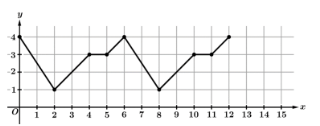
The function is decreasing on the interval.
100
What is my favorite app/calculator?
Desmos <3
100
A fidget spinner spins in a counterclockwise direction. The distance from the center to point S on the tip of the spinner is 4 centimeters. At time t = 0 seconds, the point S on the tip of the spinner is 12 centimeters from the edge of the table. The spinner completes 50 revolutions every second. As the spinner rotates at a constant speed, the distance between the edge of the table and the point S periodically increases and decreases. The periodic function h models the vertical distance, in centimeters, between the point S and the edge of the table as a function of time t in seconds.
What is the amplitude of the function?
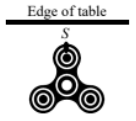
Amplitude is 4 cm.
200
A polynomial function p is given by the function below. What are all the intervals on which p(x)<0?
p(x)=-x^2(x-2)(x+3)
(-oo, -3) and (2, oo)
200
Which of the following is true about the exponential function given by h(x)=5(1/3)x?
(A) h is always increasing, and the graph of h is always concave up
(B) h is always increasing, and the graph of h is always concave down
(C) h is always decreasing, and the graph of h is always concave up
(D) h is always decreasing, and the graph of h is always concave down
C
200
The location of a point on the plane is given below. What is another representation for this point?
(5, (7pi)/6)
(-5, pi/6)
(5, (-5pi)/6)
(-5, (-11pi)/6)
200
The period function is given below. What is the period of the function P?
P(x)=sin(2.6x)+2cos(0.8x)
Period = 31.41593
200
Find all values of x for which f(x) = 1, or indicate that there are no such values.
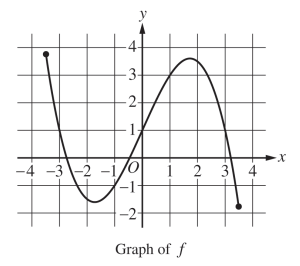
x = -3, 0, and 3
300
The function r is given below. What is the equation of the graphs horizontal asymptote?
r(x) = (4x^3-x^2+5)/(2x^3+x^2+3)
y = 2
300
For x>0, rewrite the expression with only one natural log.
ln(x+3)-2ln(x)-ln(x+4)
ln((x+3)/(x^2(x+4)))
300
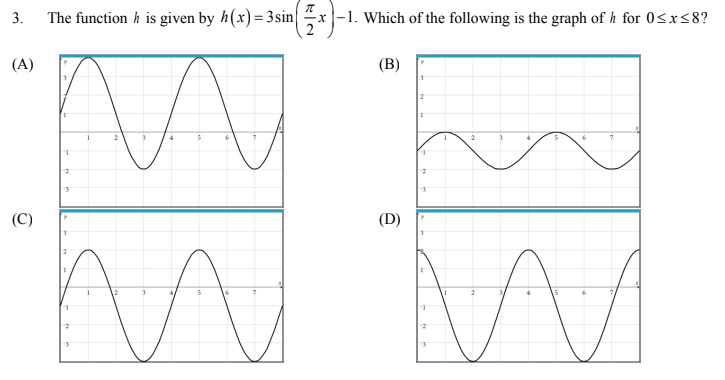
C
300
The table presents values for a function f at selected values of x. A logarithmic regression is used to model the data. What is the value of f(15)?
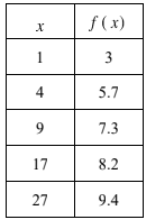
f(15) = 8.17661960065
300
On the initial day of sales (t = 0) for a new video game, there were 40 thousand units of the game sold that day. Ninety-one days later (t = 91), there were 76 thousand units of the game sold that day.
Find the average rate of change of the number of units of the video game sold, in thousands per day, from t = 0 to t = 91 days.
36/91
0.3956
400
Which type of function would you use to represent the data? How do you know?
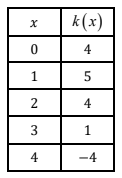
Quadratic, there is second difference or the change in average rates of change is constant.
400
The function f is defined below. Solve f(x) = 2 for all values of x.
f(x)=log_2(x+3)-log_2(2)
x = 5
400
The figure shows the graph of the sinusoidal function, f(x) = a cos(1/2x) + d. What is the product of a and d?
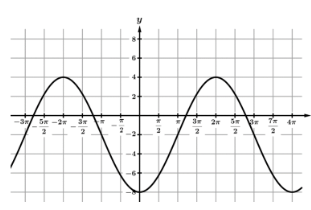
a = - 3
d = - 4
Product = 12
400
The function k is below. What is happening to k and the rate of change of k on the interval (0.8, 3)?
k(x)=3.5sin(0.6x+1.1)
The function k is decreasing, and the rate of change is decreasing.
400
Solve the equation below
e^(x+3)=10
ln(10)-3
500
The function g is defined below. For what values of x is g(x) = 0?
g(x) = (x^2-2x-3)/(1-x^2)
x = 3 only!
500
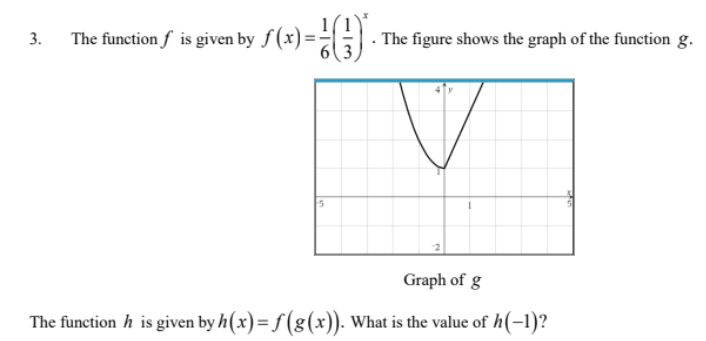
h(-1) = 1/54
500
Rewrite this expression using only sin(x).
(sin(2x)tan(x))/(csc(x))
2sin^3(x)
500
The function below is given where k is a constant. If R(5) = 21.3, what is the value of R(3)?
R(t) = 8.4ln(1.7t+k)
k = 4.12545
R(3) = 18.665
500
Rewrite this expression using only tan(x).
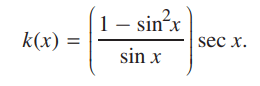
k(x) = 1/(tan(x))