UNIT 0 + 1 (ALL WORTH 500 B/C OF HEAVY VOCAB)
UNIT 2 COGNITION
DEVELOPMENT AND LEARNING UNIT 3
SOCIAL PSYCHOLOGY UNIT 4
MENTAL AND PHYSICAL UNIT 5
100
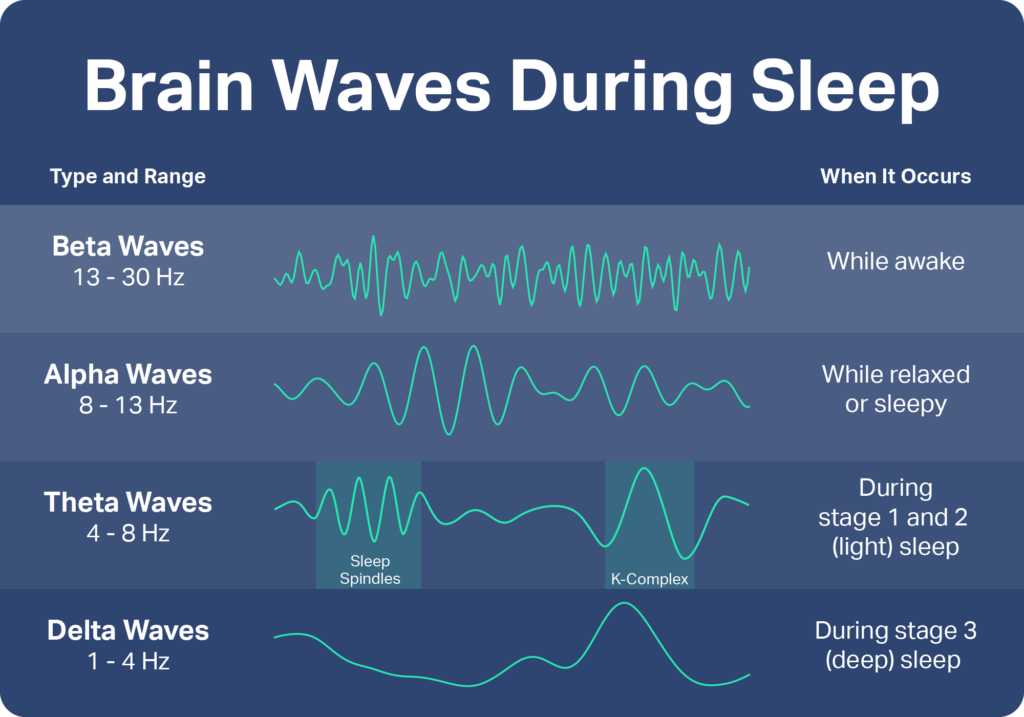
Name and define all stages of sleep, AND WHAT WAVES ARE IN EACH!
Awake, NREM 1 (Hypnogogic Sensations), NREM 2, (Sleep spindles, K Complexes) NREM 3, REM
1. Awake - beta waves (alert) or alpha waves (tired/relaxed)
2. NREM 1 - Light sleep alpha waves, hypnogogic hallucinations (vivid, dream-like sensory experiences, usually visual, auditory, or tactile, that occur while falling asleep
3. NREM 2 - Deeper Sleep theta waves, sleep spindles, (Brief .5-2 second bursts of rapid brain activity) K-complexes (High voltage waveform)
4. NREM 3 - Deep sleep, delta waves, slow breathing/heart rate
5. REM (rapid eye movement) - temporary paralysis, irregular breathing, elevated heart rate, beta waves, called paradoxical sleep: brain “seems” awake, but you really are asleep, very important to get REM sleep
100
What type of memory stores information briefly before either forgetting or encoding it
Short-term memory
(Sensory information is also acceptable)
100
The Piaget stage in which children engage in pretend play, and experience egocentrism, but lack conservation or abstract logic is _______
Preoperational
100
An advertisement that utilizes celebrities and emotional music rather than logical evidence relies primarily on _______ persuasion
Peripheral route persuasion
100
For several weeks, Noah feels hopeless, exhausted, loses interest in hobbies, and struggles sleeping. This MOST likely describes: _________ Disorder
Major depressive disorder
200
Name all parts of the Cerebrum, and Brainstem, and their function
Frontal Lobe – Decision-making, personality, voluntary movement
Motor Cortex – Controls voluntary muscle movements
Prefrontal Cortex – Planning, judgment, impulse control
Broca’s Area – Speech production
Parietal Lobe – Processes touch and body position
Somatosensory Cortex – Registers touch and sensory input
Temporal Lobe – Hearing, memory, language
Amygdala – Processes emotion, especially fear and aggression
Hippocampus – Forms and stores new memories
Auditory Cortex – Processes sound
Wernicke’s Area – Language comprehension
Occipital Lobe – Visual processing
Visual Cortex – Interprets visual information
Pons – Sleep, arousal, and facial movements
Midbrain – Movement and auditory/visual processing
Medulla – Controls heartbeat and breathing
Thalamus – Sensory relay station (except smell)
Hypothalamus – Maintains homeostasis, drives, hormones
Corpus Callosum – Connects left and right hemispheres
Pineal Gland – Regulates sleep via melatonin
200
The Smallest Distinctive sound unit in language is called a...
Phoneme
200
Alexa's parents enforce strict rules with grades and friends, have high expectations for their child, and shows little to no warmth and comfort when she is upset. Alexa's parents utilize _________ Parenting style
Authoritarian
200
During class, almost everyone gives the same incorrect answer aloud, Jordan knows it is wrong but agrees anyway to avoid standing out. This BEST demonstrates __________ Social Influence
Normative Social Influence
200
After episodes eating unusually large amounts of food, Tyler forces vomiting and excessive exercise repeatedly. This MOST likely describes _______
Bulimia nervosa
300
Name all parts of the neuron/neural communication, and their purpose
Dendrites, Soma, Axon, Myelin Sheath, Nodes of Ranvier, Axon Terminals, Synapse/Synaptic Cleft, Reuptake, Glial Cells, Afferent Neurons, Efferent Neurons
Dendrites: Branch-like extensions at the start of a neuron that receive chemical messages from other neurons via receptor sites.
Soma (Cell Body): Contains the nucleus, maintaining the cell's health and integrating incoming signals.
Axon: A long fiber that carries the electrical impulse (action potential) away from the soma towards other neurons or muscles.
Myelin Sheath: A fatty tissue layer covering the axon that insulates it and speeds up the neural impulse.
Nodes of Ranvier: Gaps in the myelin sheath that help propagate the action potential as it moves along the axon.
Axon Terminals (Terminal Buttons): Endpoints of the axon that release chemical messengers called neurotransmitters.
Synapse (Synaptic Gap/Cleft): The tiny space between the axon terminal of one neuron and the dendrites of the next, where communication occurs.
Reuptake: The process by which excess neurotransmitters are reabsorbed by the sending neuron.
Glial Cells: Support cells that provide nutrients and protect neurons by creating the myelin sheath.
Afferent (Sensory) Neurons: Carry information from the body to the brain and spinal cord.
Efferent (Motor) Neurons: Carry commands from the central nervous system to muscles and glands.
300
A student is unable to solve a problem because they only view an object traditionally. This illustrates:
Functional Fixedness
300
An employee receives a paycheck every friday. This is a _______ Interval
At a local coffee shop, buying 10 coffees will get the 11th one free. This is a ______ Ratio
Fixed Interval
Fixed Ratio
300
After seeing someone trip in hallway, Ava immediately assumes clumsiness rather than considering slippery floors. Ava demonstrates ____________
Fundamental attribution error
300
A client with social anxiety avoids parties because they believe, "If I speak, I will sound stupid and everyone will hate me. The therapist helps the client identify this as "catastrophizing" and challenges them to reframe it as, "I might have a good conversation, and even if I stumble, people likely won't care". This is an example of ________ ________ Therapy
Cognitive Behavioral Therapy
400
Define all relevant research methods in psychology
Experiment, Correlational Study, Survey, Naturalistic Observation, Case Study, Longitudinal, Cross-Sectional
Experiment – Manipulates variables to determine cause-and-effect relationships
Correlational Study – Measures relationship between variables without determining causation
Survey – Collects self-reported data from participants
Naturalistic Observation – Observes behavior in a natural environment without interference
Case Study – In-depth analysis of one individual or small group
Longitudinal Study – Studies the same group over a long period of time
Cross-Sectional Study – Compares different groups at one point in time
400
After seeing several stories about plane crashes on the news, Regina fear getting on planes and avoids traveling. This is a ___________ Heuristic
A Hiring manager overlooks a candidate with tattoos because they do not fit the managers prototype of a "professional" despite the candidate being qualified this is a __________ Heuristic
1. Availability heuristic
2. Representative Heuristic
400
Urie Bronfenbrenner (You do not need to know his name), Developed the Ecological Systems Theory, The system involving Cultural values, laws, customs, and societal norms is _______
Macrosystem
400
After spending hundreds on concert tickets, Maya insists the performances were amazing despite secretly feeling disappointed. Maya's reaction best illustrates ________
Cognitive Dissonance
400
Following the sudden death of a family member, Maria, a Puerto Rican woman, begins to shout uncontrollably, trembles, cries uncontrollably, and feels a heat in her chest rising into her head. According to her culture, this episode is known as __________
Ataque de Nervios
500
Give a short summary of each of the approaches to psychology
Behavioral, Biological, Cognitive, Evolutionary, Psychodynamic, Socio-Cultural, Biopsychosocial
Behavioral How we learn observable responses
Biological How the body and brain enable emotions, memories, and sensory experiences; how our genes and our environment influence our individual differences
Cognitive How we encode, process, store, and retrieve information
Evolutionary How the natural selection of traits has promoted the survival of genes
Humanistic How we achieve personal growth and self-fulfillment
Psychodynamic How behavior springs from unconscious drives and conflicts
Social-cultural How behavior and thinking vary across situations and cultures
Biopsychosocial How the brain and nervous system influence mental processes and behavior
500
You recently updated your bank password, but when logging in, you keep typing your old password instead of the new one. This is ______ Interference
Ms. Deckinger is trying to remember the name of an old student who came up to her in a grocery store, but cannot recall it because of her memorizing her new roster. This is ______ Interference
1. Proactive Interference
2. Retroactive Interference
500
Giving a child a compliment or candy for a Job well done is __________
Putting on a seatbelt to stop a car's annoying beeping is __________
Giving extra assignments to a student who is talking in class is __________
Taking away screen time because a child broke a rule is _________
Positive reinforcement
Negative reinforcement
Positive punishment
Negative punishment
500
Several people witness someone collapse in crowded mall, but nobody immediately helps because everyone assumes another person will act. This situation BEST demonstrates ________
Diffusion of responsibility
500
A student has to cope with a month-long high stakes final project. The student receives the project outline and realizes it counts for 50% Of their grade, (1) Then the student works on the project for three weeks, staying up late, consuming large amounts of coffee, and studying during lunch. (2) Immediately after turning in the project, the student stops taking precautions and gets extremely sick with a high fever or flu (3)
According to the General Adaptation Syndrome, what 3 stages does this scenario consist of.
1. Alarm Reaction
2. Resistance
3. Exhaustion