Energy and Chemical Reactions
Enzymes
Cell biology
Tsc/Tsl/Cell cycle/division
Tissues
100
What particle is gained or lost in oxidation-reduction reactions?
electrons
100
What is the role of an enzyme?
It acts as a biological catalyst
100
Name five different organelles and their functions, and mention if they are membrane-bound or non-membrane bound.
i. Membrane bound
-Smooth endoplasmic reticulum: synthesis, transport, storage of lipids, carbohydrate metabolism, detoxification of drugs, alcohols, and poisons,
- Rough endoplasmic reticulum: protein and peroxisome production,
- Golgi apparatus: modifying, packaging, sorting proteins, formation of secretory vesicles and lysosomes
- Lysosomes: contain digestive enzymes that digest contents of unneeded substances
-Peroxisomes: contain oxidative enzymes that serve in detoxification (hydrogen peroxide); used to oxidize other substances
-Mitochondria: powerhouse--produces cellular energy
-Vesicles (temporary membrane bound structures): transport of molecules from one place in the cell to another.
ii. Non membrane bound
-Ribosomes: contine protein and rRNA (large and small subunits) important in translation and protein synthesis
-Centrosome: organizes microtubules within the cytoskeleton, used in cell division to form mitotic spindle
-Proteasome: degrades cell proteins through ATP dependent pathway when marked with ubiquitin
- Cytoskeleton: anchoring, intracellular support, organization of organelles, cell division, movement (microfilaments, intermediate filaments, microtubules)
100
What is the order of the stages of mitosis?
Prophase
Metaphase
Anaphase
Telophase
100
From the apical side (outermost layer) to the basal side (deepest layer), what are the five layers of thick skin?
Stratum corneum (apical)
Stratum lucidum
Stratum granulosum
Stratum spinosum
Stratum basale (basal layer)
200
Give an example of potential and kinetic energy.
Potential: stored energy--membranes storing charges, a ball sitting on top of a hill, etc
Kinetic: energy of motion--heat, chemical bonds breaking, running, etc.
200
What part of the enzyme gives it specificity?
active site
200
A cell is 3.0 NaCl mM, and it's placed into 6.0 NaCl mM solution. If NaCl is non-penetrating, what will happen to the cell's shape?
The cell is placed in a hypertonic solution--it's more concentrated with solute and less concentrated with water. Since water flows down its concentration gradient (high to low), water flows from inside the cell (where the water concentration is high) to the surrounding solution, causing the cell to shrink.
200
What are replication, transcription, and translation?
Replication: DNA-->DNA
Transcription: DNA-->mRNA
Translation: mRNA-->DNA
200
What is the difference between atrophy and necrosis?
atrophy: is a shrinkage of tissue by decrease in cell number/size and may result from normal aging.
necrosis: sudden, irreversible tissue death caused by an inflammatory response in tissue in response to damage
300
Compare and contrast reversible and irreversible reactions.
Irreversible reactions: Net loss of reactions and net gain in products over time.
Reversible: no net change in concentration of reactants and products, meaning t he reactants become reactants and products at an equal rate.
300
What is enzyme saturation?
-Enzymes have an active site where substrates bind. Increasing the substrate concentration increases the rate up to the point of saturation, where all the enzymes have a full binding site. This is where an enzyme's activity tapers off.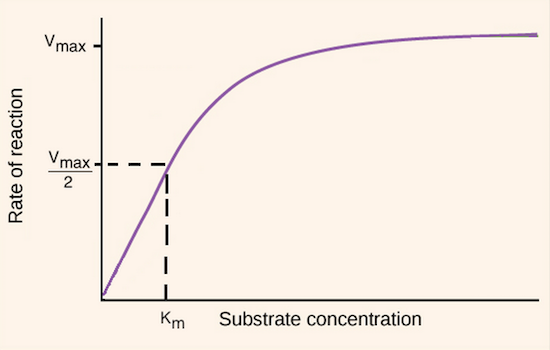
300
Compare and contrast the different types of passive membrane transport.
All passive processes don't require a energy and depend on a concentration gradient.
Simple diffusion: occurs in small, nonpolar molecules without the help of any type of protein.
Facilitated diffusion: occurs in small charged or polar solutes with the assistance from proteins. Two types: channel-mediated and carrier mediated. carrier mediated uses a transport binding through conformational changes, while channel-mediated uses a channel specific for one ion type (can be gated or leaky)
Osmosis: passive flow of water through aquaporins (always open) or through the phospholipid bilayer
300
How is DNA different from RNA?
DNA: deoxyribonucleic acid
- double stranded connected by hydrogen bonds
-uses bases A,T,G,C
-uses deoxyribose as sugar
RNA: ribonucleic acid:
-single stranded
-Uses bases A,U,G,C
-uses ribose as a sugar
300
What are the four types of tissues? Give an example of each.
Epithelial: simple squamous, simple cuboidal, simple columnar, pseudostratified columnar (ciliated/nonciliated), stratified squamous, stratified cuboidal, stratified columnar, transitional
connective: connective tissue proper (loose: areolar, adipose, reticular, Dense: regular, irregular, elastic), cartilage (hyaline, elastic, fibrocartilage) bone (compact, spongy), blood
muscle: skeletal muscle, cardiac muscle, smooth muscle
nervous: nerve cell, neuron, microglia
400
Compare and contrast decomposition, synthesis, and exchange reactions.
Decomposition: AB-->A+B, catabolism, hydrolysis, exergonic
Synthesis: A+B-->AB, anabolism, dehydration synthesis, endergonic
Exchange: AB+CD-->AC+BD; oxidation-reduction.
400
List the factors that increase enzyme reaction rate. What factors regulate enzymes?
a. -increased enzyme concentration
-increased substrate concentration
-normal to slightly elevated body temperature
-optimal pH (between 6 and 8 for most enzymes)
b. -Kinases: addition of a phosphate group; dephosphorylation: removal of a phosphate group.
-inhibitors
-in some cases, enzymes need cofactors to function properly
400
Describe the differences in mRNA, tRNA, and rRNA.
mRNA is directly transcribed from DNA to form proteins after translation.
tRNA is used during translation to help build the amino acid chain to form the polypeptide.
rRNA is a part of the ribosome, which aids in protein synthesis (translation)
400
What changes must pre-RNA undergo to become mature RNA?
1. splicing, by the spliceosome
exons: coding sequences that are expressed, made into proteins.
introns: noncoding sequences that are removed from the pre-RNA.
2. capping: Guanine bonds to the lead end of the mRNA to help prevent digestion by enzymes in the cytoplasm
3. poly-A tail: removal of terminal segments of mRNA. additional adenine nucleotides added to tail.
400
What are the five characteristics and four functions of epithelial tissue?
avascularity
polarity
attachment to basement membrane
extensive innervation
high regeneration capacity
functions
physical protection
selective permeability
secretion
sensation
500
Describe the process of ATP cycling.
ATP cycling is the continuous formation and breakdown of ATP through oxidation-reduction reactions. ATP is formed from the energy released in exergonic reactions from the oxidation of food molecules. ADP+P--->ATP TAKES energy, so it's an endergonic process.When the body needs energy, ATP is oxidized back into ADP and P, which releases the energy stored in the bond (exergonic). 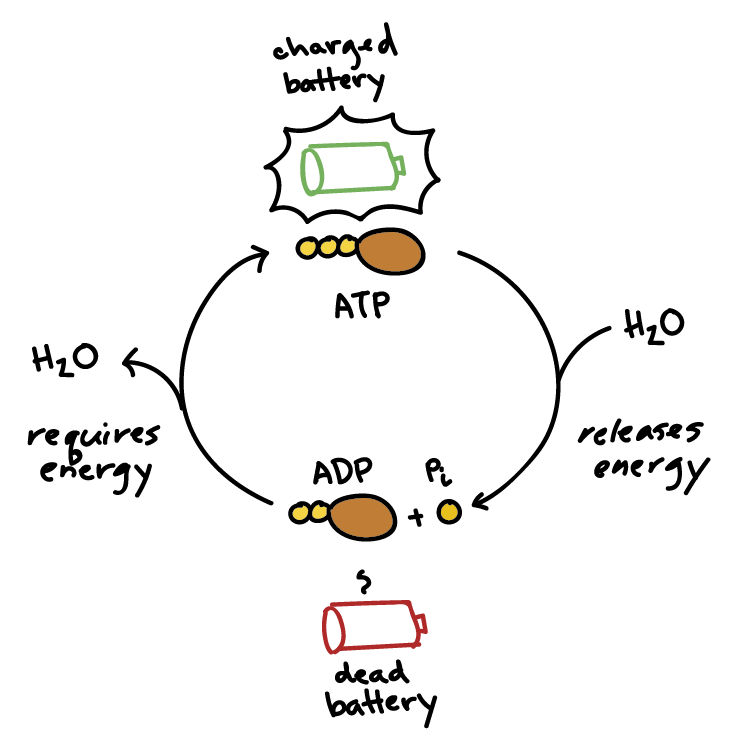
500
What is the difference between competitive and noncompetitive inhibition in regards to the substrate chemical structure, concentration of substrate and reaction rate?
-competitive inhibitors are chemically similar to the substrate, so they “compete” for the active site. With a greater substrate concentration, less competitive inhibitor will occupy the site and the reaction rate will increase.
-Noncompetitive inhibitors don’t resemble the substrate, so they bind to the allosteric site on the enzyme. This induces a conformational change to the enzyme and active site, so the reaction rate slows significantly and cannot be influenced by the concentration of substrate.
500
Describe vesicular transport: exocytosis, endocytosis (phagocytosis, pinocytosis, and receptor-mediated endocytosis)
Exocytosis: large substance secretion. contents released to outside the cell
endocytosis: cellular uptake of large substances from external environment
phagocytosis: when cell engulfs large particle with large extensions called pseudopodia--fuses with lysosome for digestion
pinocytosis: internalization of droplets of interstitial fluid
receptor-mediated endocytosis: requires binding to receptor, usually for bulk quantities of substances--moves specific molecules into cell. use clathrin to fold inward and shape a vesicle.
500
What is the difference between mitosis and meiosis?
mitosis makes exact copies of the cell while meiosis creates gametes
500
What are the functions of the epidermis?
-physical barrier/protection
-prevention of water loss
-metabolic regulation (vitamin D)
-secretion
-absorption