6.5 Operon Models & Prokaryotic Gene Regulation
7.5 Hardy–Weinberg equilibrium & formal population genetics math
Full biochemical pathway detail (STUDY IN DETAIL ON YOUR OWN, 400)
Standardized set of AP lab investigations
100
Prokaryotes (like bacteria) often organize related genes into clusters called: _______
They include:
- structural genes (coding for proteins)
- a promoter (where transcription begins)
- an operator (where regulatory proteins bind)
- a regulatory gene (which produces a regulatory protein)
All genes within this cluster are transcribed together into a single mRNA, then translated into multiple proteins. This is efficient for prokaryotes because related proteins are often needed at the same time.
What is "Operons"
100
What is the Hardy-Weinberg Equilibrium
Theoretical model that describes how allele frequencies in a population will remain constant over time in the absence of certain influences, such as natural selection genetic drift, mutation, and migration.
100
The study of energy flowing through living systems
Bioenergetics
100
4 Experimental design essentials
- Independent variable → The factor you change (e.g., light intensity)
- Dependent variable → The result you measure (e.g., rate of photosynthesis)
- Control variables → Factors kept constant (e.g., temperature, pH)
- Control group → A baseline setup to compare results
200
Identify which type of operons the following are:
LAC Operon
TRP Operon
LAC-Inducible System: normally "off" but turns "on" when needed
TRP-Repressible System: normally "on" but turns "off" when needed
200
What are the five conditions for the Hardy-Weinberg equilibrium model?
1) No mutation: new alleles are not added to gene pool (existing alleles are passed on to the next generation)
2) No selection: no natural or artificial selection is acting on the population (no alleles favored over another)
3) No gene flow: no movement of individuals between populations or migrations that introduce new or remove existing alleles
4) Infinite population size: so large that no random fluctuations in frequency (genetic drift) do not occur
5) Random Mating: completely random and not influenced by genetic or environmental factors
200
What is:
Molecular control mechanisms (e.g., transcription factors multiple control points)
Another AP topic that you have to review
200
Data Analysis strategies (5)
- Calculate means, medians, and standard deviations
- Interpret line and bar graphs
- Identify trends and patterns in experimental data
- Apply the Chi-square test for statistical significance
- Use the Hardy–Weinberg equation to calculate allele frequencies
300
Types of Regulatory Sequences
Promoters: Located right before the gene where RNA polymerase binds to start transcription, "ignition switch" for gene expression
Enhancers: Increase the rate of transcription. Can be located far away from the gene they control and still influence it by DNA looping.
Silencers: Decrease or prevent transcription, slowing or stopping gene expression.
Operators: Primarily in Prokaryotes, binding sites for repressor proteins that block transcription
300
What is the Harvey-Weinberg calculated ratios:
p^2 + 2pq + q^2 = 1
p + q = 1
p^2 represents the frequency of homozygous dominant genotype
2pq represents the frequency of heterozygous genotype
g^2 represents the frequency of homozygous recessive genotype
300
Inhibition by a binding event at a site different from the active site, which induces a conformational change and reduces the affinity of the enzyme for its substrate
Allosteric Inhibition
300
Elements of a Lab Summary Sheet:
- Title of the lab
- Key concept tested
- Variables and controls
- Expected results and explanations
- Real-world applications
400
Changes in gene expression that don't involve changes to DNA sequence. Instead they affect how accessible the DNA is to transcription machinery.
Epigenetic Changes
400
A rare genetic disorder is caused by a recessive allele, "a", in a population. The frequency of the allele in the population is 0.02. Using the Hardy-Weinberg equilibrium, calculate the frequency of the dominant allele, "A", and the frequency of individuals who are homozygous recessive (aa) and heterozygous (Aa) for the disorder.
The frequency of individuals who are homozygous recessive (aa) is: q² = 0.02² = 0.0004, or 0.04%.
The frequency of individuals who are heterozygous (Aa) is: 2pq = 2(0.98)(0.02) = 0.0392, or 3.92%.
400
Top Processes to study for AP BIO!!!
Glycolysis
Citric acid (Krebs) cycle
Electron transport & oxidative phosphorylation
Fermentation (anaerobic glycolysis)
400
Creating lab diagrams
1) Clearly label
2) Scale indication
3) Legend
4) Title/Label graph/label axis
5) Trendline analysis
500
Two types of epigenetic changes and how they work
DNA Methylation: Methyl groups attach to cytosine bases in DNA, silencing genes by blocking transcription factors from binding
Histone Modifications: DNA wraps around histone proteins like thread on spools. Changes to histones can loosen DNA or tighten, making more or less accessible
500
A small group of lizards colonizes an island. After five generations, the island population has a mean tail length of 15 cm (SE = 1.5 cm). The original mainland population has a mean tail length of 20 cm (SE = 0.5 cm). Using 95% confidence intervals (Mean ± 2SE), does the island population differ significantly from the mainland population?
Yes, founder effect caused divergence; intervals 12–18 cm and 19–21 cm do not overlap.
500
Describe Krebs Cycle
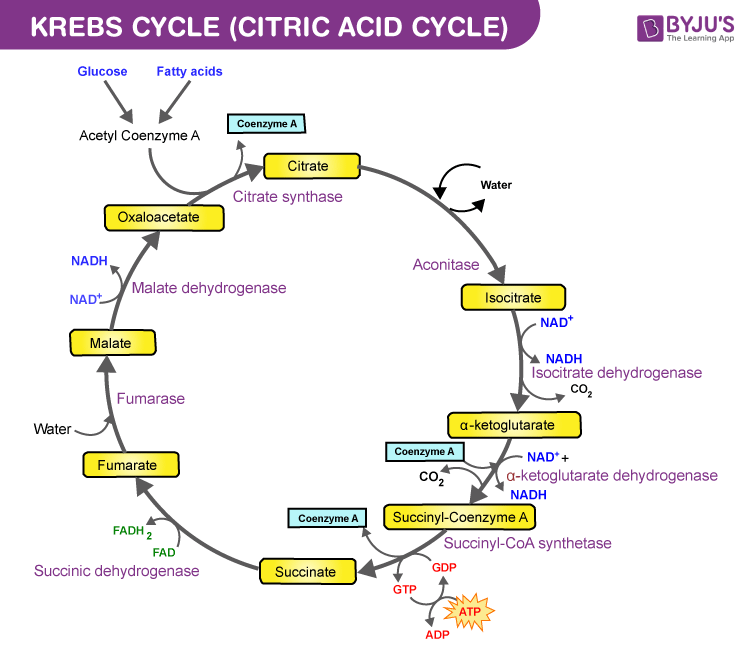 Acetyl CoA reacts with oxaloacetic acid (OAA) to form citrate.
- Citrate loses two carboxyl groups, releasing CO2and becoming
- Isocitrate is oxidized, releasing CO2. At this stage, NAD+ is converted to NADH.
- α-ketoglutarate is oxidized, again converting NAD+ to NADH and releasing CO2. The molecule that remains then becomes succinyl CoA.
- Succinyl CoA loses its CoA and picks up a phosphate group. This phosphate group transfers to ADP to produce ATP.
- Succinate is oxidized and becomes fumarate. Two hydrogen atoms then transfer to FAD to convert it to FADH2.
- H2O attaches to fumarate, converting it into malate.
- At the end of the cycle, OAA has been reformed, and one more molecule of NAD+ is converted to NADH. The OAA is then fed back into the beginning step to continue the cycle.
500
what are the:
- Artificial Selection – Investigating changes in a population over time
- Mathematical Modeling: Hardy–Weinberg – Applying population genetics formulas
- Comparing DNA Sequences – Using bioinformatics to explore evolutionary relationships
- Diffusion and Osmosis – Modeling membrane transport
- Photosynthesis – Measuring the rate using floating leaf disks or sensors
- Cellular Respiration – Measuring oxygen consumption or CO₂ production
- Mitosis and Meiosis – Observing and calculating phases
- Bacterial Transformation – Introducing foreign DNA into bacteria
- Restriction Enzyme Analysis – Using gel electrophoresis to visualize DNA fragments
- Energy Dynamics – Measuring biomass and energy flow in ecosystems
- Transpiration – Measuring water loss in plants under different conditions
- Animal Behavior – Observing choice and movement in response to stimuli
- Enzyme Activity – Measuring reaction rates under different conditions
13 AP Biology Labs with concepts