Category 1
Category 2
Category 3
Category 4
100
The average number of people per unit of land area
Arithmetic density
100
A country in stage 1 of the Demographic Transition Model would have _______ birth rates, _______ death rates, and _______ population growth
High, High, Low
100
What is a concern of an aging population?
Less young people to work, less tax revenue to support older people
100
What is one economic incentive to decrease population growth?
Increasing distribution, availability, or affordability of contraceptives to men and women
Promoting economic development, poverty reduction, sustainable development
Promoting female labor force participation or business ownership (e.g., microcredit, access to capital)
Offering incentives for smaller families or disincentives for having larger families
Implementing a government economic safety net to support the elderly
200
The largest number of people that the environment of a particular area can support.
Carrying Capacity
200
What is a reason why Thomas Malthus' prediction did not come true in the 1800s?
Industrialization, Better agriculture production, smaller household sizes due to urbanization
200
Describe a push factor
War, religious persecution, racial persecution, natural disasters, high crime rates, poverty, disease, etc.
200
What can be a potential impact (positive or negative) of strategies to decrease population growth?
Reduced birth rates or fertility rates (lower population is not acceptable)
Move from stage two to stage three of the demographic transition
Fewer children lead to more resources for better education or health care
Improved gender equality or female empowerment
Conflicts between traditional social norms and new population programs
Increased social tension between men and women
Skewed gender ratio
Increased elderly dependency ratio; population aging; reduced youth dependency ratio
300
The average number of people per unit area of arable land
Physiological Density
300
What was Thomas Malthus' theory?
The Medical Revolution and the Industrial Revolution.
300
Describe a pull factor
Economic opportunities, climate, higher standards of living, etc.
300
Describe ONE social program or policy that a country with a high population growth rate could use to decrease population growth
Promoting family planning, or reproductive health education
Increasing education of girls, promoting higher education for women
Implementing antinatalist policies that limit the number of children
Improving healthcare for women, infants, and children
Producing media or ad campaigns showing benefits of family planning practices
Promoting urbanization
Changing, implementing, or enforcing laws about increasing the minimum age at marriage
400
The average number of children born to a woman of childbearing age is
Total Fertility Rate
400
What do antinatalist policies promote?
Family planning, better education for women, etc.
400
What are some positive impacts of immigration on cities in the US?
New culture, arts, food, religion, etc.
400
What is one potential impact (positive or negative) of policies to decrease population groth?
Reduced birth rates or fertility rates (lower population is not acceptable)
Move from stage two to stage three of the demographic transition
Fewer children lead to more resources for better education or health care
Improved gender equality or female empowerment
Conflicts between traditional social norms and new population programs
Increased social tension between men and women
Skewed gender ratio
Increased elderly dependency ratio; population aging; reduced youth dependency ratio
500
What would be the most likely reason for the death of a citizen in stages 4 or 5 of the Demographic Transition Model?
Degenerative Disease
500
What do higher birth rates in developing countries suggest about the women who live there?
Lack of access to education and employment
500
What can lead to high population growth rates?
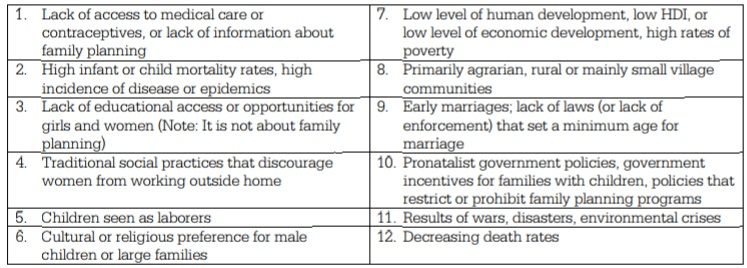
500
Complete the Spongebob quote: "it's not just a boulder, ________________________"
"It's a rock"